
For years, the promise of automation has been as simple as it is tempting: if one tool can send emails, another can update spreadsheets, and a third can collect form submissions, why not make them “talk” to each other—without needing a developer for every small step? That gap was popularized by platforms like Zapier, and later a wave of alternatives arrived focused on self-hosting and flexibility, such as n8n.
In that landscape, Activepieces is becoming a recurring name for teams that want automation without lock-in, without sacrificing a usable interface… and with a clear bet on the rise of AI-powered workflows.
Activepieces describes itself, plainly, as “an open source replacement for Zapier.” That’s not just marketing: the project has grown to 20,000+ GitHub stars and thousands of forks—signals that often point to an active community, a growing integration ecosystem, and documentation that improves quickly over time.
What is Activepieces, and why is it gaining traction?
Activepieces is an open-source automation platform designed to build workflows by connecting services and actions—from classic tasks (for example, receiving an email and pushing data into a CRM) to internal automations (alerts, reporting, operations) and, increasingly, processes where AI plays a role.
The key is that the tool tries to serve two profiles at once:
- Non-technical users who want a drag-and-drop builder with clear logic and predictable outcomes.
- Technical teams who need to extend connectors, control deployments, or integrate internal rules without turning every automation into a software project.
Instead of forcing a choice between “pure no-code” and “pure scripting,” Activepieces aims for a hybrid approach: visual workflows first, with real extensibility when needed.
How it differs from AutoHotkey: “automation” doesn’t always mean the same thing
Tools like AutoHotkey and platforms like Activepieces are often lumped together, but in practice they solve different problems.
AutoHotkey (especially popular on Windows) shines for local automation: keyboard shortcuts, macros, window manipulation, and repetitive desktop actions. It’s powerful, yes—but it typically requires writing and maintaining scripts, and its natural home is the end-user workstation.
Activepieces, by contrast, is built for process automation across services: SaaS apps, APIs, internal systems, workflows with approvals, retries, and branches. And it does so with a visual builder where, in many cases, you don’t have to dive into code for the majority of everyday scenarios—while still offering escape hatches when you do.
“Pieces”: the core concept—and why TypeScript matters
One of the project’s most distinctive elements is its concept of “pieces”: packaged integrations and actions that connect inside workflows.
According to the project’s own description, pieces are written as TypeScript packages, and the ecosystem is open, with a large share of integrations contributed by the community. That’s not a minor detail: a framework-style integration model can scale through contributions without relying entirely on a central team.
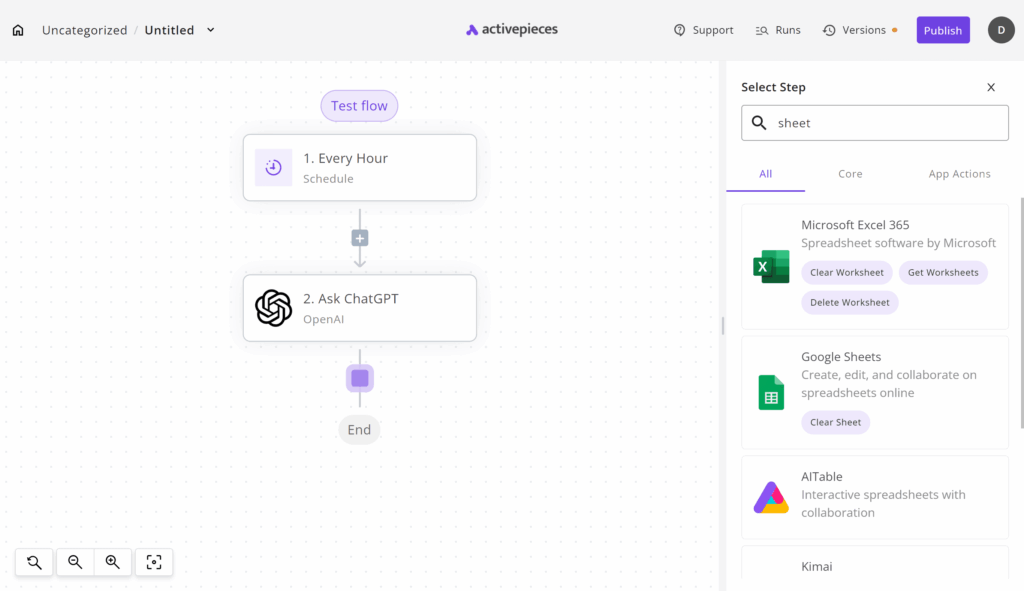
In the workflow builder, Activepieces highlights capabilities that have become standard in modern automation: loops, branches, automatic retries, HTTP calls, and the ability to run code using NPM. It also emphasizes that workflows are versioned, which helps when automations evolve and you need to audit changes or roll back safely.
The current angle: AI, agents, and MCP
Where Activepieces is trying to differentiate most aggressively is in its “AI-first” narrative. The repository and docs point to native AI pieces and an SDK for building agent-assisted flows.
But what’s drawing particular attention from technical audiences is the connection to MCP (Model Context Protocol): Activepieces claims that pieces become available as MCP servers, so they can be used with LLM-based tools and assistants (for example, workflows that can be invoked as “tools” from AI-enhanced environments). Put simply: instead of being limited to “if this happens, then do that,” the platform is positioning itself for a world where AI proposes, calls tools, and executes actions with context.
One important nuance: the public integrations catalog lists 559 pieces, and it also indicates that some require a special license. In other words, the ecosystem is large and fast-moving, but not everything is “100% free with no strings attached”—there are layers, especially around premium connectors or certain provider-specific capabilities.
Self-hosting, control, and “human in the loop”
Another recurring theme is control. Activepieces highlights the option to start in the cloud or self-host with Docker, and the repository messaging leans into security-minded scenarios where organizations prefer operating in more isolated environments or with stricter governance.
It also promotes “human in the loop” patterns: rather than automating blindly, you can design steps where execution is delayed or requires approval—particularly relevant when workflows touch payments, deletions, production changes, or sensitive communications.
The platform also supports “human input” triggers such as chat and forms, which matches two realities: some automations begin with an internal request rather than a webhook, and many processes benefit from removing repetitive work while keeping human oversight.
Who it’s for (and who it isn’t)
Activepieces is especially compelling for:
- Teams that want Zapier-style automation with more control, for cost, sovereignty, or compliance reasons.
- Organizations where IT enables integrations and the rest of the business builds workflows.
- Environments that want to experiment with AI applied to processes without building the entire “connections and actions” layer from scratch.
It’s not magic, though: self-hosting still means operations (updates, credentials, permissions, security), and for advanced integrations you may run into the boundary between community features and licensed ones.
The bottom line is straightforward: Activepieces is aiming at a space that has become critical in 2025 and 2026—automation accessible to business users, extensible for IT, and built for the next step where AI doesn’t just write, but acts.
Frequently Asked Questions
Can you self-host Activepieces on your own server with Docker?
Yes. Activepieces states you can start on its cloud offering or deploy it yourself using Docker—useful for organizations that want tighter data control and deployment governance.
What’s the difference between Activepieces and n8n for business automation?
Activepieces positions itself as an open-source Zapier replacement and emphasizes its “pieces” framework, a smoother experience for non-technical users, and integration with MCP/AI. n8n is also widely used for automation, but the focus and licensing model can differ depending on editions and use cases.
What does it mean that “pieces” can be used as MCP servers?
It means integrations and actions aren’t only usable inside the visual workflow builder—they can also be exposed so LLM-based assistants can invoke them as “tools,” bridging automation with AI agents.
Is Activepieces suitable for automating processes without programming?
In many cases, yes: the goal is to build workflows through a visual interface. That said, it also supports code steps and NPM usage when you need to go further.