
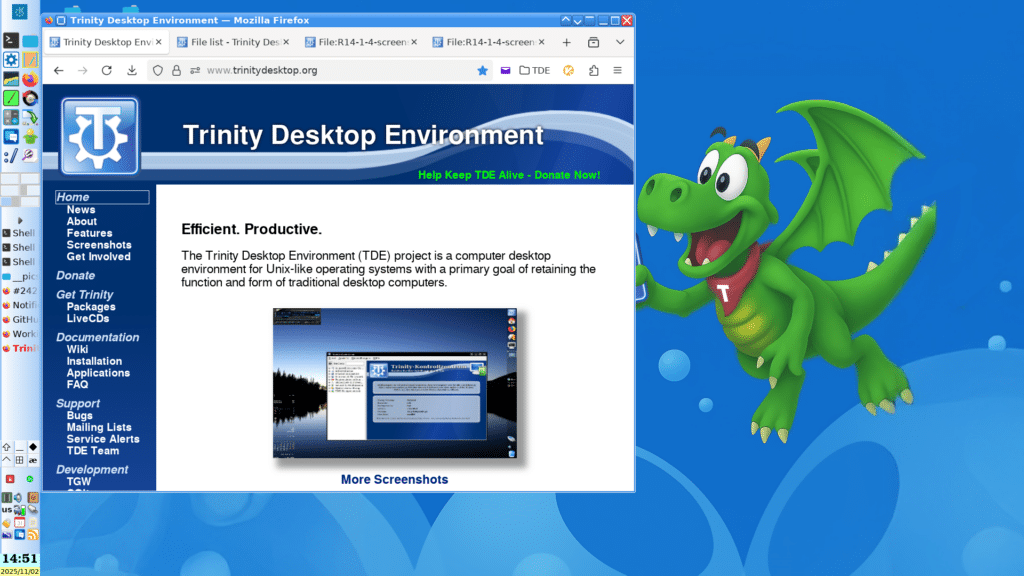
In a year where many desktop environments keep adding layers, animations, and background services, the Trinity Desktop Environment (TDE) is taking the opposite bet: efficiency as a feature, not a compromise.
TDE R14.1.5—the latest maintenance release in the R14.1.x line—has just landed with a very practical message: “classic” doesn’t have to mean “stuck in the past.” It’s still a lightweight, fully usable desktop aimed at people who prefer a lean and predictable workflow, and it remains available across multiple Linux distributions (plus BSD and DilOS).
What’s new in R14.1.5 (and why admins should care)
This release isn’t about flashy reinvention; it’s about removing friction:
- Multi-monitor tiling support in twin (window manager): small change, big productivity win in real-world multi-display setups.
- TQt event loop fixes that could cause 100% CPU usage: exactly the kind of low-level issue that matters when you’re running many sessions, VDI, or resource-constrained machines.
- Improved lock stability in kdesktop: fewer “why is this unresponsive?” moments on shared workstations or kiosks.
- Kicker improvements and new options, plus a handful of usability wins like a clipboard-as-text paste command in krdc.
There are also compatibility updates that signal the project is staying plugged into modern ecosystems—Debian adds support for Trixie, and RHEL 10 is now supported (while some older targets are dropped).
If you saw references to Fedora 43 in recent TDE news, that appeared in the previous maintenance release notes as part of distro support updates.
Why “KDE 3.5 thinking” still has a place
For many sysadmins, TDE isn’t nostalgia—it’s strategy.
- Older or modest hardware: thin clients, lab PCs, repurposed desktops, and budget laptops can remain genuinely usable.
- Virtualized desktops and remote sessions: lower baseline resource use can mean higher density per host and fewer spikes under load.
- Corporate endpoints and purpose-built machines: not every workstation benefits from transparency effects and GPU-heavy compositing. Many just need to be fast, stable, and boring—in the best sense.
In other words: sometimes the “innovation” is simply refining what already works, shipping fewer surprises, and respecting the machine’s resources.
Where do you land in 2026: modern aesthetics first, or performance and predictability above all?