
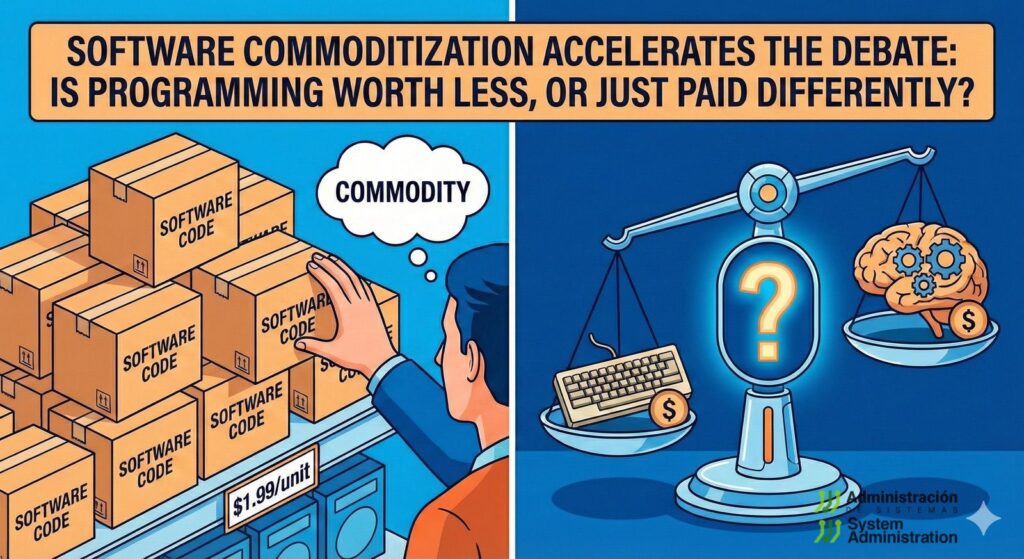
For years, the tech industry ran on a straightforward assumption: people who could build software held a durable advantage. That advantage isn’t disappearing—but it is being redistributed. The accelerating commoditization of software—the idea that building apps becomes cheaper, faster, and more accessible—has moved from theory to structural trend. And it’s forcing an uncomfortable question on companies and professionals alike: if code costs less, what keeps its value?
This isn’t just a technical argument. It’s an economic one. As AI-assisted development and low-code tooling reduce the effort required to ship usable software, code starts to resemble other layers of digital infrastructure: abundant, replicable, and, in many cases, interchangeable. The new debate isn’t whether we’ll create more software—we will. It’s how you compete when almost anyone can create.
The hard-line view: software gets cheaper, and “just being a dev” loses leverage
The bluntest version of the argument comes in three parts.
First, **building software will keep getting cheaper—sometimes effectively free—**for a large slice of the market. Where a company once paid a vendor to build an internal tool, it may now do it with fewer people and more automation. Where a founder once needed a team to launch an MVP, they can now get surprisingly far with AI assistance and off-the-shelf components.
Second, if someone is a “mere developer”—meaning they mostly execute specs and implement tickets—their bargaining power compresses. When the supply of “ability to produce code” expands quickly, the price of pure execution drops. Code still matters; it just becomes less of the bottleneck.
Third, commoditized software pushes toward commoditized digital products. If spinning up a custom email client, a fitness app, or a productivity workflow becomes easy, the market floods with “good-enough” alternatives. Differentiation erodes, and the “product” as a standalone object loses value.
From that perspective, what retains value isn’t the codebase—it’s two things:
- Distribution: the ability to reach users (hardware, operating systems, platforms with installed bases, app stores, ecosystems, social platforms, creators, podcasts).
- Storytelling and brand: the ability to guide users through an overwhelming sea of options and earn trust.
The conclusion is intentionally provocative: if you want a stable future, don’t focus on being a developer—focus on being a great storyteller.
The counterpoint: code gets cheaper, but architecture and business logic get more valuable
A growing group of engineers and builders disagree with the “forget being a dev” line—not because they deny commoditization, but because they think it targets the wrong layer. Their core claim is simple: AI is a tool, not an architect.
Generating code is not the same as designing a resilient system. The hard part—especially in real companies with real constraints—isn’t writing functions. It’s deciding what to build, how to build it, and how to keep it alive.
In this view, value doesn’t vanish; it migrates upward into areas that remain scarce:
- System architecture: structure, boundaries, data flows, dependencies, security.
- Business logic: translating messy needs into a working product, prioritization, trade-offs, measurement.
- Operations and cost: deployments, observability, performance, reliability, continuity, cost control.
- Quality and risk: testing, compliance, incident readiness, technical debt management.
This camp often agrees about storytelling—just not as a replacement for engineering. Instead, it’s a multiplier. An engineer with strong communication, empathy, and product thinking becomes more effective and harder to replace.
The common ground: value shifts toward distribution, trust, and judgment
Despite the clash, both sides describe the same underlying reallocation. When producing software gets easier, scarcity moves to different places:
- Distribution: being built is not the same as being used.
- Trust: security, reliability, support, compliance, and reputation matter more when alternatives are endless.
- Judgment: good decisions in architecture, data, dependencies, and UX become the real differentiator.
- Narrative: clarity about why something exists and what it does for the user.
Commoditization doesn’t eliminate value. It reshuffles it—downward for repetitive execution, upward for decisions that prevent expensive mistakes.
What’s next: more software, less user patience
The likely outcome is a market with more supply and less patience. If anyone can generate a functional app, users will face an infinite catalog of “pretty good” solutions. The winners won’t necessarily be those who type the most code the fastest. They’ll be the ones who combine three things:
a product that works + a message people understand + a channel that reliably delivers users.
For professionals, the adaptation path isn’t “stop being a developer.” It’s expanding what “developer” means: less implementation-only work, more design, operations, judgment, and communication. Storytelling helps people choose—but architecture keeps the product from collapsing.
FAQ
Does AI mean developers will be replaced?
More likely, developers’ work will change. Repetitive coding becomes cheaper, while architecture, integration, security, reliability, and product judgment become more valuable.
What skills keep their value as code gets cheaper?
System design, business logic, operational maturity (DevOps/SRE thinking), security, quality, and the ability to communicate trade-offs clearly to non-technical stakeholders.
Why might distribution matter more than the product itself?
Because when there are thousands of “good enough” tools, reaching users and earning attention becomes the bottleneck—through platforms, ecosystems, communities, and brand trust.
Is storytelling more important than engineering now?
It’s not either/or. Storytelling helps adoption and differentiation; engineering fundamentals keep systems reliable, secure, and scalable. The strongest profiles combine both.