
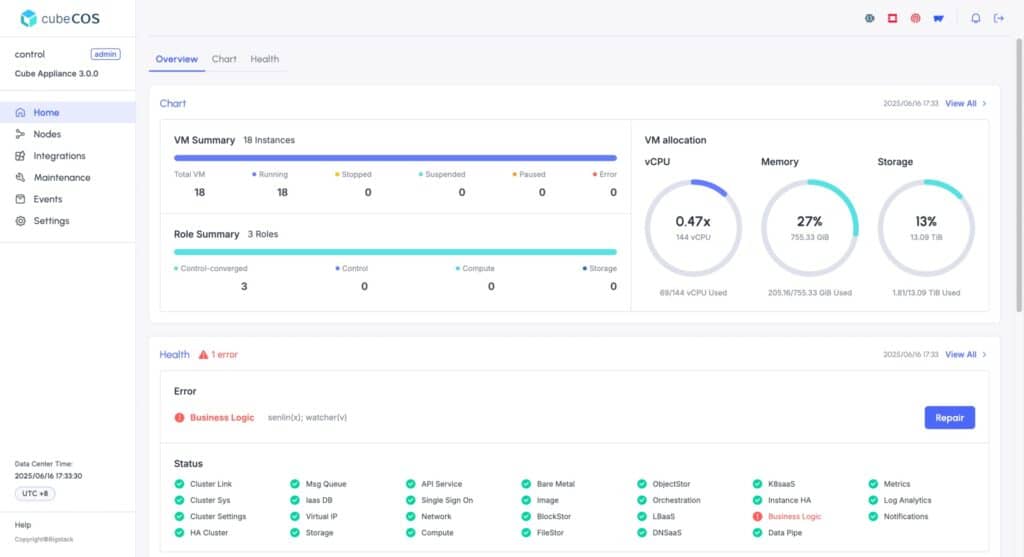
The boom in artificial intelligence and the rising cost of infrastructure have brought an old debate back to the forefront of IT departments: how much control should stay “in-house,” and how much should be delegated to third parties. In that context, Bigstack has put forward a proposal aimed at simplifying the path to a modern private cloud: CubeCOS (Cube Cloud Operating System), an open-source platform designed to automate and streamline the deployment of virtualization infrastructure and cloud services, with a management layer built for self-service.
The company positions CubeCOS as an out-of-the-box system for running virtualization environments through a simple admin portal, with the flexibility to integrate with other systems and REST APIs for automating operations. In practice, the project relies on well-known technologies in the community—such as QEMU/KVM—to run virtual machines and containers, while adding an orchestration layer and day-to-day user experience focused on reducing friction: network creation, workload deployment, and cluster administration from a unified dashboard.
From hypervisor to platform: what CubeCOS promises
CubeCOS is not marketed as a standalone component, but as a foundation for building IaaS/PaaS infrastructure without starting from scratch. That approach aligns with a clear trend: many organizations are no longer looking only to virtualize, but to operate a platform where virtual machines, cloud-native services, and increasingly AI-related workloads can coexist.
In its official description, CubeCOS highlights several points:
- High-performance virtualization, built on QEMU/KVM, to run virtual machines and containers.
- A multi-tenant architecture designed to isolate networks and workloads by team or project—especially relevant when a single cluster serves multiple departments.
- A self-service portal for launching and managing resources without long, manual processes.
- An out-of-the-box cluster, with pre-integrated services ready to host workloads as soon as installation completes.
- Open standards and REST APIs, signaling easy integration with automation scripts and external tools.
The key here is not so much novelty, but packaging: the promise that the platform arrives with enough pieces already connected so teams don’t have to assemble the puzzle from separate projects.
CubeCOS 3.0: “open sourced” with a refreshed management layer
Bigstack frames CubeCOS 3.0 as a turning point, saying the release is now “open sourced,” redesigned, and more powerful, and that it ships with Kubernetes as a first-class element in its private cloud approach. This emphasis on Kubernetes is not accidental: for many companies, the main challenge is no longer just virtualization, but running cloud-native applications and data pipelines that live in containers from day one.
In the official documentation, Bigstack describes CubeCOS as an SDDC (Software-Defined Data Center) solution that combines the control of a self-hosted private cloud with capabilities typically associated with public clouds. It also highlights the ability to integrate with higher-level services in its ecosystem (such as VDI, edge computing, or AI workloads). The company further claims clusters can scale horizontally without downtime—a direct message to organizations that fear scaling will require constant maintenance windows.
The 3.0 shift is also packaged with an operations-first narrative: simpler deployment, easier maintenance, and better visibility. Bigstack argues CubeCOS reduces the time needed to deploy production-ready clusters “from weeks to a few hours,” and points to a predictable “per-node” cost model as a long-term investment argument. These are ambitious claims, but they clearly define the positioning: compete on speed-to-deploy and cost control.
Installation: quick lab or production-ready cluster
The quick-start guide summarizes the approach through two clear paths:
1) Single-node installation, aimed at testing and evaluation. It’s the fastest way to validate the platform, but without fault tolerance or high availability.
2) Three-node cluster installation, recommended for production scenarios or for testing high availability, recovery, and failover with the platform’s “full functionality.”
Designing the entry points this way is telling: CubeCOS aims to cover both the “show me now” lab mindset and the “make it operable” production mindset, without forcing teams to reinvent architecture on day one.
Community, support, and licensing: open source with clear rules
On the community side, CubeCOS relies on the typical channels of modern projects: Slack, Discord, and GitHub Discussions for questions and conversation. The documentation also draws a clear line between community support, enterprise support, and security handling: vulnerabilities should not be filed as regular issues, but reported through the process outlined in the project’s security policy.
From a legal standpoint, the repository specifies the Apache 2.0 license—an important detail for enterprise adoption. Compared with more restrictive copyleft licenses, Apache 2.0 often makes corporate use, integrations, and internal development easier, while keeping attribution and clear conditions.
Market context: alternatives and “control” as the key word
Although CubeCOS is presented as a general private cloud platform, the timing of its open-source push is revealing. The industry has spent months absorbing major shifts in enterprise virtualization, with VMware’s move to a subscription-based model and the end of perpetual licenses—changes that have reignited debates about costs, vendor lock-in, and migration strategies.
Bigstack does not hide that framing: on its website it places CubeCOS under a “VMware Alternative” section, arguing for a move to an open, enterprise-ready platform. This aligns with what many organizations are living through: maintaining stability and continuity, while avoiding surprises in commercial models and gaining more room to maneuver.
In other words, CubeCOS is entering a space where it’s not enough to promise features—it must prove operational maturity, support options (community or commercial), and a clear adoption path. If the platform fits real pilots—not just demos—it could become one more piece of the new private cloud map, where hyperconvergence, Kubernetes, automation, and increasingly AI workloads coexist.