

Cloudflare has put forward one of the most ambitious CMS proposals seen in years: EmDash, an open-source project the company describes as the “spiritual successor” to WordPress. This is not an update, a fork, or just another site builder. It is a full rethinking of the traditional CMS model built around a different foundation: TypeScript instead of PHP, Astro instead of the classic theme stack, sandboxed plugins instead of extensions running inside the same execution context, and an architecture designed for serverless environments, while still being able to run on a standard Node.js server. Cloudflare has released it as a v0.1.0 preview under the MIT license, and says no WordPress code was used.
The bet makes sense both technically and strategically. WordPress still dominates the market by a huge margin, so any serious attempt to compete with it has to begin with a simple reality: being modern is not enough. A new CMS also needs to offer something understandable and practical for sysadmins, developers, and hosting platforms that have spent years building around PHP, MySQL, plugins, and legacy themes.
Before getting into the ideological debate, one thing matters: WordPress is far from finished. Its ecosystem remains enormous, its software requirements are widely understood by infrastructure teams, and its plugin, theme, agency, and hosting communities remain one of its biggest strengths. But it also carries operational costs and architectural limitations that are harder to ignore in 2026.
EmDash’s core argument: plugin security through real isolation
Cloudflare has built the EmDash launch around a very specific pain point: plugin security. That argument rests on a real problem. Patchstack reported thousands of newly disclosed WordPress ecosystem vulnerabilities in 2024 and said the overwhelming majority came from plugins rather than WordPress core. In other words, this is not a theoretical weakness.
Cloudflare’s interpretation is straightforward: the classic WordPress plugin model gives third-party code too much access to the internals of the system. EmDash tries to answer that with a different approach. Each plugin runs in its own isolated Worker, with explicit capabilities declared in a manifest. The idea is that a plugin only gets access to the things it asks for and the administrator approves. For a systems administrator, that is probably the single most important architectural difference between the two platforms.
That does not mean EmDash has magically solved CMS security. It is still an early project, its ecosystem is tiny compared to WordPress, and it has not yet been tested at the same scale or under the same hostile conditions as WordPress. But it does introduce a powerful design principle: a plugin should not automatically be trusted with access to everything. It should operate inside real boundaries.
There is also an economic and governance angle here. Cloudflare argues that if plugin security is improved at the architectural level, developers and hosting platforms can rely less on centralized marketplaces as the main source of trust. In EmDash, the core is MIT-licensed, and plugin authors can choose their own license. That is not a small detail in a space where licensing and ecosystem lock-in remain a recurring topic.
Comparison table: WordPress vs. EmDash
For sysadmins and developers, the useful comparison is not in the marketing language. It is in the architecture, operating model, extension model, and deployment assumptions.
| Aspect | WordPress | EmDash |
|---|---|---|
| Primary language | PHP | TypeScript |
| Base stack | PHP + MySQL/MariaDB + HTTPS, typically Apache or Nginx | Serverless-first; can also run on any Node.js server |
| Project status | Mature, dominant, heavily proven in production | v0.1.0 preview, early ecosystem |
| Market presence | Dominant global CMS footprint | No meaningful market share yet |
| Plugin ecosystem | Massive and mature | New architecture, ecosystem still forming |
| Plugin security model | Plugins run inside the WordPress context | Plugins run in isolated Workers with declared capabilities |
| Theming model | WordPress templates, often tied to functions.php and PHP logic | Astro-based themes |
| Operations model | Well understood by LAMP/LEMP teams and hosters | Best aligned with serverless and edge-oriented platforms |
| Core license | GPL | MIT |
| Plugin licensing | Closely tied to the WordPress ecosystem and GPL interpretation | Plugin authors choose their own license |
| Authentication | Traditional login model, extensible through plugins and SSO integrations | Passkeys by default, pluggable auth |
| AI integration direction | Added through plugins and external services | CLI, MCP, and agent-focused workflows built in |
| Hosting assumptions | Traditional web hosting remains the norm | Designed for Cloudflare-style serverless, but portable to Node.js |
What changes for systems administrators
For sysadmins, WordPress still has one practical advantage that is hard to beat: almost every provider, control panel, backup workflow, WAF, and monitoring stack already knows how to live with it. There are runbooks, incident procedures, deployment checklists, and years of operational knowledge behind it. In many environments, deploying WordPress on a LAMP or LEMP stack is still trivial.
EmDash is playing a different game. Cloudflare presents it as a CMS that can scale to zero, bill only for useful CPU time, and run on the same infrastructure model as Workers. It can also run on a regular Node.js server, which broadens the options for self-hosting, labs, and internal platforms. For multi-tenant platforms or providers that want low-cost, fast-starting instances, that is a very attractive idea. But it also requires a cultural shift: away from the classic PHP + database + cache + cron model and toward an isolated runtime, edge-oriented platform way of thinking.
Operationally, that brings both benefits and trade-offs. The benefits are obvious: better isolation, less shared attack surface, and stronger alignment with distributed deployments and automation. The trade-offs are just as obvious: immature tooling, a smaller ecosystem, less production experience, and a design that, while portable to Node.js, is clearly optimized around Cloudflare’s architectural worldview.
For many hosting companies, EmDash does not replace WordPress today. What it offers instead is a serious experimental path for new products, vertically integrated publishing platforms, or managed environments that want tighter security and cleaner extension boundaries from the start.
What changes for developers and frontend engineers
The other major break is in the frontend layer. WordPress still lives in a world of templates, hooks, PHP logic, blocks, and conventions accumulated over more than two decades. EmDash is built around Astro for themes and organizes projects around pages, layouts, components, styles, and a seed file that defines content types and fields. For developers already comfortable with Astro, TypeScript, and modern component-based stacks, that will feel much more natural than the structure of a traditional WordPress theme.
Cloudflare pushes that idea even further by arguing that EmDash themes should not be doing database work at all. In its model, the theme is a rendering layer, not an all-purpose execution environment. From a software design perspective, that separation makes a lot of sense. From the perspective of a veteran WordPress developer, it requires rethinking long-established habits.
Illustrative Astro example for an EmDash-style theme
Because the ecosystem is still early, the most useful way to understand EmDash is through the direction it points to. The following Astro example shows what a technical news homepage might look like if content is already resolved by the CMS and the theme layer focuses purely on rendering.
---
import BaseLayout from "../layouts/BaseLayout.astro";type Post = {
  id: string;
  slug: string;
  title: string;
  excerpt?: string;
  category?: string;
  publishedAt: string;
};const posts: Post[] = Astro.locals.posts ?? [];const latestPosts = posts
  .filter((post) => post.slug && post.title)
  .sort(
    (a, b) =>
      new Date(b.publishedAt).getTime() - new Date(a.publishedAt).getTime()
  );
---<BaseLayout title="Technical News">
  <main class="container">
    <header class="hero">
      <h1>Latest posts</h1>
      <p>News and analysis for sysadmins and developers.</p>
    </header>    <section class="grid">
      {latestPosts.map((post) => (
        <article class="card">
          {post.category && <p class="meta">{post.category}</p>}
          <h2>
            <a href={`/posts/${post.slug}/`}>{post.title}</a>
          </h2>
          {post.excerpt && <p>{post.excerpt}</p>}
          <time datetime={post.publishedAt}>
            {new Date(post.publishedAt).toLocaleDateString("en-GB")}
          </time>
        </article>
      ))}
    </section>
  </main>
</BaseLayout><style>
  .container { max-width: 1120px; margin: 0 auto; padding: 2rem; }
  .hero { margin-bottom: 2rem; }
  .grid { display: grid; gap: 1.5rem; grid-template-columns: repeat(auto-fit, minmax(280px, 1fr)); }
  .card { border: 1px solid #ddd; border-radius: 12px; padding: 1.25rem; background: #fff; }
  .meta { font-size: 0.875rem; color: #666; text-transform: uppercase; }
  h2 { margin: 0.5rem 0 0.75rem; }
  a { color: inherit; text-decoration: none; }
</style>
This is illustrative rather than a definitive API reference, but it captures the design philosophy Cloudflare is pushing with EmDash: an Astro project where the theme layer renders content cleanly, without mixing presentation, privileged system access, and application logic.
Can EmDash really replace WordPress?
Today, not in a broad production sense. And Cloudflare probably knows that. EmDash is interesting as an architecture, as a technical statement, and as a demonstration of what an open CMS might look like if it were designed from scratch in 2026. But there is a huge distance between a compelling preview and a real alternative to the WordPress stack that powers media sites, company blogs, public institutions, agencies, and managed hosting products.
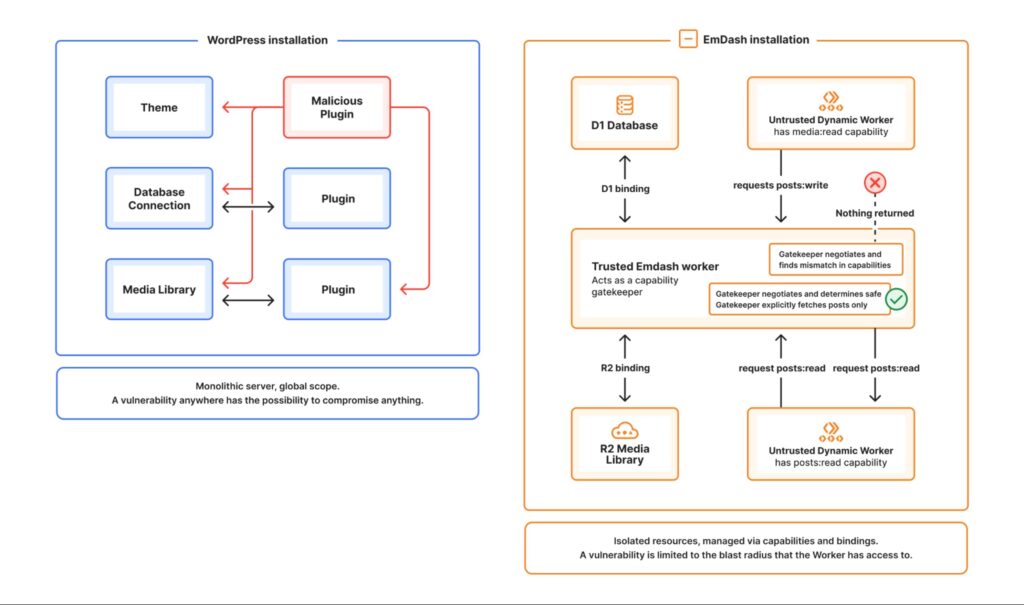
WordPress has community, compatibility, battle-tested hosting patterns, extensive documentation, and enormous operational inertia. EmDash, for now, has a strong idea and a technically coherent direction.
Still, it would be a mistake to dismiss it as pure marketing. The project raises questions WordPress cannot ignore forever: how far an old CMS core can stretch before architectural debt becomes too expensive, how third-party extensions should be isolated, how AI tooling should be integrated without turning the admin panel into a pile of plugins, and how a CMS should feel to developers who are already building in Astro and TypeScript.
EmDash does not have to replace WordPress tomorrow to matter. It only has to push the CMS conversation in the right direction.
Frequently asked questions
Does EmDash use WordPress code?
No, according to Cloudflare. The company says EmDash was built without reusing WordPress code, which is why it can be released under the MIT license instead of GPL.
Is EmDash only meant for Cloudflare Workers?
No. Cloudflare clearly designed it to take advantage of Workers and Dynamic Workers, but it also says EmDash can run on any Node.js server and on self-hosted hardware.
Is WordPress still the safer production choice today?
In many real-world environments, yes. Its maturity, market dominance, ecosystem, and the amount of operational experience around it still make it the more practical production choice for most organizations.
What problem is EmDash trying to solve that WordPress struggles with?
Mainly plugin isolation and a more modern default architecture for deployment, security, frontend development, and AI-oriented workflows.
Source: emDash vs Wordpress