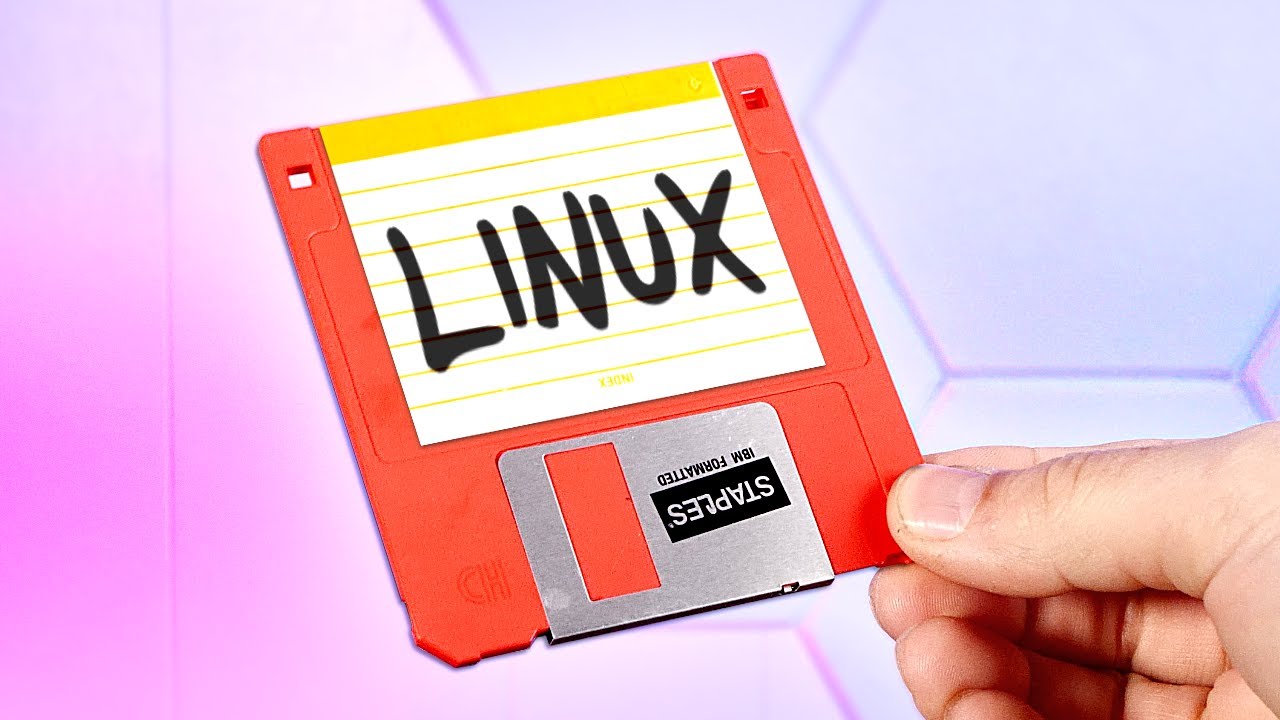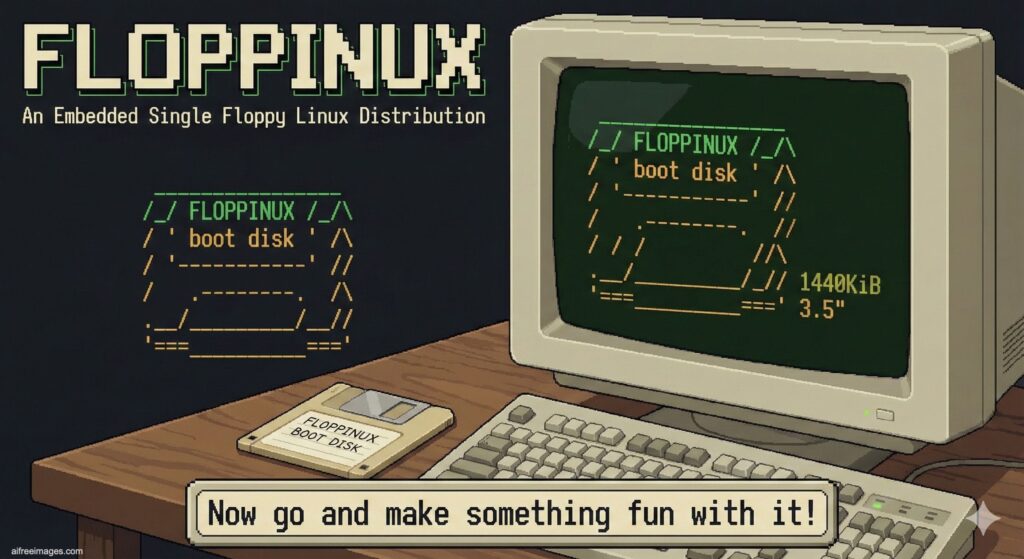
In an era where operating systems are measured in gigabytes and “lightweight” often still means “needs an SSD,” a small open-source project is trying to prove something that sounds impossible at first glance: a modern, usable Linux environment can still live on a single 1.44MB floppy disk.
That project is FLOPPINUX, described by its maintainer as a complete Linux distribution that boots straight into a working terminal, includes a minimal toolset, and even offers a tiny slice of persistent storage for saving files between reboots. The central promise isn’t novelty for novelty’s sake: it’s about pushing the boundary of what can be built when constraints are treated as a design feature rather than a limitation.
A “Linux From Scratch” mindset, compressed into 1.44MB
FLOPPINUX positions itself like a practical workshop in extreme minimalism. The repository frames the idea as comparable to Linux From Scratch, but with a very different end goal: not a general-purpose system, but a distribution engineered to fit the unforgiving geometry of a floppy image.
The current published track is presented as a “FLOPPINUX 2025 Workshop (v0.3.1)”, a structured tutorial intended to guide people through building their own floppy-sized Linux from scratch. It’s not just “download and run”—the educational angle is part of the product.
That approach matters because the real achievement here isn’t simply booting Linux on limited hardware (that’s been done before). The interesting point is doing it while keeping the system understandable, hackable, and reproducible—so that readers can learn how each component earns its place inside a 1.44MB boundary.
What you actually get when it boots
FLOPPINUX boots to a Linux terminal and comes with a small set of essentials geared toward basic interaction and file work. The project highlights a Vi text editor and “essential file manipulation tools,” aiming to provide a minimal but coherent environment rather than a one-trick demo.
One detail that stands out is persistent storage—an intentionally tiny space reserved for user files. FLOPPINUX cites 264KB of persistent storage, which obviously won’t replace a hard drive, but it’s enough to make the system feel more like a usable tool than a disposable boot gag.
The “works on real hardware and emulation” point is also important. A lot of retro-themed projects quietly assume emulators; FLOPPINUX explicitly treats real machines and virtualized testing as first-class options.
Minimal hardware, surprisingly broad compatibility
FLOPPINUX is designed for 32-bit x86 hardware reaching back to the Intel 486DX era, with a stated minimum of 486DX 33MHz and 20MB of RAM (plus a 3.5″ floppy drive, for anyone doing it the old-fashioned way).
The project also emphasizes that it ships with a “latest Linux kernel” while retaining i486 support, listing kernel 6.14.11 in its current description. That combination is part of what makes it feel less like pure nostalgia: it’s framed as a modern kernel configured and curated to keep older CPU families in reach.
Why this matters in 2025 (beyond retro charm)
It would be easy to dismiss FLOPPINUX as a quirky throwback. But its real value shows up in three practical corners:
- Education: constraint-driven builds force clarity. When every kilobyte matters, you quickly learn what the boot process truly needs, what can be replaced, and what tradeoffs are unavoidable.
- Embedded thinking: even if you never ship a floppy-based product, the mindset translates to small images, rescue environments, and purpose-built appliances.
- Resilience and recoverability: minimal Linux environments remain useful in diagnostics, lab scenarios, and “get me a shell” recovery workflows—especially when designed to be reproducible and easy to rebuild.
FLOPPINUX leans into this philosophy by presenting itself as “fully customizable and hackable,” essentially inviting readers to treat the distro as a starting point rather than a finished product.
Licensing and resources
The repository lists a CC0-1.0 license, reinforcing the “learn it, remix it, build on it” intent.
It also points to a downloadable floppy image and multiple formats for the workshop/tutorial materials (including online HTML and ePub/Markdown options).
FAQs
Can FLOPPINUX really fit a usable Linux system on a 1.44MB floppy?
Yes—FLOPPINUX is explicitly designed as a complete Linux distribution that fits on a single 1.44MB floppy disk image and boots into a working terminal environment.
What hardware do you need to run FLOPPINUX on real machines?
The project states it supports 32-bit x86 CPUs back to the Intel 486DX, with minimum requirements of a 486DX 33MHz CPU and 20MB RAM, plus a 3.5″ floppy drive for physical media.
Does FLOPPINUX include persistent storage, or is it read-only?
It includes a small persistent storage area—listed as 264KB—for saving user files.
Is FLOPPINUX only for emulators, or can it run on actual retro hardware?
The project states it works both on real hardware and in emulation, which makes it practical for testing and for running on original systems.