
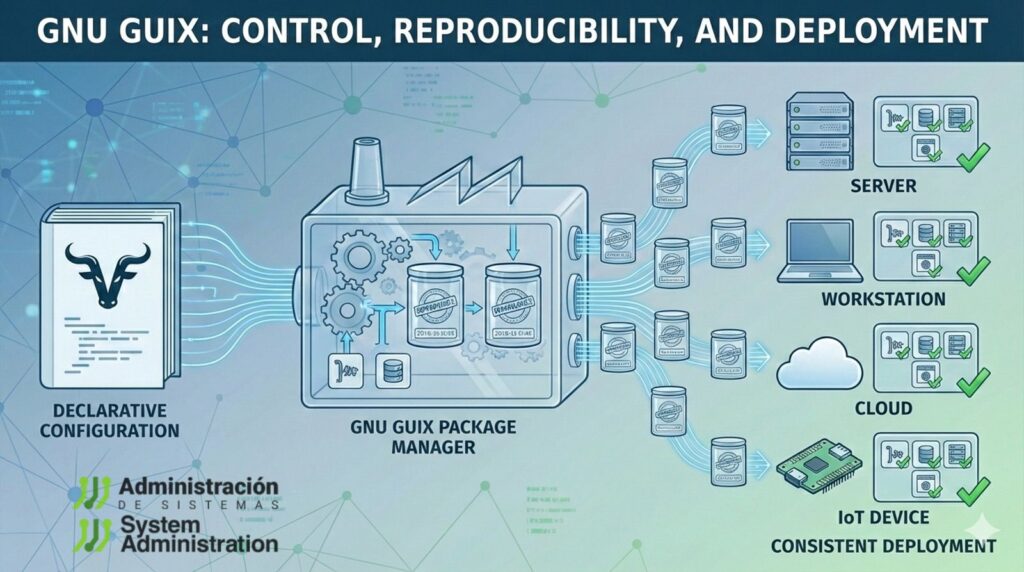
GNU Guix—best known for its “transactional” package management and a strongly principled approach to software freedom—has released version 1.5.0. While Guix operates as a rolling release (most users update continuously via guix pull), this milestone matters because it consolidates years of work into a clearly defined baseline: installer images, virtual machine images, and updated tooling that reflects where the project is heading next.
What stands out in this release is not only the technical scope, but also the project’s candid acknowledgment of what slowed it down: it has been three years since the previous major release, and the team frames 1.5.0 as the first output of a newly adopted release process aimed at making future releases more regular—ideally on an annual cadence.
A Release That Starts With Governance, Not Packages
It is unusual for an operating system release announcement to lead with collaboration mechanics, but Guix does. The project describes an internal shift meant to reduce friction as the contributor base grows:
- A new consensus-based decision-making process adopted unanimously.
- Formal “Guix Consensus Documents (GCDs)” to propose and ratify significant changes.
- A community-driven migration to Codeberg, bringing repositories and bug trackers together and moving contributions toward pull requests rather than email patch series.
- A new release process intended to support an annual cycle going forward.
The signal is clear: Guix is treating project operations as a first-class dependency. If the distribution is going to remain credible for reproducible deployments and long-lived systems, it must also scale how decisions get made and how changes ship.
The Scale of Change: Tens of Thousands of Updates, Thousands of New Packages
Guix 1.5.0 aggregates a large volume of work across the ecosystem. The announcement highlights:
- 71,338 commits by 744 contributors since the last release.
- 12,525 new packages and 29,932 package updates.
On the desktop side, Guix now includes KDE Plasma 6.5 and updates GNOME from 42 to 46, with Wayland by default. Under the hood, the release cites notable toolchain and platform updates, including GCC 15.2.0, Emacs 30.2, LLVM 21.1.8, and Linux-libre 6.17.12.
The net effect is that Guix feels less “out of sync” with modern upstreams—while still preserving its distinctive packaging model and configuration philosophy.
Security: “Rootless” Operation Becomes the Default on Non-Guix Systems
One of the most consequential changes in 1.5.0 is security-oriented: the Guix daemon can now run without root privileges. This “rootless” mode is positioned as a way to reduce the blast radius of privilege escalation bugs—an especially relevant goal for a package manager that handles many system-level operations.
Guix states this rootless mode is now the default when installing Guix on distributions other than Guix System. On Guix System itself, enabling it is currently an explicit choice. The release notes also call out the practical reality of modern Linux security: user namespaces may be restricted without appropriate policy, so Guix includes AppArmor profiles installed by default on “foreign” systems to support the model.
The announcement also references multiple CVE-related security fixes applied to components in the Guix ecosystem.
DevSecOps and Supply-Chain Readiness: SBOM Output and Better Packaging Targets
Guix has always attracted attention in reproducibility circles. With 1.5.0, it leans further into modern supply-chain expectations:
guix graphadds backends for GraphML and CycloneDX JSON, enabling SBOM generation down to early bootstrap binaries.guix shellcontainer workflows improve with options like--nestingand--emulate-fhs, making it easier to run software that expects an FHS-style filesystem layout.guix packadds new output formats, including RPM and AppImage, making it easier to publish Guix-built artifacts to non-Guix environments.- A new
guix locatecommand helps identify which package provides a given file—small, but meaningful in real operational workflows.
For teams that need repeatable builds plus auditability, these changes reinforce Guix’s positioning as more than a niche curiosity: it is intentionally aligning with how modern organizations document, ship, and verify software.
Architecture Expansion: RISC-V and Better GNU Hurd Coverage
Guix 1.5.0 also broadens platform reach:
- Release tarballs are now available for 64-bit RISC-V (riscv64-linux).
- The GNU Hurd story advances on x86_64 with improved support, including being available as an option in the installer and additional service tooling to manage Hurd environments.
This aligns with Guix’s long-standing “trusting trust” concerns and its emphasis on building systems from source in a way that minimizes opaque dependencies.
The Practical Takeaway for Non-Guix Users
Even if most mainstream Linux users never install Guix, the project’s trajectory matters because it represents one of the clearest end-to-end attempts to make software installation:
- Transactional (upgrades and rollbacks are first-class),
- Declarative (system configuration is treated like code),
- Auditable (graphing dependency trees and exporting SBOMs),
- Safer by design (reducing privileged operations where feasible).
In a market increasingly shaped by supply-chain risk, compliance requirements, and the operational cost of unstable updates, Guix continues to bet that reliability and traceability can be architectural defaults rather than afterthoughts.
FAQs
What is GNU Guix, in plain terms?
GNU Guix is both a package manager and an operating system distribution designed around reproducible builds, transactional upgrades, and declarative system configuration.
Why does a “major release” matter if Guix is rolling?
Rolling updates cover day-to-day change, but major releases provide a stable reference point: updated installer images, consolidated tooling changes, and a well-defined baseline for new deployments.
What does “rootless” Guix change for security?
Running the Guix daemon without root reduces the impact of potential privilege escalation vulnerabilities and limits how much damage a compromised component could cause.
How does CycloneDX SBOM support help organizations?
It supports auditing, compliance, and supply-chain governance by producing standardized “bill of materials” inventories of software components and dependencies.
vía: guix.gnu