
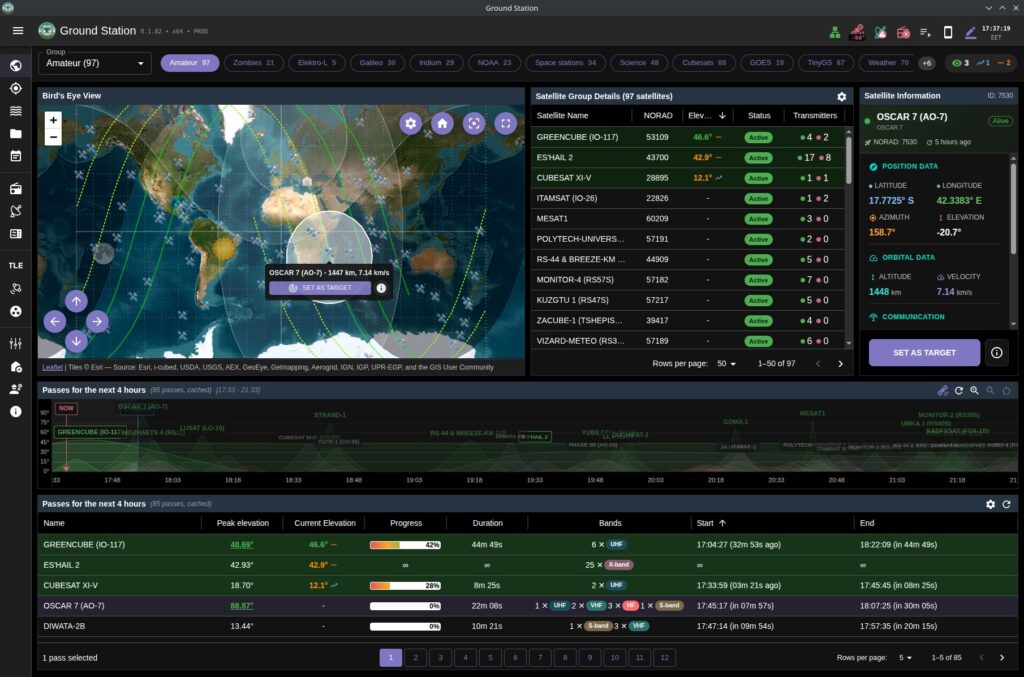
The world of ham radio, satellite monitoring, and over-the-air signal decoding has a new open source project worth watching. It is called Ground Station, and its creator presents it as an all-in-one suite for tracking satellites, controlling radio hardware, and decoding signals locally through a modern web interface. The project is published on GitHub under the GPL v3 license, has already attracted more than 1,800 stars, and is aimed squarely at amateur radio operators, satellite enthusiasts, and researchers who want to build their own ground station with open tools.
What makes the project interesting is that it goes beyond simply plotting satellites on a map. According to its official repository, Ground Station combines real-time satellite tracking, antenna rotator control, support for Hamlib-compatible rigs, integration with SDR hardware such as RTL-SDR, SoapySDR, and UHD/USRP radios, IQ recording in SigMF format, and multiple decoding and visualization tools. It also includes a React frontend, a FastAPI backend, and a worker-based architecture that separates SDR acquisition, FFT processing, demodulation, decoding, and browser delivery.
In practice, that means the software is trying to unify tasks that are often spread across several different applications. Ground Station says it can track hundreds of satellites using precise orbital models, with automatic TLE synchronization from CelesTrak and SatNOGS, then connect that tracking layer directly to signal reception and analysis. That puts it much closer to a software-defined ground station than to a simple pass predictor.
From SDR waterfalls to weather images and telemetry
One of the most compelling parts of the project is its SDR and decoding stack. The repository says Ground Station supports live radio streaming and recording from a range of SDR devices, plus IQ playback through a virtual SDR source for later analysis. On the decoding side, it currently lists support for SSTV, FSK, GFSK, GMSK, and BPSK with AX25 USP Geoscan framing, along with SatDump integration for decoding METEOR-M2 weather imagery in LRPT and HRPT.
That means there is a real basis for capturing spaceborne transmissions and saving them directly to disk, including decoded outputs such as weather images, telemetry payloads, and packet data. For users already working with RTL-SDR or SoapySDR-compatible hardware, that could make Ground Station a more approachable entry point into satellite reception workflows.
That said, some caution is necessary. The project itself makes clear that not every announced feature is fully mature yet. The README openly states that some decoders are still in development or currently not working, including LoRa and AFSK, and lists NOAA APT support and additional telemetry formats as roadmap items. So while Ground Station is already a serious and ambitious piece of software, it should not be presented as a finished, fully polished platform across every protocol.
It is also worth softening one of the more viral claims circulating around projects like this: that you can do “everything without the internet.” The core SDR capture and much of the signal processing can indeed be done locally, but several parts of the platform still depend on external services. TLE synchronization pulls from CelesTrak and SatNOGS, while audio transcription relies on Gemini Live or Deepgram, using the user’s own API keys. So the main radio and decoding workflows can run locally, but not every feature in the stack is fully offline.
Automation, scheduled observations, and Docker deployment
Another strong part of the platform is automation. Ground Station includes a scheduled observation system that can calculate upcoming passes, trigger jobs automatically at AOS (Acquisition of Signal), and stop them at LOS (Loss of Signal). Each observation can combine IQ recording, audio recording, protocol decoding, and optionally AI transcription. It also supports isolated internal sessions for automated passes and lets users watch a scheduled observation in real time through the browser interface.
For users who do not want to fight with SDR dependencies manually, the project also offers Docker support and publishes pre-built images for both amd64 and arm64. The latest release currently visible on GitHub is v0.2.14, published on March 12, 2026. The repository also notes support for Raspberry Pi 5 on ARM64, which could make it especially appealing for compact, low-cost home ground station setups.
Overall, Ground Station looks more like a serious open source platform than a weekend experiment. It tries to bring together orbit tracking, SDR workflows, radio control, automated pass scheduling, and decoding in a single coherent system. It still has rough edges, and its usefulness will depend heavily on the user’s hardware and experience level, but for anyone interested in satellites, SDR, and space-derived data, it is one of the more ambitious open source projects to emerge recently.
Frequently Asked Questions
What is Ground Station exactly?
It is an open source suite for satellite tracking and SDR radio that combines orbital tracking, hardware control, IQ recording, signal decoding, and a real-time web interface.
What SDR hardware does it support?
The project lists support for RTL-SDR, SoapySDR devices, UHD/USRP radios, and remote sources such as SoapyRemote and rtl_tcp.
Can it already decode weather satellite images?
Yes. It includes SatDump integration for METEOR-M2 weather imagery in LRPT and HRPT. However, NOAA APT is still listed as a planned feature.
Does it really work without the internet?
Not entirely. SDR capture and much of the signal processing can be done locally, but TLE synchronization depends on CelesTrak and SatNOGS, while transcription uses Gemini Live or Deepgram.