
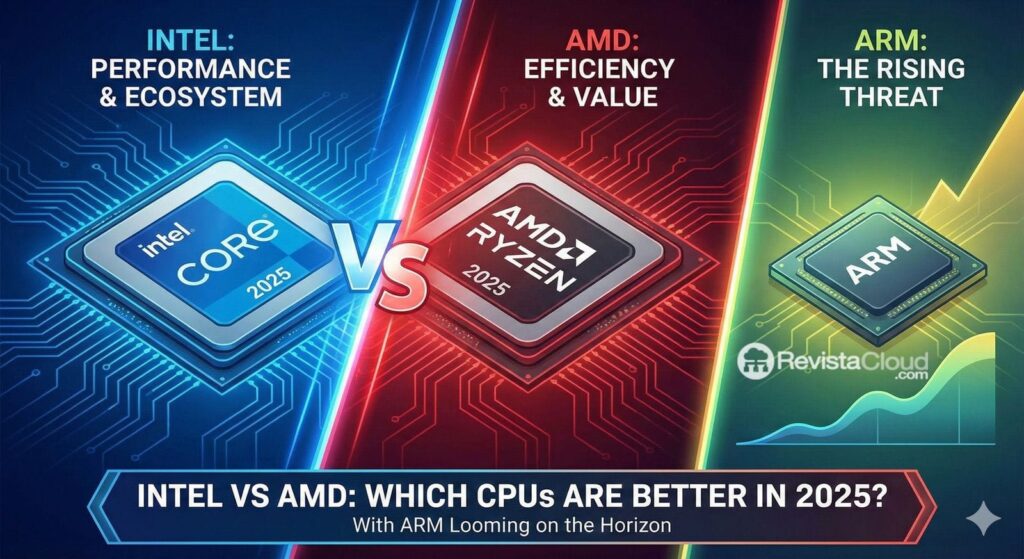
For sysadmins and infrastructure teams, the “Intel vs AMD” question hasn’t gone away in 2025. What has changed is the context around it: power efficiency, rack density, and AI-adjacent workloads have pushed CPU decisions beyond raw benchmarks. And in the background, a third player has become impossible to ignore.
Arm-based server CPUs are no longer a niche experiment. Between hyperscaler adoption (notably AWS Graviton instances), dedicated Arm server vendors (like Ampere), and NVIDIA’s Grace CPU as part of AI-centric platforms, Arm has moved from “interesting” to “strategic consideration” in certain data center and cloud environments.
This puts infrastructure buyers in a three-way landscape:
- Intel (x86): wide enterprise footprint, platform breadth, and predictable compatibility
- AMD (x86): strong core density and performance-per-watt, especially compelling in consolidation scenarios
- Arm (various vendors): increasingly competitive on efficiency and scale-out economics—when the software stack is ready
The 2025 baseline: Intel and AMD remain the safe choice for broad compatibility
For most mixed enterprise environments, x86 continues to be the lowest-risk path. The reasons are practical rather than ideological:
- Mature hypervisor support across common stacks (VMware alternatives, KVM-based platforms, container runtimes)
- Broad driver and firmware ecosystem
- Fewer surprises with commercial software dependencies and legacy binaries
- Established operational patterns for monitoring, tuning, and incident response
That said, the difference between Intel and AMD tends to show up in how teams prioritize platform consistency, core density, memory channels, power envelopes, and total cost of ownership under real-world loads.
Where Intel tends to fit best in server ops (2025)
Intel’s strongest hand remains its breadth of platform options and “it just works” profile in many enterprise fleets. For teams with a lot of heterogeneity—mixed storage HBAs, specialized NICs, vendor appliances, security tooling, or heavily standardized golden images—Intel remains a common default.
Intel also benefits from deep integration across many OEM reference designs, which can matter if your procurement and support model depends on specific vendor-certified configurations.
Where AMD tends to win mindshare in infrastructure (2025)
AMD has become a go-to choice for organizations optimizing around:
- High consolidation ratios (lots of VMs/containers per host)
- Throughput-heavy workloads (CI, build farms, batch processing, scale-out services)
- Efficiency and density goals (more work per rack, fewer hosts for the same fleet capacity)
In practice, AMD’s value proposition often shows up when teams map workloads to a “cores + memory bandwidth + power budget” equation and try to minimize the number of physical nodes they operate.
The big shift: Arm is now “serious” for servers — but not for every workload
Arm’s rise in the server world is being driven by two realities:
- Power is a first-class constraint (electricity, cooling, rack density, sustainability targets)
- A lot of modern workloads are already portable (containers, microservices, stateless services, managed runtimes)
Arm-based servers can be very attractive when workloads are:
- Linux-native and containerized
- Built with multi-arch images (amd64 + arm64)
- Using common runtimes (Go, Java, Node.js, Python) without hard x86-only dependencies
- Designed for scale-out patterns rather than single-thread dominance
Where Arm still requires caution:
- Legacy commercial software tied to x86 licensing or binary-only distributions
- Proprietary kernel modules or drivers with limited arm64 support
- Specialized “appliance-like” vendor stacks that assume x86
- Certain virtualization-heavy designs where tooling maturity or vendor support is a deciding factor
Quick workload fit matrix (2025)
| Workload / environment | Intel (x86) | AMD (x86) | Arm (servers) |
|---|---|---|---|
| General enterprise virtualization | Strong | Strong | Depends on stack/support |
| Kubernetes / containers (cloud-native apps) | Strong | Strong | Strong (when multi-arch is ready) |
| CI/CD build farms | Strong | Very strong | Strong if toolchain is clean |
| Databases (high-performance OLTP) | Strong | Very strong | Mixed; validate carefully |
| HPC / highly tuned native code | Strong | Strong | Niche; depends on libraries |
| Edge servers with tight power budgets | Strong | Strong | Often compelling |
| Vendor appliances / legacy software estates | Very strong | Strong | Usually not first choice |
Operational reality: it’s not “CPU speed,” it’s fleet economics
For sysadmins, the CPU choice shows up later as operational friction or operational leverage.
What x86 still dominates in
- Lowest compatibility risk for “unknown unknowns”
- Easier vendor escalation paths in classic enterprise support models
- More predictable outcomes across mixed fleets and older dependencies
Where Arm can change the cost curve
- Better economics in scale-out environments where efficiency matters more than peak single-node performance
- Strong fit for standardized container platforms with clean CI pipelines and reproducible builds
- Potentially simpler lifecycle planning when the stack is intentionally modern and portable
Practical decision checklist for sysadmins
Before considering any “architecture switch” (even partially), teams typically validate:
- Software inventory
- Any x86-only binaries?
- Any vendor-supported requirements that assume x86?
- Container readiness
- Multi-arch base images available?
- CI builds for arm64 tested and reproducible?
- Observability and tooling
- Agents and exporters supported on arm64?
- EDR/security tooling parity?
- Performance testing
- Benchmark the real workload (not synthetic CPU tests)
- Watch memory bandwidth, tail latency, and IO behavior
- Support model
- Who supports what: OEM, cloud provider, distro vendor, app vendor?
Bottom line for 2025
- Intel vs AMD is still a meaningful choice inside x86, and the “better” pick depends on your workload profile and fleet economics.
- Arm is not replacing x86 across the board, but it is absolutely a viable server option in 2025 for organizations running modern, portable workloads—especially where efficiency and density are top priorities.
- The smartest teams are increasingly treating CPU architecture as a workload placement decision: keep x86 for the heavy legacy and vendor stacks, and evaluate Arm where the software is already cloud-native and portable.
If you want, paste your typical workload mix (virtualization %, Kubernetes %, databases, CI, edge) and your constraints (power, rack space, support requirements), and I’ll map it to a concrete recommendation matrix.