
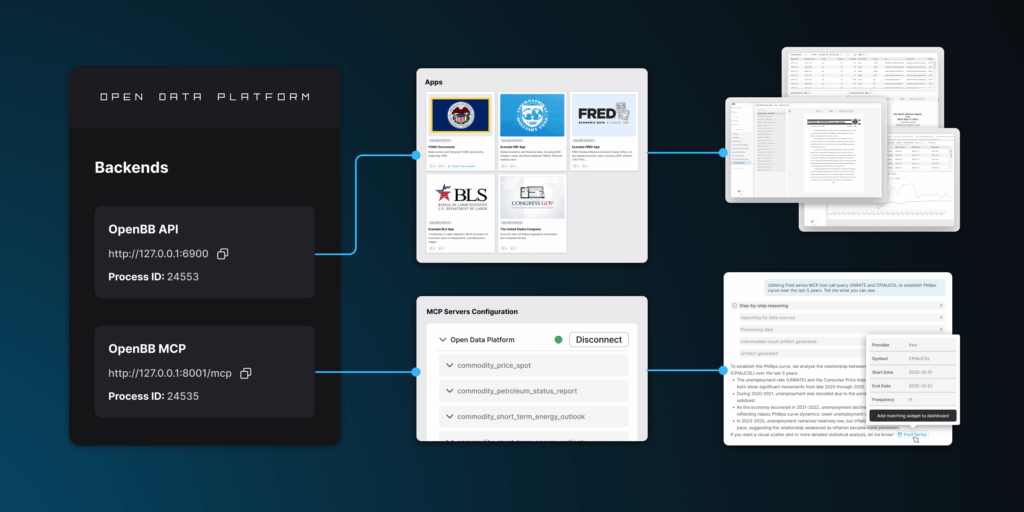
For years, the market has been chasing one big promise: make financial data accessible without forcing people into the price tag of a traditional “terminal.” In that landscape, OpenBB has been carving out a space as a modern, modular platform for analysts, quants, and teams that need to integrate multiple sources—public, licensed, or internal—and consume them consistently across different workflows.
The idea driving the project can be summed up in a phrase repeated across its documentation and repositories: “connect once, consume everywhere.” And it’s not just marketing. Anyone who has maintained data integrations knows the pain: the cost isn’t always the data license—it’s the ongoing effort to keep changing APIs, quotas, formats, and authentication flows under control.
From “Terminal” to platform: a strategic shift
OpenBB was long associated with a terminal-style experience for financial research. But the company chose to change direction, arguing that maintaining a heavy install (with a large Python dependency chain) and constantly fixing breakages from third-party changes wasn’t sustainable over time. In its own explanation, the terminal had roughly 7,000–10,000 monthly active users, yet the cost of delivering an “all-in-one” experience kept rising. The result: the “Terminal” gets repositioned, while the platform approach takes center stage—alongside a CLI reborn in a more platform-oriented form.
This isn’t just a UI makeover. It’s a product transformation: less monolithic tooling and more reusable infrastructure. Instead of one big tool that tries to do everything, OpenBB is pushing a foundation layer that can power dashboards, research workflows, internal copilots, and analytics apps—without rebuilding the plumbing each time.
The technical core: Open Data Platform
At the heart of this strategy is the Open Data Platform (ODP), described as an open-source toolset that helps data engineers integrate proprietary, licensed, and public sources—and serve them to multiple “consumption layers”: Python environments for quants, REST APIs for other apps, Excel connectors, and MCP servers designed for AI copilots and agents.
In practice, the onboarding path is straightforward: install via pip and start using it programmatically. The official repository includes examples such as pulling historical equity prices and converting results into a dataframe. ODP can also run as a local backend: executing openbb-api launches a FastAPI server (via Uvicorn) at 127.0.0.1:6900. With that backend running, OpenBB frames integration into its Workspace UI as a simple connection step—so analysts can consume data in a dashboard without engineering teams hand-wiring every chart or view.
This separation—ODP as the integration layer, Workspace as the interface layer—matters for a very practical reason: it reduces duplication. One connector can feed Python, Excel, a web app, and an AI agent without rewriting the same logic four different ways.
Workspace and the promise of “team-ready” analytics
If ODP is the engine, Workspace is positioned as the cockpit: a modern dashboard-driven interface that sits somewhere between BI tooling and a terminal, designed for visualization and analysis—with AI agents as part of the experience.
The narrative targets a specific audience: firms handling sensitive (often regulated) data that don’t want AI experimentation to mean losing control over data, prompts, or internal documents. OpenBB emphasizes on-prem or private cloud/VPC deployment options and a posture where organizations retain control over credentials and models—especially when combining internal datasets with external providers.
The trend behind this pitch is clear: a “nice UI” isn’t enough anymore unless it comes with governance, auditability, and a realistic path to integrating multiple data sources. In that sense, OpenBB is aiming to be technical glue: less lock-in, less repeated work, and a standardized way to expose financial information across a firm.

Security and compliance: where adoption decisions get made
In enterprise rollouts, what blocks projects isn’t usually the lack of charts—it’s the uncomfortable question: “Where does our data end up?” OpenBB positions itself as a solution for scenarios where teams need to work with proprietary data without leakage. It stresses deployment flexibility, access controls, and a security posture aligned with environments where data governance and audit requirements are non-negotiable.
At the same time, ODP’s local-first approach becomes an operational argument: keep credentials under customer control, avoid telemetry, and prevent unexpected outbound collection. In regulated industries, that promise can matter just as much as performance.
AGPL licensing: a detail that becomes critical once it’s productized
Another major piece is the open-source licensing model. OpenBB highlights an AGPL-licensed core and addresses common questions about internal use, proprietary integrations through standard interfaces, and what changes when you modify and offer the software as a network service.
This is where many teams get tripped up by assumptions: using open source internally is not the same as distributing a modified version—or building a SaaS offering on top of it. OpenBB’s approach appears to balance two goals: keep the core open (and protect contributions) while offering commercial flexibility when usage crosses into redistribution or network-delivered services.
A “modular Bloomberg,” but with real-world caveats
Calling OpenBB a “Bloomberg without the subscription” works as a shorthand for ambition, but it needs context. A large part of any professional terminal’s value lies in data agreements, coverage, and delivery guarantees. OpenBB doesn’t erase that reality: if you need specific premium feeds, costs may still sit with the underlying providers and API keys.
Where OpenBB aims to change the game is the integration and consumption layer: less dependence on a single terminal, more ability to connect internal data, more consistency across analyst and engineering workflows, and a bridge toward AI agents that can operate with real firm context—not just generic demos.
FAQs
How do you install OpenBB Open Data Platform locally and run its API in an organization?
ODP can be installed via Python using pip, and it can run a local backend using openbb-api, which launches a FastAPI server at 127.0.0.1:6900. This architecture helps separate data integration from consumption—especially in internal networks and security-sensitive environments.
What does OpenBB’s AGPL license mean for internal use by a research or analytics team?
AGPL licensing often allows internal use without distribution, but obligations can change if you modify and provide the software as a network service. Teams typically evaluate this carefully when building client-facing tools or hosted services.
Can OpenBB be used as an alternative to a financial terminal for teams with proprietary data?
OpenBB is especially relevant when a firm wants to combine internal data with public or licensed sources and expose them across multiple surfaces (Python, Excel, dashboards, and AI agents) through a shared integration layer.
How do you connect OpenBB Open Data Platform to OpenBB Workspace or to Excel workflows?
The “connect once, consume everywhere” approach uses ODP as the integration backend and Workspace/Excel as consumption layers. A common setup is to run the ODP backend locally and connect it from Workspace, while other tools consume the same data via APIs or dedicated add-ins.
source: OpenBB Finance & ODP Desktop