
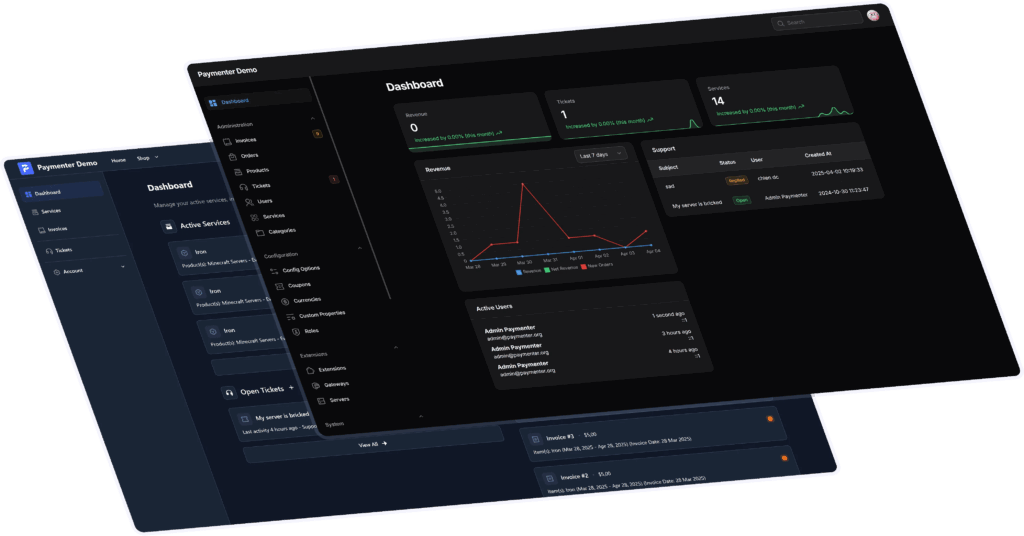
In hosting, you can have a great product, spotless infrastructure, and fast support — but if billing breaks (signups, renewals, payments, suspensions, notifications), the business pays the price. That’s the space where projects like Paymenter come in: a free, open-source webshop and billing platform designed specifically for hosting providers.
The pitch is straightforward: automate subscriptions, reduce manual work, and avoid the rigid dependencies (or rising costs) that often come with closed tools. For many small teams — and also for mid-sized providers with mature operations — the real value isn’t just “taking payments online,” but running a stable lifecycle: the customer orders, pays, gets provisioned, renews, gets managed, and everything is auditable.
What Paymenter Is — and Why Developers Care
Paymenter describes itself as billing “built for hosting”: a panel to manage customers, services, and payments, built to fit into a provider’s stack. Being open source changes the game because it’s about control:
- Self-hosted: runs on your infrastructure, under your policies and backups.
- Extensible: fits well with a plugin-first approach (extensions + customization).
- No vendor lock-in: if the project roadmap doesn’t fit you, you can fork it or build what you need.
- Automation-minded: the goal isn’t a generic ERP — it’s billing + service lifecycle workflows typical in hosting.
Technically, it targets a common, accessible stack for most sysadmins and web devs: modern PHP, Composer, a web server (Apache or Nginx), and a MariaDB-style database. In other words: easy to deploy in the environments the industry already uses.
Open Source in Billing: The Real Difference Isn’t “Free” — It’s “Governable”
When a provider relies on closed billing software, the risk isn’t always the subscription fee — it’s the full package:
- Licensing changes or shifting terms.
- Integration limits with internal systems.
- Dependency on a marketplace for modules.
- Harder auditing of what the system actually does (payments, logs, permissions, etc.).
Paymenter plays the opposite game. Its MIT license enables flexible use, including modifications and redistribution under the usual conditions (keeping the license notice). That makes it especially appealing for technical teams who want to connect billing with their own backend, provisioning panel, internal tools, or support workflows.
Quick Comparison: Paymenter vs. Common Alternatives
When choosing billing for hosting, almost nobody decides based only on “does it work?” The decision is usually about balancing total cost, integration, control, community, and pace of change. A practical comparison (without discussing pricing) looks like this:
| Solution | Model | Open Source? | Self-Hostable? | Customization | Lock-In Risk | Typical Fit |
|---|---|---|---|---|---|---|
| Paymenter | Hosting-focused billing platform | Yes | Yes | High (code + extensions) | Low | Technical teams who want control and custom workflows |
| WHMCS (industry reference) | Commercial billing/automation suite | No | Yes | Medium (modules/themes) | Medium/High | Providers who want the “market standard” + commercial ecosystem |
| Blesta (commercial) | Commercial billing for hosting | No | Yes | Medium | Medium | Hostings prioritizing stability and paid support |
| FOSSBilling | Open-source billing/management | Yes | Yes | High | Low | Teams wanting an open-source base to tailor to their operations |
Takeaway for devs: Paymenter makes the most sense when the team values “I can change it” (code, integrations, internal automation) more than “everything ships out of the box.” In other words: less dependency, more engineering control.
Where It Can Deliver Real Value (Realistic Use Cases)
1) Small hosters who want to stop “gluing tickets together”
Many providers start with manual processes: onboarding via bank transfer, renewals via reminders, suspensions done by hand. Paymenter targets that friction — as long as the provider already has at least a minimal provisioning path (even partially automated).
2) Providers selling non-standard services
When the catalog goes beyond typical plans (hybrid bundles, managed services, recurring consulting, bespoke add-ons), open systems are often easier to live with: you can adapt logic, the admin panel, and the customer experience.
3) Teams that prioritize technical sovereignty
If billing is the business “cash register,” many providers prefer full control over it: deployments, backups, logs, auditing, and changes on their own schedule.
4) Internal integrations and custom automation
A common scenario: linking billing to usage metrics, cluster provisioning, IP inventory, fraud controls, KYC/AML (when applicable), or even internal FinOps workflows. Here, open source isn’t a luxury — it’s a shortcut.
What to Review Before Adopting It
Even if the concept is appealing, billing software can’t be chosen on vibes alone:
- Product maturity: review releases, issues, PRs, and real project activity.
- Migration: if you’re coming from another platform, plan imports (customers, services, invoices, statuses).
- Security: deploy with best practices (permission separation, backups, key rotation, WAF if relevant, monitoring).
- Integrations: confirm it fits your provisioning/payment stack, or estimate the engineering effort to bridge gaps.
Bottom line: Paymenter can be a strong option for providers and developers who want billing without lock-in and with real room to adapt. It’s not just a “cheaper alternative” — it’s a controllable one, which matters a lot when your business depends on automating the service lifecycle reliably.