
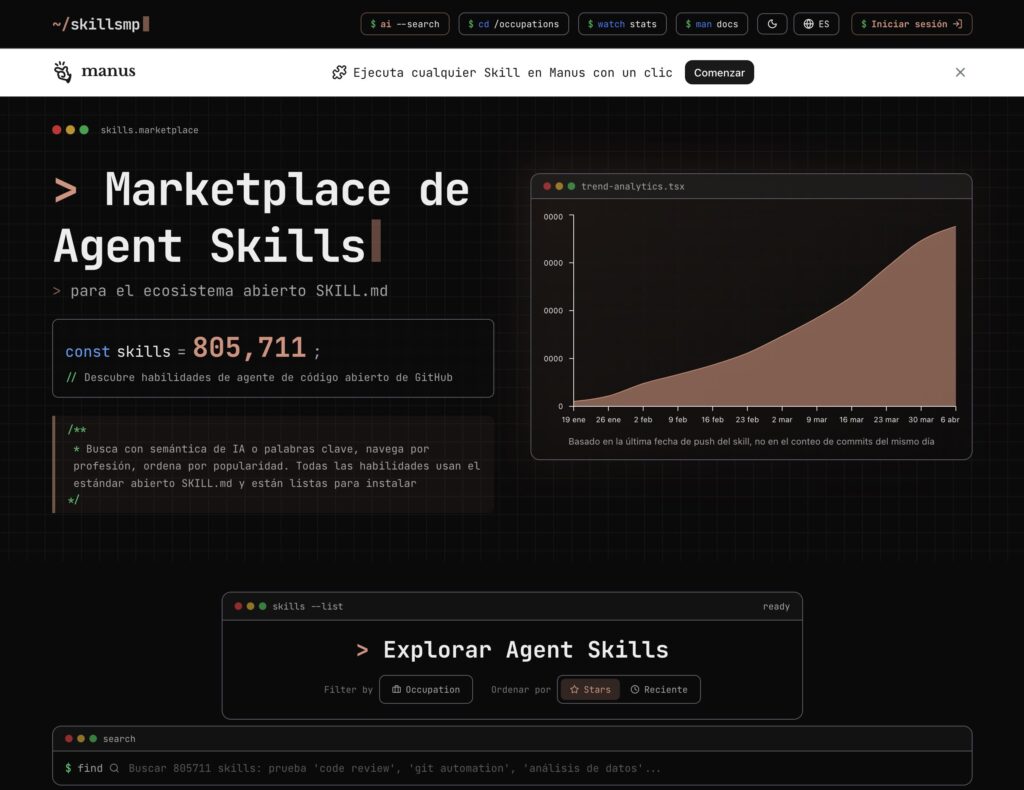
As AI agents become more useful in real workflows, a new problem is emerging just as quickly: finding the right skill among the growing sprawl of GitHub repositories, templates, and community-built automations. That is the space Skills Marketplace is trying to occupy. The site presents itself as a discovery platform for agent skills built around the open SKILL.md format, with search, filtering, categorization, and one-click installation flows designed to make those skills easier to find and use.
The pitch is straightforward. Skills Marketplace says it has aggregated more than 800,000 skills from public GitHub repositories and turned them into a searchable catalog. On its homepage, the live counter shows 805,711 skills, along with filters by occupation, category, popularity, and keyword search. The site also claims full classification across 23 major occupation groups and 867 SOC occupations, which suggests it is trying to go beyond a generic code index and build something closer to a navigable layer for professional use cases.
That occupational angle is one of the more interesting parts of the project. In its “About” page, Skills Marketplace argues that skills are not just code snippets, but “vessels for experience,” naming examples such as legal contract review workflows, tax planning standards, diagnostic frameworks, and growth playbooks. In other words, the platform is not only chasing developer automation. It is also trying to frame skills as reusable professional knowledge that can survive staff turnover and become explicit, installable assets inside AI-assisted workflows.
The timing makes sense. Over the last year, the conversation around AI tooling has moved away from models alone and toward everything that surrounds them: agents, prompts, tool orchestration, connectors, and reusable skills. Skills Marketplace is clearly betting that this layer will become big enough to justify its own search and discovery market. The homepage explicitly positions the catalog as compatible with Claude Code, OpenAI Codex CLI, and ChatGPT, all through the same open SKILL.md format.
There is also a practical argument behind the site’s existence. Skills Marketplace says the current ecosystem is fragmented, difficult to evaluate, and full of uncertainty about quality. Its own wording is blunt: good agent skills are hard to discover, it is hard to know what other people are building, and it is often unclear whether a skill was carefully crafted by an expert or merely generated by AI. That is a real discovery problem, and one that becomes more important as more companies start building internal agent workflows instead of experimenting casually.
Still, the platform is not pretending that curation is solved. In fact, it says the opposite. The site describes itself as being in a collection phase, focused first on aggregating skills from across GitHub. Its next priorities are community ratings, usage statistics, quality filters, and expert verification for domain-specific skills. That roadmap matters, because aggregation alone does not solve trust. At this stage, Skills Marketplace looks more like a large index with ambition than a fully mature marketplace with proven quality controls.
The site does show some early attempts at adding guardrails. Its FAQ says skills are sourced from public GitHub repositories, that the platform filters out low-quality repositories with a minimum two-star threshold, and that users should always review code before installing anything. That is a sensible warning, especially in an ecosystem where a skill may trigger scripts, automate actions, or interact with external systems. It also underlines a broader reality: discovery is only half the job. Trust and verification are likely to become the harder part.
Another notable detail is positioning. Skills Marketplace repeatedly says it is an independent community project and not affiliated with Anthropic. The FAQ extends that point by directing users to Anthropic’s official skills repository and OpenAI’s own documentation for official sources. That disclaimer is important, because the site is clearly surfing a wave created by larger AI platforms while trying to remain a neutral discovery layer above them.
In the end, the most important thing about Skills Marketplace may not be the site itself, but what it signals. The AI ecosystem is starting to generate enough reusable agent behavior that it now needs indexing, filtering, and packaging. A year ago, that would have sounded premature. In 2026, it looks increasingly logical. Skills Marketplace may still be early, and it still has obvious quality and trust challenges ahead of it, but it is already pointing at a likely next phase of the agent economy: a world where the value is not just in the model, but in the library of specialized skills that sit on top of it.