
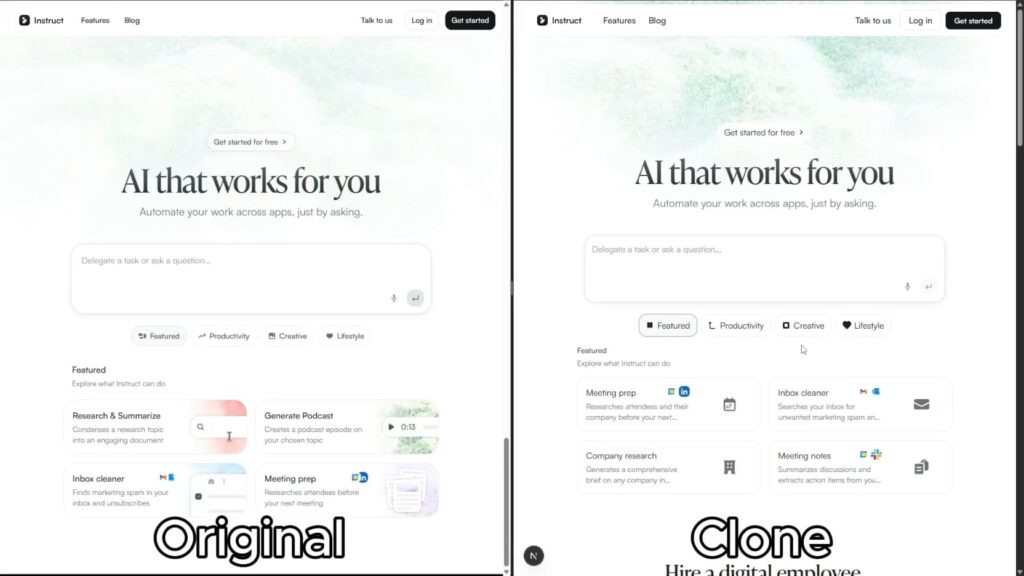
A new GitHub project is gaining attention among developers and makers for a simple reason: it promises to take an existing website and rebuild it into a clean, editable Next.js project using AI coding agents. The repository, ai-website-cloner-template, describes itself as a reusable template for reverse-engineering websites into a modern frontend stack, with Claude Code recommended as the best option, though support is also listed for tools such as Codex CLI, Cursor, GitHub Copilot, Gemini CLI, OpenCode, Cline, Amazon Q, and others.
The workflow is designed to feel almost absurdly simple. According to the project’s README, the user clones the repository, installs dependencies, launches an AI coding agent, and runs the command /clone-website <target-url>. From there, the agent inspects the target site, extracts design tokens and assets, writes component specifications, and dispatches parallel builders to reconstruct each section. The stack behind the project includes Next.js 16, React 19, TypeScript, Tailwind CSS v4, and shadcn/ui.
What makes the repo especially interesting is that it does not present itself as a one-click pirate copier. Its framing is much more technical: it is a template for reverse-engineering a site into a modern codebase. The README says the process includes several phases, from reconnaissance and screenshot capture to design token extraction, component specification, parallel building in git worktrees, and final visual comparison against the original site. In other words, the goal is not only to imitate what a page looks like, but to rebuild it as structured, reusable frontend code.
That makes it particularly useful in a few real-world scenarios. One is platform migration, such as rebuilding a site you already own from WordPress, Webflow, or Squarespace into a cleaner Next.js stack. Another is recovering a site when the live page still exists but the original repository is gone or tied to an outdated system. A third is purely educational: breaking down how production websites achieve certain layouts, responsive behavior, or interaction patterns by turning them into readable code. The repo lists these use cases explicitly.
At the same time, the project draws a clear ethical and legal line. It states that the template is not intended for phishing, impersonation, or passing someone else’s design off as your own, and warns that logos, brand assets, and original copy still belong to their owners. It also reminds users that some websites prohibit scraping or reproduction under their terms of service. That warning matters, because tools like this will inevitably attract interest from both legitimate developers and people looking for shortcuts that cross a legal boundary.
The repo’s momentum also helps explain the buzz around it. At the time of checking, the project showed about 7.8k stars, roughly 1k forks, and 37 commits, suggesting fast adoption and an active early community around the idea. That does not automatically make it production-grade, but it does show that many developers see real value in a workflow that turns a public-facing website into a modern, editable frontend foundation.
For developers, that may be the biggest takeaway. The project is less about “stealing websites with AI” and more about compressing a process that normally takes many hours: audit the interface, inspect styles, map components, recreate sections, wire assets, and clean up the result. AI agents do not remove the need for judgment, editing, or legal caution, but they can dramatically reduce the mechanical part of rebuilding a site.
Frequently Asked Questions
Can this project really clone any website with one command?
Not perfectly and not magically. The repository says it can reverse-engineer a website into a modern Next.js codebase using AI coding agents, but the result still depends on the complexity of the original site, the quality of the agent, and human review afterward.
Do you have to use Claude Code?
No. The project recommends Claude Code with Opus 4.6 for the best results, but its README lists support for many other AI coding agents, including Codex CLI, Cursor, GitHub Copilot, Gemini CLI, Cline, Continue, Amazon Q, and others.
What does the build process actually do?
The repo says the /clone-website skill runs a multi-step pipeline: reconnaissance, foundation setup, component specification, parallel building, and final assembly with visual QA against the original site.
What is it useful for in practice?
The README highlights three main scenarios: migrating a site you own from older platforms, recovering code when the live site remains but the original source is gone, and learning how real production sites are built.
Is it legal to use this on any website?
Not automatically. The project explicitly warns against phishing, impersonation, and presenting someone else’s branding or copy as your own. It also notes that some websites may prohibit scraping or reproduction in their terms of service.
What technologies does the generated project use?
The repository is based on Next.js 16, React 19, TypeScript, Tailwind CSS v4, and shadcn/ui.