
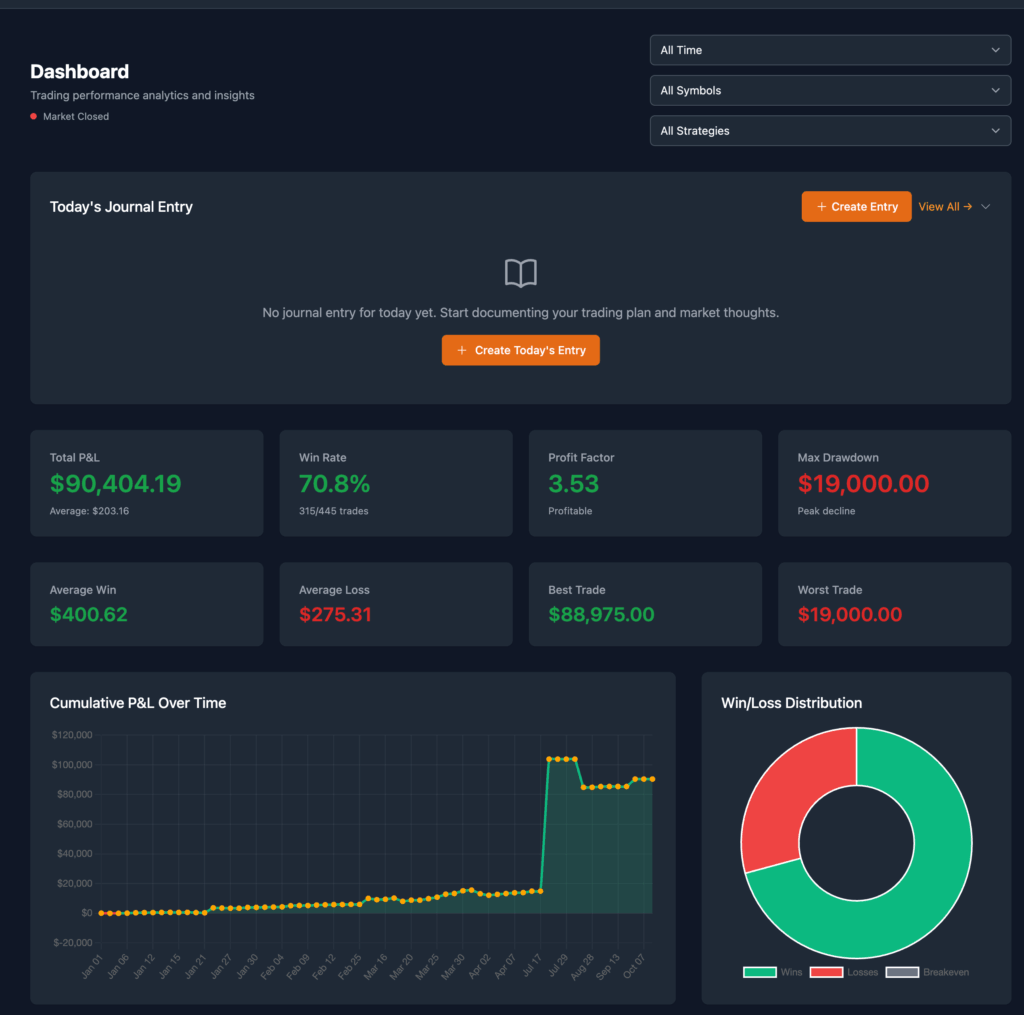
In trading—whether retail or professional—there’s a line people repeat like a mantra: “If you don’t measure it, you can’t improve it.” The catch is that measuring well isn’t as simple as jotting down entries and exits in a spreadsheet. For many traders, the real leap happens when they can connect trades to context—time of day, sector, hold time, that day’s news—and turn all of that into clear habits, alerts, and patterns. That’s where TradeTally comes in: a trading journal and analytics platform positioning itself as a TraderVue alternative, with an unusual twist for this category: it offers both a hosted SaaS version and a free, open-source self-hosted deployment that includes “Pro features.”
The project, hosted on GitHub and licensed under Apache-2.0, combines a modern web app with a native iOS app distributed via TestFlight. The pitch is straightforward: centralize trade tracking, automate part of the performance “bookkeeping,” and add layers of analysis—including AI-assisted insights—without forcing users to lock their trading history inside a closed platform.
A journal built for data-driven trading, not memory
TradeTally describes itself as a trading journal and analytics platform built with a Vue.js frontend and a Node.js backend, focused on recording trades, calculating metrics, and spotting patterns. The emphasis is on visualization and analysis—from candlestick charts with entry/exit markers to dashboards that aggregate results and break them down across variables that, day to day, often explain why a strategy works… or suddenly stops working.
The tool includes multi-broker import—including Lightspeed, Charles Schwab, ThinkorSwim, IBKR (Interactive Brokers), and E*TRADE—and also mentions ProjectX. That matters because adoption often hinges on how quickly someone can move from “manual logging” to automation. If a trader can import and normalize their history, the journal stops being another chore and starts becoming a learning system.
TradeTally also doesn’t limit itself to stocks. The project highlights support for options and futures, with specialized analytics for these instruments. In derivatives trading—where outcomes depend heavily on context (time in the market, contract type, risk patterns)—the promise of purpose-built analytics is a notable draw, at least on paper.
Advanced analytics, behavioral signals, and even health: building a fuller picture of performance
TradeTally’s value proposition goes beyond “P&L and done.” Key features include:
- Real-time market data and unrealized P&L tracking
- Advanced charts that analyze performance by hold time, day of the week, sector, and more
- News integration that automatically enriches traded symbols
- Earnings tracking for watchlist names
One section stands out because it turns trading psychology into measurable signals: behavioral analytics. TradeTally mentions detecting “revenge trading” (impulsive trades after a loss) and tracking overconfidence, listed as “Pro” capabilities—while the project also states that self-hosting includes Pro features.
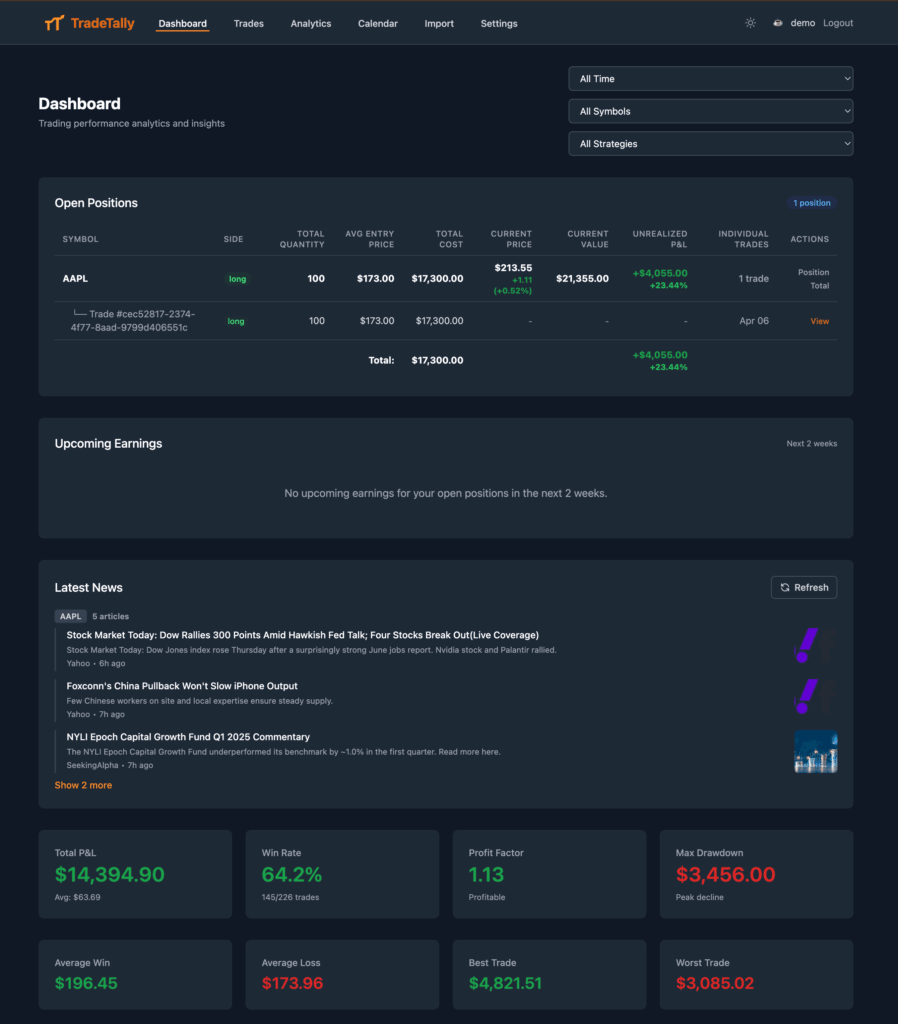
Even more unusual is its Health Tracking concept: correlating sleep, heart rate, or other health metrics with trading performance. This isn’t new in sports or productivity software, but it’s less common in trading tools. The goal is to put numbers behind what many traders already suspect: a strategy’s biggest enemy can be fatigue, stress, or poor decision-making on “off” days.
Built-in AI: personalized recommendations with Gemini
TradeTally also leans into AI-driven analytics. The repository describes personalized trading recommendations powered by Google Gemini under an “AI-Powered Analytics” banner. It’s worth approaching this cautiously: the real value of recommendations depends on data quality, context, and sensible guardrails. Still, the direction matches where the market is heading: trading journals have evolved from “logging plus basic stats” into discipline copilots that surface recurring mistakes and behavioral patterns.
Community and gamification: from personal review to peer motivation
Another notable layer is social and gamified features. TradeTally includes leaderboards, an achievements/badges system, and public trade sharing to learn from others. It also links to a dedicated forum (Discourse-based). Community + gamification is common in fitness apps, but it can be controversial in trading: some find it motivating, while others worry it encourages trading “for points” rather than trading well. Either way, TradeTally offers the option, and it appears designed for teams or groups that want shared accountability and progress comparisons.
SaaS vs self-hosted: two paths to the same platform
TradeTally offers two deployment models:
- SaaS at tradetally.io, priced at $8.00/month or $80/year
- Self-hosted, free and open source, with full control over your data and no subscription
The self-hosted angle is likely the biggest hook for technical users and privacy-minded traders: a trading journal can contain sensitive information (history, habits, mistakes, implicit strategy), and many prefer not to outsource it. TradeTally also notes that to unlock all features (real-time quotes, advanced charts, sector analysis), users may need a Finnhub Basic plan—though a free tier exists with limitations.
A familiar stack for technical teams: Vue, Node, PostgreSQL, and Docker
On the technical side, TradeTally uses a very standard modern web stack: Vue.js 3, Tailwind CSS, and Pinia on the frontend; Node.js/Express and PostgreSQL on the backend; and deployment via Docker and Nginx. The documentation includes a “quick start,” and the project provides Docker/Compose guidance to bring up the application alongside PostgreSQL, with environment variables for API keys (Finnhub, Alpha Vantage, Gemini) and optional feature toggles.
For end users, that translates into a simple idea: no hand-built installs required. TradeTally can be deployed as a service on a personal server, VPS, or homelab and maintained like any other containerized app.
A product still evolving—but with clear signals of intent
TradeTally doesn’t feel like a casual experiment. Between the public demo, dedicated docs site, Docker Hub image, and iOS TestFlight build, the project shows a serious effort to cover the full loop: onboarding, daily use, and deployment. Its ambition is obvious: become a trading journal that doesn’t just log trades, but explains patterns, compares performance, and helps correct habits.
As with any platform in this space, the big question isn’t whether it has features—it’s whether it can do the hardest thing: get traders to use it consistently, keep data clean, and produce insights that actually change behavior. If it pulls that off, TradeTally could fit neatly into a growing niche: traders who want serious analytics without giving up control and portability of their own data.
FAQs
How do you install self-hosted TradeTally with Docker on a VPS or your own server?
TradeTally supports Docker and Docker Compose. A typical setup runs the app alongside a PostgreSQL database and configures environment variables (API keys, URLs, credentials, etc.) to enable market data and AI features.
Is TradeTally an open-source alternative to TraderVue for trading journaling?
Yes. The project positions itself as a TraderVue alternative and offers a free, open-source self-hosted option, plus a SaaS version for users who prefer a managed service.
Which brokers can TradeTally import from, and how do you migrate trades?
TradeTally lists imports from Lightspeed, Charles Schwab, ThinkorSwim, IBKR, and E*TRADE, among others. Imports typically rely on broker export formats (such as CSV) and TradeTally’s internal import workflow.
What do you need to enable real-time quotes and advanced analytics in TradeTally?
For full access to real-time quotes, advanced charts, and sector analysis, the project notes that a Finnhub Basic plan may be required (a limited free tier is available). You’ll also need to configure the relevant API keys.
Source: Tradetally in GitHub