
For decades, .Q files have lived in a strange corner of digital history: common enough to appear in old software archives, BBS-era collections, and legacy CD-ROM mirrors, yet inconvenient—sometimes practically impossible—to extract on modern systems without recreating a full DOS environment. The format behind those files, known as Quantum, was technically ambitious for its time. The tooling around it, however, aged poorly.
That gap is exactly what UnQuantum sets out to close. Written in Rust and designed for modern operating systems, the project brings native support for extracting standalone Quantum (.Q) archives on Linux, macOS, and Windows. The aim is straightforward: make a once-useful compression format usable again, without emulators, without 1990s runtime baggage, and without the typical ritual of hunting for the “right” DOS setup.
A format that punched above its weight
Quantum’s original window was short but influential. Developed by David Stafford at Cinematronics (Austin, Texas) in the 1993–1995 period, Quantum was built around LZ77 combined with arithmetic coding, a less common choice in consumer-facing compression tools of the era. That combination helped Quantum achieve strong compression ratios at a time when many popular archivers leaned heavily on Huffman-style coding.
Quantum wasn’t just a niche experiment either. The algorithm was licensed by Microsoft and integrated into Cabinet (.CAB) technology, with the broader Quantum approach finding interest across the industry landscape of the time. Still, the standalone .Q format gradually faded from everyday use, and its practical accessibility collapsed as the original tooling stopped fitting into modern operating systems.
The real reason .Q files became painful to open
The problem wasn’t that Quantum archives were inherently “exotic.” It was that the most commonly referenced decompressor, UNPAQ.EXE, was a 32-bit DOS program that depended on a Borland DPMI extender. That requirement creates friction even for enthusiasts—and for archivists, IT teams, or anyone handling large volumes of legacy data, it quickly becomes a non-starter.
In the modern world, “just spin up DOSBox” is not a scalable strategy. It complicates automation, introduces workflow variability, and turns a simple extraction step into a fragile environment dependency. In short: the format didn’t die because the algorithm was weak, but because the execution environment fossilized.
What UnQuantum changes
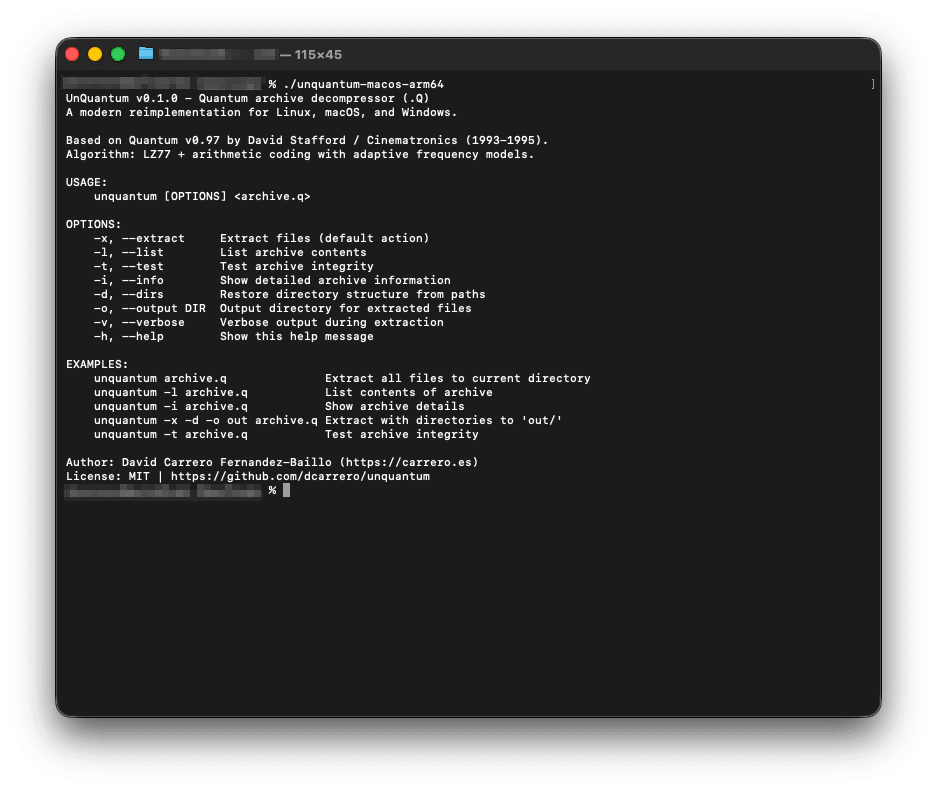
UnQuantum approaches Quantum archives as a first-class citizen in a modern toolchain: something that can be analyzed, tested, and extracted without special runtime assumptions. The project includes functionality geared toward real-world use cases:
- Listing archive contents
- Testing/validating archives
- Extracting one or more files
- Handling directory structures where paths are present
- Supporting key aspects of the Quantum bitstream, including multiple window sizes and adaptive models
But UnQuantum’s most important contribution isn’t just “it runs on today’s OSes.” It’s that it resolves a subtle, high-impact correctness issue that historically made multi-file Quantum archives a trap for reimplementations.
The missing 16 bits that broke everything
Early progress on UnQuantum followed a familiar pattern: single-file archives decompressed cleanly, while multi-file archives failed starting at the second file, producing corrupted output. In many legacy-format projects, this is where time disappears—because the bug isn’t in the obvious place.
In this case, the breakthrough came from careful testing and reverse engineering of how the standalone .Q format delineates files inside a continuous compressed stream. The key discovery: between files, the format inserts a 16-bit checksum directly into the raw bitstream, outside the arithmetic decoder.
That detail matters because Quantum’s stream is not neatly reset per file. The coder state and adaptive models persist across file boundaries. If an implementation fails to consume the checksum bits at the correct moment, the bit alignment shifts, and everything downstream—every symbol decode, every model update—goes off the rails. The result looks like “random corruption,” but it’s actually deterministic desynchronization.
This checksum behavior is also significant because it differs from the CAB variant many engineers are more familiar with. It’s a reminder that “Quantum” is not one monolithic format: the standalone .Q implementation has quirks that don’t necessarily appear in other containers that licensed the algorithm.
Why this matters beyond retro computing
UnQuantum lands at the intersection of two trends that are increasingly relevant in 2026: data preservation and operational practicality.
Organizations and individuals are sitting on decades of digital assets—source code snapshots, early software distributions, academic datasets, vendor toolchains, and long-forgotten internal archives. When those assets use formats tied to obsolete environments, the data is not truly “stored.” It’s merely “parked,” waiting for the day the right tool stops being available.
UnQuantum is an example of how modern engineering can reduce that risk. A native, cross-platform extractor can be integrated into automation pipelines for cataloging, validating, and migrating historical archives. It can be used in bulk workflows, CI-like verification tasks, or long-term preservation projects without embedding DOS emulation into the process.
And, perhaps most importantly, it demonstrates a principle that sysadmins and developers recognize immediately: the difference between “theoretically supported” and “operationally usable” is often one undocumented edge case away.
FAQs
What is a .Q file, and where do they typically come from?
A .Q file is a standalone archive created with the Quantum compression format from the MS-DOS era. These archives often show up in older software collections, BBS archives, and legacy distribution mirrors.
Why did extracting .Q files become so difficult on modern systems?
The most common historical tool, UNPAQ.EXE, is a DOS-based program that relied on a Borland DPMI extender, pushing users toward DOS emulation rather than native extraction workflows.
Why do multi-file .Q archives break in some modern implementations?
Standalone Quantum archives can insert a 16-bit checksum between files directly into the raw bitstream, outside the arithmetic decoder. If that checksum isn’t consumed correctly, the stream becomes misaligned and subsequent files decompress incorrectly.
Does UnQuantum also extract Microsoft CAB files that use Quantum?
UnQuantum focuses on standalone .Q archives. Quantum inside CAB is related but not identical in behavior, and other tools and libraries typically handle CAB as a separate target.
Avalaible in GitHub.