
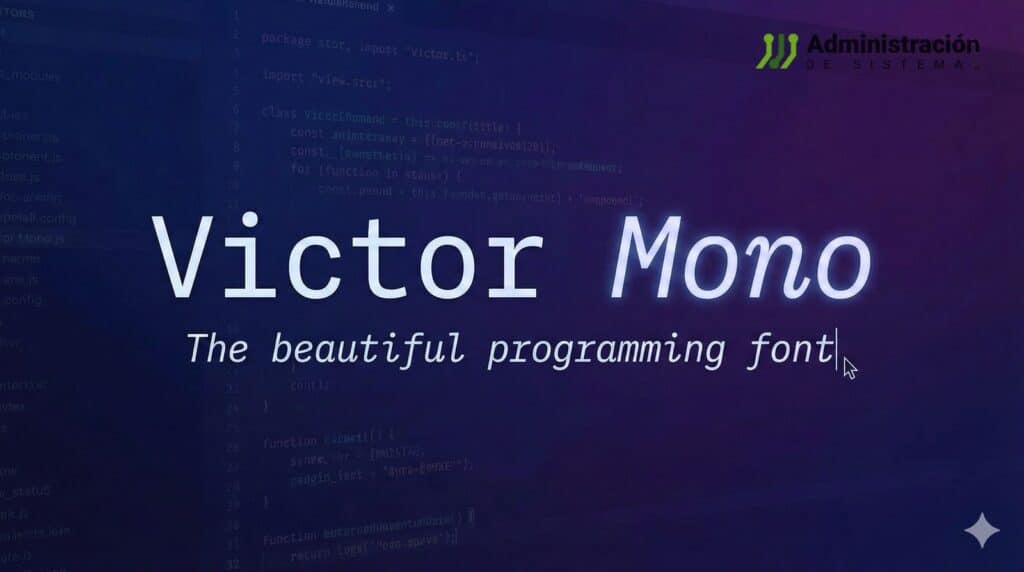
In the crowded world of coding fonts – long dominated by names like Fira Code, Cascadia Code or JetBrains Mono – one project has quietly built a devoted following: Victor Mono, a free, open-source monospaced typeface with cursive italics and programming ligatures, designed specifically for writing code.
Created by Norwegian designer Rune Bjørnerås, Victor Mono started as a personal experiment. He simply could not find a font, paid or free, that felt comfortable for long programming sessions. So he drew his own. What began as a side project in 2019 has evolved into a full family of fonts that is updated regularly and maintained openly on GitHub.
A design tuned for code, not paragraphs
Victor Mono is a monospaced font, which means every character occupies exactly the same horizontal space. That is crucial for developers: aligned indentation, clear tables and clean diffs depend on this property.
But the project goes far beyond the basic monospaced requirement.
Key characteristics include:
- A tall x-height, so lowercase letters are relatively high compared to capitals. That improves legibility on screens and at small sizes, where most code lives.
- Fine, crisp strokes that pack many lines on screen without feeling cramped, ideal for split views and dense editor layouts.
- Carefully drawn punctuation and symbols, making characters such as
{},(),=>,==or!=immediately distinguishable, even after hours of work. - Programming ligatures, which merge character sequences into single, more readable glyphs – for example
!=,=>,->or::.
The family offers several weights, from thin styles to bold, and multiple variants (Roman, Italic and Oblique), giving users flexibility to differentiate comments, keywords or emphasised elements without leaving the visual universe of the font.
Cursive italics with personality
One of Victor Mono’s most distinctive features is its semi-cursive italics. Instead of simply slanting the regular shapes, Bjørnerås designed more handwritten, flowing forms. The result is a subtle “human” touch in a context – source code – that often feels cold and mechanical.
Those italics are particularly useful for:
- Comments, which can stand out from code while remaining pleasant to read.
- Highlighting, when themes use italics for keywords, function names or documentation blocks.
On top of that, Victor Mono ships with several stylistic sets (ss01, ss02, etc.) that let users customise details such as:
- The form of the letter “a”.
- Different versions of the slashed zero.
- A slashed seven.
- Straighter shapes for the digits 6 and 9.
- A more “fishlike” turbofish ligature for Rust’s
::<.
These variants can be activated via font-feature-settings in CSS or through editor-specific options. Visual Studio Code, Sublime Text and the Kitty terminal, among others, support enabling individual stylistic sets so each developer can fine-tune the look of their code.
From desktop editors to the web
The project provides several ways to start using Victor Mono, depending on the environment.
- Direct download
Users can download a ZIP archive with all styles, install the font on their operating system and then select “Victor Mono” in their editor or IDE of choice. It works on Windows, macOS and Linux. - npm integration for web projects
For frontend applications or documentation sites, Victor Mono is published as an npm package (victormono). After runningnpm i victormono, developers can import it into their build and reference it in CSS withfont-family: 'Victor Mono'. - CDN for online editors
For quick experiments on platforms such as CodePen or JSFiddle, there is a ready-to-use stylesheet served from a CDN. Adding the<link>tag in the HTML head exposes the font asVictor Mono, monospacefor immediate use. - Font managers and package systems
On macOS, for example, Victor Mono can also be installed via Homebrew casks, making it easy to keep updated alongside other development tools.
This flexibility has helped the font spread not just in local editors and terminals, but also on documentation websites, live code sandboxes and teaching platforms.
Open licence and active community
Victor Mono is released under the SIL Open Font License (OFL 1.1), the standard open licence for fonts. It allows free use in both personal and commercial projects and permits modifications and redistribution under specific conditions.
The source files – including the Glyphs design files for each style – are hosted on GitHub. The repository has accumulated hundreds of commits and a healthy number of stars, reflecting a small but active community. Contributors help by:
- Reporting rendering and hinting issues.
- Suggesting additional ligatures or stylistic tweaks.
- Testing the font in different environments (IDEs, terminals, browsers).
Although the font is free, the author openly encourages donations from users who rely on it every day. Those contributions, through GitHub Sponsors or other channels, support ongoing refinements and expansion of character coverage.
How it compares to other coding fonts
The landscape for programming fonts has become highly competitive. Cascadia Code, Fira Code, JetBrains Mono, Iosevka and others all offer high-quality monospaced families with ligatures and extensive Unicode support.
Victor Mono distinguishes itself in a few ways:
- A narrower width, which fits more characters on each line – useful on laptops or when multiple files share the screen.
- Italics with a more expressive, cursive feel, giving themes a distinctive personality, especially in dark colour schemes.
- A visual style many users describe as “elegant but relaxed”, less corporate than some alternatives while still clean and professional.
It is not necessarily the best choice for every developer. Some prefer more conservative italics or dislike ligatures altogether. But precisely that strong personality is part of the appeal: Victor Mono does not try to please everyone, it offers a clear identity for those who enjoy its aesthetics.
A small side project turned everyday tool
Six years after its first release, Victor Mono has quietly become a go-to option in many “best programming fonts” lists. It appears in screenshots of code editors, terminal configurations, live demos and even marketing materials for developer tools.
In a world where developer productivity depends as much on comfort as on raw hardware – from editor themes to how much code fits on a screen – Victor Mono is a good reminder that typography is not just decoration. For many programmers, it is part of their daily tooling, as important as a good keyboard or a reliable editor.
What began as one designer’s search for a more pleasant coding experience has turned into a widely adopted font that gives thousands of developers’ screens a distinctive, carefully crafted voice.