
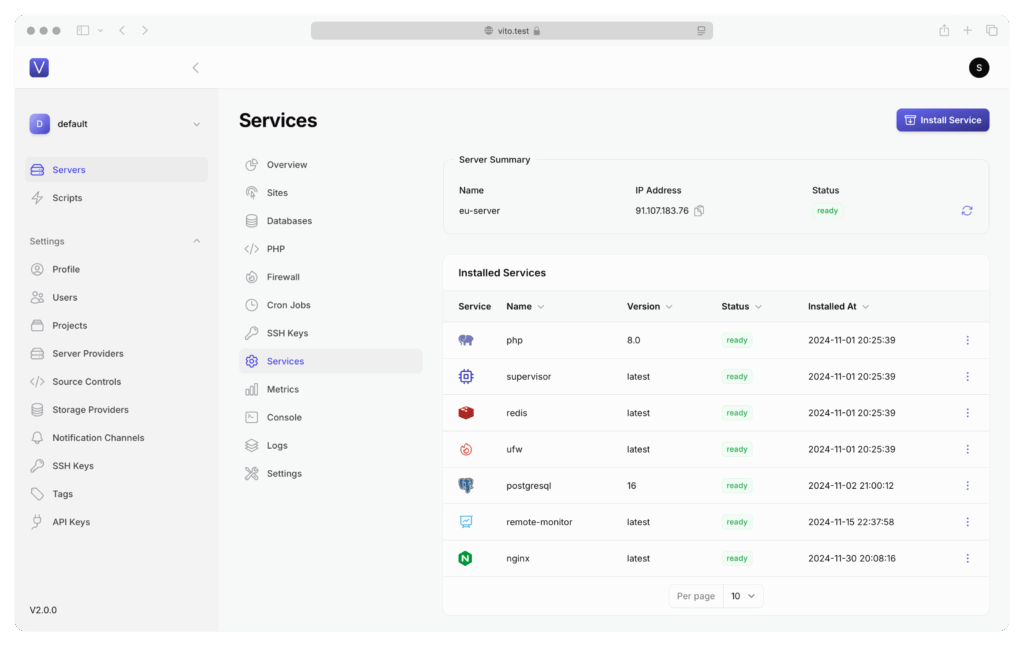
The market for self-hosted server management tools keeps expanding, but not every project is trying to solve the same problem. Vito, also known as VitoDeploy, positions itself as a self-hosted web application designed to help teams manage servers and deploy PHP applications to production without relying on a proprietary cloud control panel. Its promise is straightforward: bring together server provisioning, database management, application deployment, firewall controls, SSL handling, and day-to-day operations in a single interface that organizations can host themselves.
This is not a fringe experiment. The official vitodeploy/vito repository has already gathered solid traction on GitHub, with thousands of stars, hundreds of forks, and an active development history. The project is released under the AGPL-3.0 license, which will appeal to teams that value open-source infrastructure tooling, while also reminding them to pay attention to the implications of copyleft in hosted environments.
At first glance, Vito sits in a familiar category: tools that try to make life easier for teams running VPS instances, dedicated servers, or small cloud footprints for web applications. But its focus is relatively clear. The project is built around PHP-oriented hosting and deployment workflows, with explicit attention to frameworks such as Laravel, while also supporting broader website hosting scenarios, including WordPress. In that sense, Vito is less about being a universal infrastructure orchestrator and more about being a practical operational layer for teams that want control without unnecessary complexity.
A self-hosted panel for teams that want real infrastructure control
The core appeal of Vito is that it gives users a private operational dashboard instead of locking them into someone else’s SaaS control layer. In practical terms, that means being able to create servers, install and manage services, deploy sites, configure firewalls, handle SSL certificates, manage cron jobs, and work with SSH keys from a single web-based interface.
Its documentation highlights a feature set that covers a lot of the daily operational workload many teams still handle manually: server provisioning and management, database administration, custom SSL or Let’s Encrypt certificates, service control, queue supervision, domain and DNS handling, workflow automation, API access, backup-related operations, and a plugin ecosystem. For smaller engineering teams, agencies, or SaaS startups, that can represent a meaningful reduction in repetitive systems work.
One of the more valuable aspects from a cloud perspective is that Vito is not limited to manually prepared servers. The platform can integrate with multiple infrastructure providers, allowing users to create servers directly through the panel. Official documentation mentions support for AWS, Akamai/Linode, DigitalOcean, Vultr, Hetzner, and a custom option for self-managed machines, as long as root SSH access is available. That flexibility makes Vito especially relevant for teams that operate across multiple providers or that want to keep one foot in public cloud and another in their own infrastructure.
Database management and operational basics, without leaving the panel
Database administration is another area where Vito tries to be useful rather than flashy. The platform supports MySQL, MariaDB, and PostgreSQL, with documented version support for each engine. That makes it suitable for a broad range of modern PHP application stacks and for many common production scenarios.
At the same time, the project does not pretend to be an everything-goes orchestration platform. Its design choices suggest a preference for keeping infrastructure manageable and opinionated. For many teams, that may be a strength rather than a weakness. The real-world problem is often not the lack of infinite flexibility, but the lack of a clean and consistent way to operate a moderate number of servers and applications efficiently.
This is where Vito starts to stand out. It aims to serve the space between fully manual Linux administration and heavyweight enterprise-grade orchestration platforms. That middle ground is larger than it often looks, especially among small cloud-native businesses, hosting providers, and web-focused engineering teams.
Automation, plugins, and DNS from one interface
Vito also tries to address a growing operational need: reducing repetitive tasks without forcing teams to build internal platform tooling from scratch. Its documentation highlights workflows for automating deployment and maintenance operations, a REST API for integrations, and a plugin system that includes both official and community extensions.
That matters because self-hosted infrastructure tools increasingly live or die on how well they can adapt to real deployment patterns. A panel that only handles the basics quickly becomes limiting. A panel that can integrate with DNS providers, trigger automated actions, expose an API, and support plugins becomes much more interesting as a long-term operational layer.
DNS integration is especially practical. According to the documentation, Vito can work with DNS providers directly from its own interface, reducing the need to jump between different dashboards every time a new site is launched, a domain is moved, or certificate validation has to be handled. For small teams, that kind of consolidation is often worth more than theoretical feature depth.
Technically, Vito is built on a modern Laravel-centered stack. The project credits Laravel, InertiaJS, React, Shadcn UI, Tailwind CSS, and Vite, which makes its architecture relatively approachable for developers already familiar with the contemporary Laravel ecosystem. That also suggests the project is trying to balance polished UI and practical extensibility, rather than acting as a thin wrapper around shell scripts.
Not a universal control plane, but a very practical one
It is important not to oversell what Vito is. It is not trying to replace large-scale Kubernetes orchestration, multi-cluster infrastructure platforms, or highly specialized enterprise automation systems. Its value lies elsewhere: providing a self-hosted, modern, and relatively opinionated operational layer for teams managing PHP applications and the servers behind them.
That makes it especially attractive for digital agencies, Laravel developers, bootstrapped SaaS teams, small hosting environments, and lean DevOps groups that want to move away from closed commercial panels without taking on the burden of building their own internal platform. The fact that Vito can be installed directly on a server or via Docker, and that it includes APIs, workflows, plugin support, and cloud provider integrations, makes it more than just another dashboard project.
In a market full of infrastructure tools that are either too limited or too complex, Vito is aiming for a space that many teams still need: a self-hosted operational control panel that is open source, practical, and focused on helping real production work happen faster.