
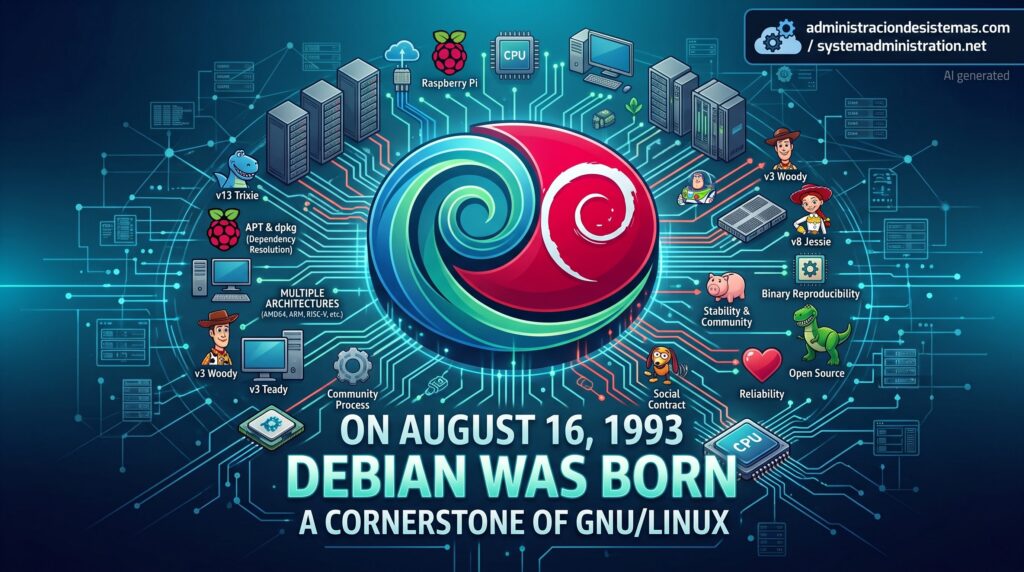
August 16 marked 33 years since the birth of Debian, one of the most influential GNU/Linux distributions in history and the foundation on which, directly or indirectly, a huge part of today’s Linux ecosystem has been built. More than three decades later, it remains a familiar presence for users, developers and, especially, system administrators.
The key facts about Debian’s 33 years in 20 seconds
- Ian Murdock announced Debian on August 16, 1993, on the comp.os.linux.development newsgroup.
- His message was titled “New release under development; suggestions requested”.
- From the beginning, Debian was conceived as an openly and collaboratively developed distribution.
- More than three decades later, it remains active and provides the foundation for well-known distributions such as Ubuntu, Linux Mint and Raspberry Pi OS.
Some dates only reveal their importance with the benefit of hindsight. August 16, 1993 probably looked like just another day in the early history of Linux. The kernel created by Linus Torvalds had only been around for a couple of years, and distributions were still figuring out how best to turn it, together with GNU software and other tools, into operating systems people could actually use.
That day Ian Murdock published a message whose consequences would still be felt decades later.
Its subject was simple: “New release under development; suggestions requested”. Murdock announced that he was working on a new Linux distribution and asked the community for suggestions.
That distribution would be called Debian.
A project that began by asking the community for help
The origin of the name is also part of Debian’s history. Debian was formed by combining Debra, the name of Ian Murdock’s then-partner, and Ian.
Much more important than the name, however, was the way Murdock wanted the distribution to be developed.
Linux was growing rapidly, although installing and maintaining a system was still a long way from today’s experience. Early distributions had begun solving part of the problem by bundling the kernel, GNU utilities and applications, but Murdock advocated an open development process in which anyone could participate.
The August 1993 announcement was only the beginning. A few months later, he published the Debian Manifesto, explaining in greater detail how the new distribution should be developed.
Debian would eventually become an international community project without a single company owning it. That model remains one of its defining characteristics 33 years later.
The project also developed elements that came to define its identity, including the Debian Social Contract and the Debian Free Software Guidelines (DFSG), which establish the principles Debian uses to determine what it considers free software.
Debian ended up in far more places than it might seem
Describing Debian simply as a Linux distribution understates its influence.
Debian became the technological foundation for a vast family of derivative distributions. The best-known is probably Ubuntu, launched by Canonical in 2004, which in turn became the basis for many other projects.
The family tree is enormous.
Ubuntu, Linux Mint, Kali Linux, Raspberry Pi OS, Tails, MX Linux and many other distributions have a direct or indirect relationship with Debian. Some use its packages and infrastructure closely, while others have built their own desktops, tools and release cycles on top of that foundation.
As a result, millions of systems are running software originating from the Debian ecosystem even when their users have never installed Debian itself.
For system administrators, the relationship is even more obvious.
apt, .deb packages, dpkg, repositories and Debian’s well-known focus on stability are part of the daily routine of countless servers.
A simple:
apt update && apt upgrade
is now an entirely ordinary operation. Behind it lies an infrastructure of packages, dependencies, repositories, maintainers and policies built over decades.
From early servers to cloud infrastructure and containers
Debian has also achieved something difficult in technology: it has changed enormously without becoming unrecognisable.
The hardware Linux ran on in 1993 has little in common with today’s infrastructure. Servers with hundreds of CPU cores, large-scale virtualisation, cloud computing, containers, Kubernetes, ARM architectures and globally distributed data centres have all arrived since then.
Debian has moved into these environments without abandoning its community-driven philosophy.
Today it can be found on physical servers, virtual machines, cloud images, containers, ARM devices, personal computers and a wide range of specialised systems.
For a SysAdmin, that continuity is particularly striking. Many professionals who started administering Debian twenty or even thirty years ago still encounter familiar concepts when logging into a modern server.
| Debian over 33 years | Why it matters |
|---|---|
| Project started in 1993 | It has survived several generations of technology |
.deb package management | Became one of Linux’s fundamental package formats |
| APT | Simplified software installation and updates for decades |
| Community development | Debian is not controlled by a single vendor |
| Foundation for many distributions | Its influence extends far beyond direct Debian installations |
| Broad architecture support | Debian runs on much more than conventional PCs |
| Focus on stability | Keeps it relevant for long-lived server deployments |
This also helps explain why Debian continues to have such a strong presence in infrastructure. It does not need to be the distribution announcing the largest number of new features every few months. A significant part of its user base is looking for almost the opposite: predictability, maintained packages and release cycles that make systems manageable over long periods.
That does not mean Debian has remained static. The project has continuously adapted to new kernels, architectures, init systems, firmware requirements, security challenges, virtualisation, cloud computing and new ways of distributing applications.
That ability to evolve is probably one of the reasons for its longevity.
Debian has changed when necessary, although not always quickly and rarely without extensive discussion within its community.
Debian Day: celebrating something that still works
August 16 is known within the community as Debian Day, commemorating Ian Murdock’s original 1993 announcement.
Looking back from 2026 makes its significance easier to appreciate.
Thirty-three years is an extraordinarily long time for any software project. Operating systems, companies, programming languages, platforms and technologies that seemed indispensable during the 1990s have disappeared or now survive only in niche roles.
Debian is still releasing new versions, maintaining packages and running real production infrastructure.
And that may be the best way to understand what happened on August 16, 1993. Ian Murdock did not simply announce another Linux distribution. He started a community and a way of building an operating system that has survived for more than three decades.
For several generations of system administrators, Debian is also something much more familiar: servers that have been running for years, SSH terminals, APT updates and the reassuring feeling of working with a system they know.
Happy 33rd anniversary, Debian. And happy Debian Day to all proud Debian users.
Frequently Asked Questions
When was Debian created?
Debian considers August 16, 1993 the beginning of the project, when Ian Murdock publicly announced that he was developing a new Linux distribution.
Who created Debian?
Debian was started by Ian Murdock, an American developer who envisioned it as an open distribution developed with community participation.
What does the name Debian mean?
The original name combines Debra and Ian, referring to Debra Lynn and Ian Murdock.
Which Linux distributions are based on Debian?
Debian has given rise to an extensive family of distributions. Some of the best known include Ubuntu, Raspberry Pi OS, Kali Linux and Tails, along with many distributions derived directly or indirectly from Ubuntu.