
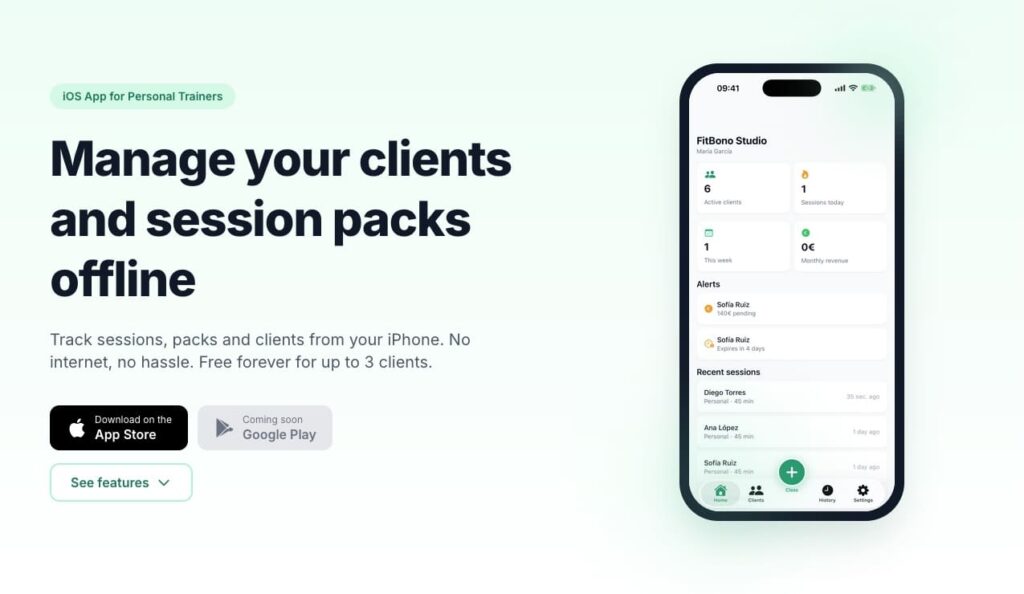
Not every useful app needs a flashy AI feature in the interface. Sometimes the real story is how the product was built. That is the case with FitBono, an iPhone app for personal trainers that was created with support from Claude Code and is already available as an offline-first tool for managing clients, session packs, and class records from a single device. According to FitBono’s official website, the app is designed specifically for personal trainers, works fully offline, and offers a free tier for up to three clients, plus a Pro tier with unlimited clients and iCloud backup.
That makes FitBono interesting for two reasons. The first is the product itself: it targets a very specific niche and tries to solve a real operational problem rather than chasing a generic “fitness app” label. The second is what it says about the current software cycle. Tools like Claude Code are increasingly being used not to build AI chatbots for consumers, but to accelerate the creation of focused, practical apps that can reach the App Store faster than before. Anthropic describes Claude Code as an agentic coding tool that can read a codebase, edit files, run commands, and integrate with development tools across the terminal, IDE, desktop app, and browser.
FitBono’s own feature set is straightforward and product-minded. The app’s website says users can manage client records, create session packs, register classes, capture digital signatures on the iPhone, store GPS location data for sessions, view dashboard statistics, export data in JSON, and use the interface in 39 languages. The company also says data stays on the device, with no external servers, no tracking, and no mandatory account creation. For a solo developer or a small product team, that kind of scope is exactly where AI-assisted coding tools can have a measurable impact: not by replacing engineering, but by reducing the time spent on repetitive UI scaffolding, model definitions, validation logic, refactoring, localization, and debugging.
Anthropic’s documentation does not promise that Claude Code can magically ship a complete app on its own, and that distinction matters. What it does claim is that the tool can help developers build features, fix bugs, automate development tasks, and work across multiple files and tools. In practical terms, that makes it well suited for a product like FitBono, where the architecture appears relatively lean and focused: a native iPhone utility, offline data handling, subscription logic, settings, and a set of tightly scoped workflows around trainers and clients.
There are no public figures from FitBono’s team detailing how many hours Claude Code saved during development, so any comparison has to be treated as an editorial estimate, not a reported company metric. Still, based on the app’s visible scope and on the workflows Claude Code is designed to support, it is reasonable to estimate that AI assistance could cut a meaningful portion of MVP development time for a small iOS project of this type.
| Development phase | Without AI support | Estimated time saved |
|---|---|---|
| App structure and navigation | 3–5 working days | 40–60% |
| Core screens and user flows | 5–7 working days | 35–50% |
| Data models, session packs, records | 4–6 working days | 30–45% |
| Validation, cleanup, bug fixing | 5–6 working days | 25–40% |
| Localization and final polish | 6–8 working days | 40–50% |
| Estimated MVP total | 23–32 working days | 35–55% |
The point of that table is not that AI writes production software alone. It does not. The value is that a developer can iterate faster, test ideas sooner, and move from concept to usable product with less friction. For small, niche apps, that can be the difference between shipping and stalling. It also changes the economics of experimentation: products that might once have been too small to justify the time can now become viable. That is especially relevant in the Apple ecosystem, where many successful apps are not giant platforms but tightly focused tools that solve one problem well.
FitBono fits that pattern neatly. Its free plan supports up to three clients, while the Pro plan costs €9.99 per year and adds unlimited clients plus iCloud backup. The roadmap on the official site also mentions upcoming calendar features and PDF or Excel exports, suggesting a product that is still early but already thinking in practical workflow terms. Whether FitBono itself becomes a breakout app is a separate question. What already matters is what it represents: a clear example of how AI-assisted development is helping small teams build useful iPhone apps faster, with narrower scope, lower overhead, and a much shorter path from idea to release.