
Anthropic’s Claude Code team has published how it reviews code now that Claude writes about 90% of the product’s own codebase: AI agents do most of the reading, and humans approve changes based on how risky each one is. The engineering post, by Addy Osmani, Morgan Westlee Lunt and Qing Wang, was published on 15 October. According to the team, the share of internal pull requests that get substantive review comments rose from 16% to 54% at the research-preview launch of Claude Code Review.
Claude Code’s review pipeline in 20 seconds
- Parallel agents hunt for bugs, and a separate set of verifier agents votes on every finding before it is posted.
- A classifier assigns zero, one or two human approvals based on the change’s risk.
- An agent’s approval never counts as a human one, and a person stays accountable for every change.
The driver is volume. Between June and September, merged pull requests to Claude Code more than doubled while the share that had to be reverted fell by more than 40%, according to the post. Across Anthropic’s monorepo, changes landing per day went from about 2,500 in May to more than 30,000 in September. The team frames its target as the minimum human review time that does not raise reverts or incidents, and treats those two numbers as guardrails: if they rise, human time has not been saved, only moved.
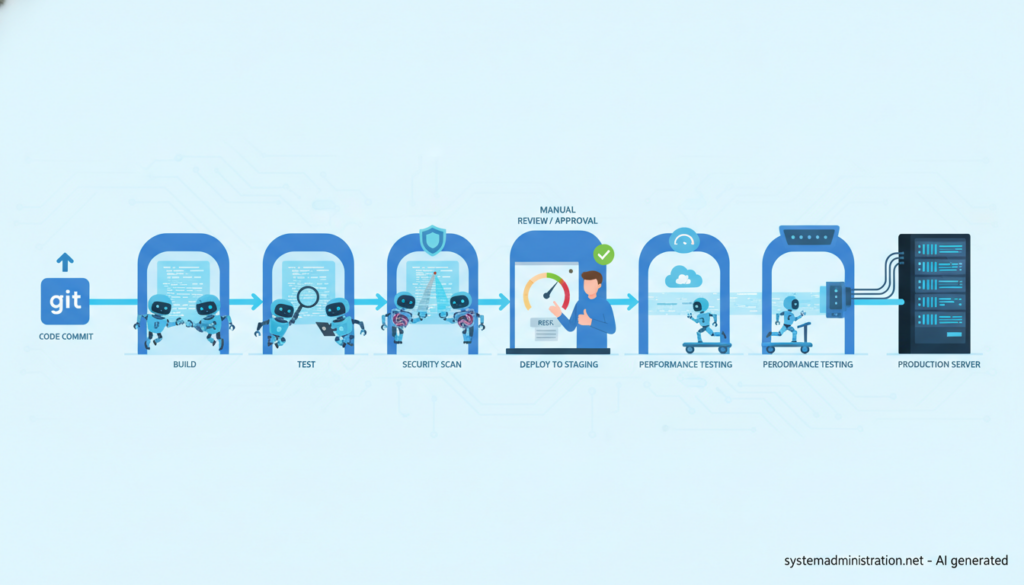
Seven layers between a commit and production
Verification starts before the pull request exists. Claude is expected to run tests, builds, linters or screenshot comparisons and show the output, and a subagent reviews the diff with fresh context. Boris Cherny, who created Claude Code, estimates in the post that giving Claude a way to check its own work makes results two to three times better.
Every pull request then goes through Claude Code Review, which reads the diff against the whole repository and the change’s stated intent. Several agents look for bugs in parallel, and a separate group of verifier agents votes on each finding; only findings enough of them agree on are posted. Style and cleanup-only comments are dropped, and the rest are tagged as Important, Nit or Pre-existing so inherited bugs are not blamed on the author. A separate security review can block the merge, followed by blocking CI (lint, type checks, tests on every platform, builds), a merge queue that re-runs checks against current main, feature flags with staff-first rollouts, a latest channel before stable, and flags that can be switched off without a deploy.
The part most relevant to anyone running a change-management process is risk-scaled approval. A classifier sets the tier based on the change, not the author. Docs, copy, internal-only features and additive changes behind a flag need no human approval once automated and security checks are green. Ordinary product changes and sensitive areas such as caching, the auto-updater or system prompts need one person, and the highest-risk paths need two. Approvals are bound to a specific commit, any CI workflow file always requires a human, only trusted authors get the lighter paths, and the person directing an agent-written pull request counts as a required reviewer.
What the numbers show, and what they leave out
The team also had to stop reviews from looping. On internal pull requests, the share passing after one review-and-fix round rose from 65% to 78%, those needing five or more rounds dropped from 8.9% to 1.5%, and the mean number of reviews to pass fell from 2.08 to 1.32. One CLI pull request went through more than fifty rounds overnight, with an agent writing and another reviewing, before its author stopped it. The reviewer now asks the author to reconsider the approach after three rounds, switches to diff-only re-reviews and does not repeat findings it has already posted. Every incident or revert becomes an evaluation case, and changes to the reviewer’s prompts, tools or model are kept only if they score higher.
All of these figures are Anthropic’s own, measured on its code, with no external verification. The post gives no false-positive rate, no total count of bugs caught and no review time saved in hours. The authors also list gaps: there are no circuit breakers yet that tighten approval when revert or incident rates move, and spotting a bad merge still depends on the author and on-call. Code Review is generally available on Team and Enterprise plans with Quick, Standard and Deep settings per repository, and a lighter /code-review command runs locally. Every review loads the repository’s CLAUDE.md plus a REVIEW.md written by code owners, so it is worth revisiting how CLAUDE.md hierarchy and rules work before rolling it out.
Frequently asked questions
Has Anthropic stopped human code review?
No. Machines do most of the reading, but medium- and high-risk changes need one or two human approvals, and a person remains accountable for every change that ships.
Which changes merge without a human approval?
Low-risk ones from trusted authors, such as docs, copy, internal-only features or additive changes behind a flag, once automated and security checks pass.
Who can use Claude Code Review?
It is generally available on Claude Team and Enterprise plans. A lighter /code-review command runs locally in Claude Code.
How do they keep agent reviews from looping forever?
After three rounds the reviewer asks the author to rethink the approach, later passes only review the new diff, and findings already posted are not repeated.
Sources: