
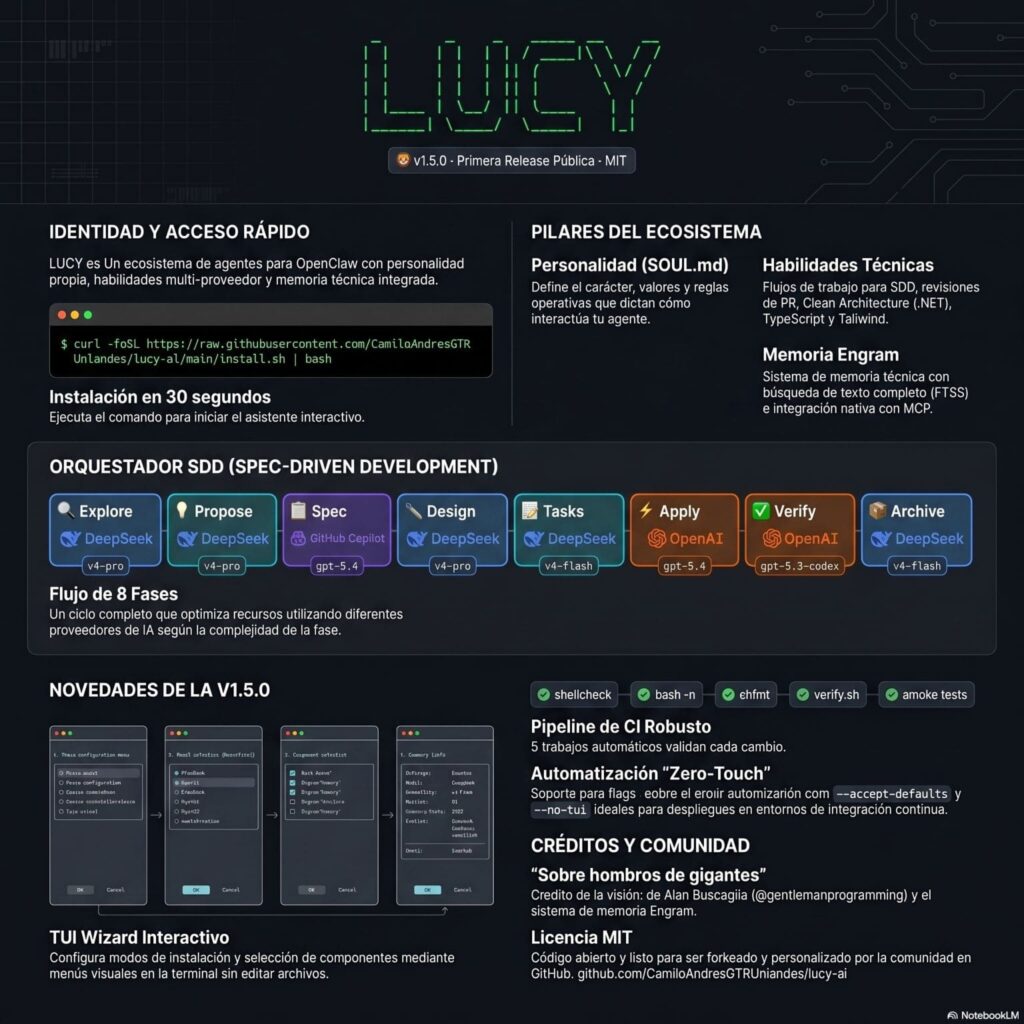
Lucy-agent is one of those small projects that explains quite well where AI-assisted development is heading. It is no longer just about calling a model through an API, sending a prompt, and waiting for an answer. The new layer of work is about creating agents with identity, memory, operating rules, technical skills, and an organized way to tackle complex tasks.
The project, published on GitHub by Camilo Andres GTR Uniandes, defines itself as “Lucy Under the Coding Yield”: an installable ecosystem for OpenClaw that adds personality, skills, conventions, and ready-to-use configuration. In practice, Lucy-agent works like an agent distribution: it installs on top of OpenClaw, adds workflow templates, integrates technical memory through Engram, and allows users to configure models and providers for different development phases.
The version currently shown in the repository is already v1.6.3, with major changes compared with the 1.5 branch: more technical skills, Docker support, an interactive TUI wizard, a GitHub Actions CI pipeline, and verification tests that the project presents as 60/60 checks passed. It is a fast evolution for a tool aimed at a very specific audience: developers who want to turn a general-purpose agent into a working colleague with a defined method.
From generic agent to development workflow with judgment
OpenClaw is a personal AI assistant that can run on user-controlled devices and connect to channels such as WhatsApp, Telegram, Slack, Discord, Google Chat, Signal, iMessage, Matrix, or Microsoft Teams, among others. Lucy-agent does not aim to replace it, but to give it a layer of configuration and skills designed for software development.
The differentiating point is its approach to SDD, Spec-Driven Development. Instead of asking a model to write code directly, Lucy organizes work into phases: explore, design, specify, apply, and verify. According to the project documentation, the SDD orchestrator can delegate those phases to different models or providers, with configuration handled during installation through a dialog-based TUI assistant.
This architecture reflects a trend already taking hold among advanced AI coding users: not every model is equally useful for every task. One model may be better for exploring a codebase, another for writing specifications, another for applying changes, and another for verification. Lucy-agent turns that idea into an installable configuration, without forcing users to build the whole system from scratch.
The installer offers several modes. Users can clone Lucy’s exact configuration with --clone, start from a generic template with --template, pin a specific version with --tag, avoid the TUI with --no-tui, or use --accept-defaults for automated CI/CD-friendly installations. It also includes options to skip Engram, skip ClawHub, skip workspace seeding, or preview changes with --dry-run.
That approach is useful because it brings agents closer to standard modern development practices: reproducible installation, controlled updates, post-install verification, clean uninstall, and versionable configuration. It is not just a collection of prompts. It is a packaged way of working.
Technical memory with Engram and specialized skills
One of the most interesting elements of Lucy-agent is its integration with Engram, the persistent memory system created within the Gentleman Programming environment. Engram is presented as a Go binary, agent-agnostic, using SQLite and FTS5 for full-text search and exposing interfaces through CLI, HTTP API, MCP server, and TUI. Its purpose is easy to explain: helping a programming agent avoid forgetting technical decisions when a session ends.
In real projects, that memory matters. An agent may solve a single task well, but if it does not remember conventions, architectural decisions, previous conflicts, or why a solution was rejected, it tends to repeat mistakes. Engram tries to cover that gap with local or cloud memory, conflict detection, and session tracking via MCP.
Lucy-agent includes that component as part of its installation, although users can skip it. It also bundles a collection of skills aimed at specific technologies. In v1.6.3, the README lists 13 skills: SDD Orchestrator, .NET 10/C# 14, several Angular 21 areas, TypeScript, Tailwind 4, OWASP Security, pull request review, skill creation, and PR generation with conventional commits.
That selection says a lot about its intended audience: teams or developers working with modern frontend and backend stacks, who need to review PRs, apply architecture standards, and control security risks. The OWASP Top 10 2025-based security skill, for example, fits a growing concern: if agents are going to write more code, they also need to help detect unsafe patterns from the beginning.
The project also installs ClawHub skills such as weather, browser-automation, and acp-router. They are not the core of the proposal, but they extend the agent’s capabilities beyond pure coding.
Advantages and cautions for technical teams
Lucy-agent has several clear strengths. The first is that it lowers the barrier to entry. Many developers already understand that they need instructions, memory, skills, and methodology to work well with AI, but setting all that up takes time. Lucy packages it into an installer that leaves a clear structure under ~/.openclaw/lucy-agent/.
The second is that it encourages auditability. The README itself stresses that it never includes secrets in the repository, excludes sensitive files such as .env, openclaw.json, or keys, and recommends reviewing the script before running it. This point should not be overlooked. Any curl | bash installation should be treated carefully, especially on work machines. The sensible approach is to read the installer, pin versions with --tag, test in isolated environments, and avoid running it with unnecessary privileges.
The third is that it fits a more mature way of using AI. The agent is not framed as just “write me code,” but as a colleague with personality, rules, and work phases. The SOUL.md, IDENTITY.md, and AGENTS.md files define character, values, and operating rules. It may sound anecdotal, but for an agent that repeatedly works on code, these instructions act as a minimum team culture.
There are also limits. Lucy-agent depends on OpenClaw and on the gateway being active. It requires model provider keys, at least DEEPSEEK_API_KEY according to the project documentation. And although it automates quite a lot, it does not remove the need to review what it produces. An agent system can make mistakes, misread an architecture, introduce technical debt, or apply changes that are too broad. The methodology helps, but human judgment is still necessary.
Lucy-agent is interesting precisely because it sits in that middle ground. It does not promise to replace the developer. It proposes giving the agent a way of working that is more similar to a technical member of the team: with memory, skills, review, phases, and reproducible installation. At a time when every vendor is launching its own agent, open projects like this can help teams keep control over their workflow.
Lucy’s evolution also shows something relevant: AI applied to development is moving from isolated prompts toward configurable systems. The value is no longer only in the model, but in how it is orchestrated, what memory it uses, what rules it follows, what tools it has, and how its output is verified.
Lucy-agent is not a tool for everyone. It is designed for technical users who already work with OpenClaw or want to experiment with local and configurable agents. But it points in an interesting direction: agents that do not just answer, but can be installed, updated, remember decisions, and work with an explicit methodology.
Frequently asked questions
What is Lucy-agent?
Lucy-agent is an installable configuration for OpenClaw that adds personality, technical skills, Engram memory, SDD orchestration, and installation, update, verification, and uninstall scripts.
Does it need OpenClaw to work?
Yes. The documentation states that OpenClaw must be installed and the gateway must be running before installing Lucy-agent.
What does Engram add to Lucy-agent?
Engram adds persistent technical memory for programming agents, using SQLite and FTS5, with support through MCP, CLI, HTTP API, and TUI.
Is it safe to install it with curl | bash?
It can be convenient, but it is advisable to review the script before running it, pin a specific version with --tag, and test it first in a controlled environment. The project states that it does not include secrets and excludes sensitive files.