
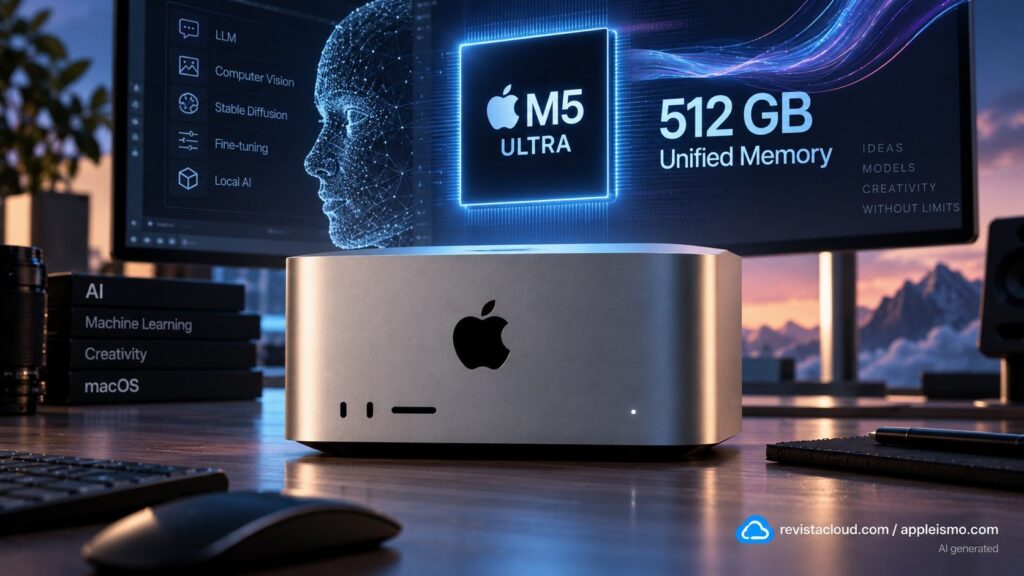
Changes to AI subscription limits have reopened a very practical question for developers: how much does it really cost to rely on cloud-based models versus running AI models locally? A Mac Studio M5 Max with 128 GB of unified memory can cost more than €5,000, but it can run large open models without paying for every session. On the other side are ChatGPT Pro, Codex, Claude Max and Claude Code, which provide access to more capable models without the upfront cost of dedicated hardware.
The key points about Mac Studio, ChatGPT and Claude for developers in 30 seconds
- A Mac Studio M5 Max with 128 GB and 1 TB costs around €5,399 in the reference configuration.
- Claude Max offers 5x and 20x tiers, both with access to Claude Code, while ChatGPT Pro has $100 and $200 tiers.
- A 128 GB Mac can run local models that do not fit into many conventional consumer-GPU systems.
- Local performance depends heavily on the model, quantization, context size and inference engine, so it does not automatically match a frontier commercial model.
- For developers, privacy and the ability to run agents without message quotas can justify the hardware even when cloud services remain cheaper on a pure cost-per-token basis.
The comparison is particularly relevant for developers who use coding assistants for several hours a day. In that situation, a usage allowance can become as important a limitation as the monthly price. But buying a computer that costs more than €5,000 simply because an AI service has reduced its limits is not a decision that should be made blindly.
The key is to separate three different needs: model quality, usage volume and control over data.
The 128 GB Mac Studio is the configuration that matters
For running local models, memory capacity is probably the most important specification of a Mac Studio.
A basic configuration with less memory can work perfectly well as a development machine, but it does not change the equation much if the goal is to run large models. The M5 Max becomes particularly interesting when combined with 128 GB of unified memory.
The reference configuration used in this analysis, with an M5 Max, 128 GB and 1 TB, costs approximately €5,399 in Spain.
That price makes the Mac a significant investment, but it also provides something that is difficult to reproduce with a conventional GPU setup: the CPU, GPU and accelerators can share the same system memory.
That makes it possible to load models requiring tens of gigabytes without needing a graphics card with all that capacity in VRAM.
A model such as Qwen 3.8 Flash-Next, included in the source material, requires approximately 96 to 114 GB of memory when used with 4-bit quantization. In that scenario, the M5 Max configuration with 128 GB leaves enough room to load the model and operate the system.
Memory also determines the context size an agent can use. A coding assistant working on a large repository can quickly consume tens of thousands of tokens through source files, instructions, tool results and previous conversation history.
For local development, therefore, 128 GB is not simply a larger number. It changes which models can be loaded and how much context can be maintained during a session.
Claude Code changes the equation
For a developer-focused comparison, the story should not stop at ChatGPT versus a Mac. Claude Code is a direct alternative because it is designed to work with repositories from the terminal.
Anthropic offers Claude Max in two main tiers: Max 5x for $100 per month and Max 20x for $200, with access to Claude Code. The difference is primarily the amount of usage available, rather than simply access to a different application.
That matters for a developer who uses agents for several hours. Claude Code can read a repository, modify files, execute commands and work iteratively on a task, so its consumption does not necessarily resemble that of a conventional chat session.
ChatGPT also has a development-focused alternative with Codex, integrated into its paid plans. The real comparison is therefore not:
Mac Studio versus ChatGPT.
It is closer to:
local model + your own tooling versus Claude Code or Codex + commercial models.
And that creates very different advantages and disadvantages.
A local model does not have to beat a frontier model
One of the most common mistakes when comparing local hardware with AI services is looking only at tokens per second.
A Mac Studio can generate text at a good speed with a quantized model, but that does not mean the model will solve programming tasks better.
The source material uses DeepSWE as a reference. In that comparison, Qwen 3.8 Flash-Next scores 58.7, compared with 66.6 for Luna, 68.8 for Sol and 74 for Astra.
That is a meaningful difference for certain programming workloads, although a benchmark never represents an entire developer workflow.
A local model can be good enough for:
- generating functions;
- writing tests;
- refactoring code;
- documenting classes;
- explaining errors;
- working with private repositories;
- running repetitive tasks.
But complex architecture work may benefit from a more capable commercial model.
That is why a hybrid strategy makes sense. A frontier model can handle design and review, while the local model handles part of the implementation.
47 tokens per second does not tell the whole story
The tests included in the source material put Qwen 3.8 Flash-Next at approximately 47 tokens per second on a programming task running on an M5 Max with 128 GB.
With speculative decoding, the figure rises to around 76 tokens per second.
Another test performed on a MacBook Pro with the same chip reached approximately 61 tokens per second with a 100,000-token context.
These figures should be treated as reference points rather than an official Mac Studio benchmark, because the source material itself notes that the tests were not specifically confirmed on that machine.
There is also another metric that matters for agents: the speed at which the input context is processed.
In the cited test, the M5 Max processes around 1,450 tokens per second with a 4,000-token input. For an agent that continuously reads files from a repository, this can be just as relevant as generation speed.
The problem is that a long session can contain tens of thousands of tokens. A fast model with a context window that is too small can ultimately be less practical than a slower model capable of maintaining the entire session.
How much does it cost to replace a subscription?
The simple calculation is to divide €5,399 by the monthly subscription price.
At €200 per month, the Mac is equivalent to around 27 months of subscription. At €100 per month, it is almost 54 months.
But that calculation is incomplete because the Mac can retain resale value.
If after three years the computer could be sold for 60% of its purchase price, for example, the depreciation would be around €2,160, equivalent to €60 per month over those 36 months.
At 70% residual value, depreciation would fall to around €45 per month.
These are scenarios, not a forecast of the second-hand market.
Electricity also needs to be included. A machine working for many hours will consume more than one sitting idle, but in this case energy is not the main component of the total cost. Most of the expense comes from the initial purchase and depreciation.
The economic argument for the Mac becomes stronger when it is used heavily and kept for several years.
Privacy and 24/7 agents are where the Mac wins
There are two situations where the comparison stops being purely financial.
The first is privacy.
A model running completely locally can work with code and data without sending them to an external provider. That does not mean every tool installed on the Mac is automatically private, because applications may still use external services, but it does allow developers to build a genuinely local inference workflow.
The second is continuous operation.
An agent running for hours can quickly consume the limits of a subscription. With a local model, the marginal cost of generating another few thousand tokens is primarily electricity.
That can be particularly interesting for personal servers, automation, development agents or internal tools that operate overnight.
For a developer who uses AI only for a few queries each day, that advantage is much less important.
ChatGPT Pro, Claude Max or Mac Studio?
The decision can be summarized practically:
| Option | Reference cost | Best suited for |
|---|---|---|
| ChatGPT Pro $100 | ~$100/month | Development and moderate intensive use |
| ChatGPT Pro $200 | ~$200/month | Very intensive use of OpenAI models |
| Claude Max 5x | ~$100/month | Claude Code and intensive development |
| Claude Max 20x | ~$200/month | Agents and intensive Claude Code use |
| Mac Studio M5 Max 128 GB | ~€5,399 | Large local models and privacy |
| Mac Studio M5 Ultra 256 GB | ~€10,999 | Larger local models |
Subscription prices are shown in dollars because that is the official reference for the plans. The final price in Spain depends on taxes, exchange rates and the purchase channel.
For a developer who already uses Claude Code heavily, Claude Max 20x is worth testing before investing €5,399 in hardware. For someone whose workflow depends on Codex and OpenAI models, the same logic applies to ChatGPT Pro.
The Mac Studio becomes difficult to replace when the main requirement is running models locally, keeping data inside the machine or having agents work without depending on a monthly usage limit.
The best purchase may be not buying anything yet
There is a simple test to run before spending thousands of euros.
For one month, a developer can use a smaller open model through an external provider and measure it against real project code. Qwen 27B, for example, can serve as a test. If it already handles a significant portion of everyday tasks, that is a reasonable signal that local hardware could be useful.
If the smaller model fails on precisely the important tasks, buying a Mac to run a larger model does not guarantee that the underlying problem will disappear.
For a professional developer, the question should not be whether a Mac Studio can run AI. It can.
The question is what percentage of the real workload it can handle well enough.
If that percentage is high, the hardware can eventually pay for itself. If the workflow depends on frontier models for architecture, complex debugging or advanced reasoning, Claude Code, Codex and comparable hosted services still have a clear advantage.
The 128 GB Mac Studio makes sense as a local AI machine. It does not make sense as an automatic replacement for every commercial model.
Frequently asked questions
How much does an M5 Max Mac Studio with 128 GB cost?
The configuration used as the reference is around €5,399 in Spain, with 128 GB of memory and 1 TB of storage.
Does Claude Max include Claude Code?
Yes. Claude Code is available with compatible paid plans, including Claude Max 5x and Max 20x.
Is Claude Code better than a local model?
Not in every situation. Claude Code provides access to more capable commercial models, while a local model gives developers greater control over their data and does not depend on a service usage allowance.
Is 128 GB worth it for local AI?
It can be, especially for large models. In the scenario analyzed, Qwen 3.8 Flash-Next requires approximately 96 to 114 GB at 4-bit quantization, making 128 GB a useful configuration for this class of model.