
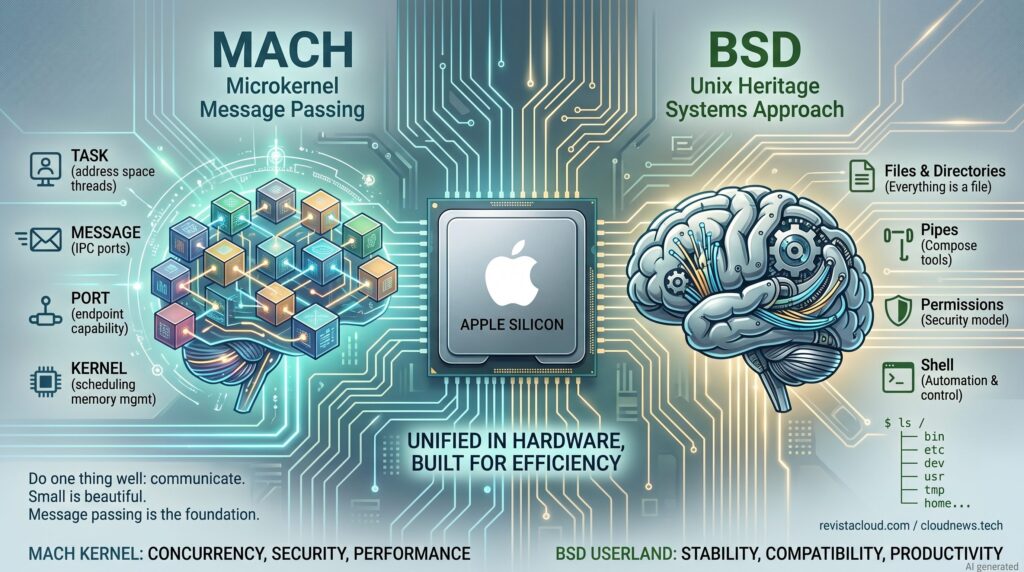
System administrators who work with both Linux servers and macOS workstations will find plenty of familiar concepts when opening Terminal: processes, signals, sockets, permissions, file descriptors, and POSIX system calls. Underneath that Unix interface, however, macOS runs XNU, a hybrid kernel that combines subsystems derived from Mach and BSD, alongside IOKit for much of its driver infrastructure. These are not two kernels running simultaneously, but components integrated into a single kernel and kernel address space.
XNU for developers and sysadmins in 30 seconds
- XNU is the kernel used by Darwin and, on top of it, macOS.
- It combines the Mach kernel with components derived from BSD and IOKit.
- Mach provides tasks, threads, virtual memory, and IPC through ports and messages.
- BSD supplies much of the Unix interface exposed to applications.
- Understanding both sides can help when debugging IPC, performance, processes, memory issues, and low-level macOS problems.
For everyday development, this architecture can remain almost completely invisible. An application calls read(), opens a socket, or creates processes using familiar Unix interfaces. Once troubleshooting moves down into XPC, Mach ports, virtual memory, scheduling, or kernel panics, concepts begin to appear that are quite different from those commonly encountered on Linux.
Apple also publishes the XNU source code. Its repository makes this architecture visible: osfmk contains Mach-based subsystems, while bsd contains BSD subsystems. IOKit, libsyscall, security components, and platform-specific code are also maintained as distinct parts of the kernel source tree.
XNU Is Not Two Kernels: Mach and BSD Are Integrated
The name XNU traditionally stands for X is Not Unix. Apple describes it as a hybrid kernel combining Mach, originally developed at Carnegie Mellon University, with components derived from BSD and a C++ driver API called IOKit.
The distinction between Mach and BSD still matters because each side contributes different abstractions.
Mach uses concepts such as tasks, threads, ports, and messages.
A task represents an execution environment that includes an address space and associated resources. Threads are the units that actually execute instructions within that context.
Communication between components can use Mach IPC (Inter-Process Communication), which is built around ports and messages.
This architecture remains visible in modern macOS interfaces. Developers are more likely to encounter XPC, the higher-level framework widely used for communication between processes and services, but underneath it sits infrastructure deeply connected to Darwin’s IPC architecture.
BSD provides the side that looks far more familiar to a Unix administrator.
This includes much of the POSIX process model, signals, sockets, the virtual filesystem, and the system calls applications use every day.
That is why code such as this looks completely normal on macOS:
int fd = open("/etc/hosts", O_RDONLY);
read(fd, buffer, sizeof(buffer));
close(fd);Code language: JavaScript (javascript)
The program interacts with familiar Unix interfaces.
It would be misleading, however, to imagine read() entering an independent BSD kernel that must then send a message to a separate Mach kernel.
BSD and Mach are both parts of XNU and share the kernel address space.
This design distinguishes XNU from a pure microkernel architecture, where some operating system services could run as separate user-space processes and communicate primarily through IPC.
Integrating them avoids some of the overhead that would come from repeatedly crossing those boundaries.
From an operations perspective, a useful way to think about XNU is as one kernel containing different families of subsystems and interfaces, rather than two operating systems running on top of each other.
What Changes When Debugging macOS After Working With Linux
The architectural differences become much more visible during troubleshooting.
On Linux, strace provides a straightforward way to observe system calls:
strace cat /etc/hostsOn macOS, dtruss, built on DTrace, has traditionally provided a comparable view:
sudo dtruss cat /etc/hostsA simplified trace might contain familiar operations:
open(...)
fstat64(...)
read(...)
close(...)
So far, the experience looks familiar to almost any Unix administrator.
The difference becomes more apparent when the activity being investigated extends beyond the POSIX surface.
XNU also exposes Mach traps, which provide operations associated with Mach infrastructure. The XNU source tree keeps these interfaces within osfmk, distinct from the BSD subsystems.
This helps explain why deeper macOS traces may contain references such as:
mach_msg
mach_msg2
task
thread
semaphore
rather than only Unix-style syscall names.
Their presence does not necessarily indicate a problem.
It simply means the administrator has moved below the POSIX abstraction and is now observing other internal components of XNU.
This distinction becomes particularly useful when working with XPC, sandboxed processes, extensions, profiling tools, or communication problems between services.
There is another caveat when following older macOS troubleshooting guides. Security restrictions introduced across successive macOS releases mean that historical DTrace commands do not necessarily work unchanged on every current Mac.
For application performance analysis, Apple increasingly directs developers toward Instruments and tooling integrated with Xcode. For kernel-level development and debugging, the XNU repository also documents workflows involving LLDB and development kernels.
Reading the XNU Source Tree Helps Explain the Architecture
One advantage for developers and administrators interested in operating system internals is that Apple publishes a substantial part of the XNU source code.
The repository structure itself provides a useful architectural map.
osfmk contains Mach-based subsystems.
bsd contains BSD subsystems.
libsyscall provides system-call library interfaces for user-space programs.
libkern contains code associated with the C++ library used by IOKit.
security contains interfaces and implementations related to Mandatory Access Control policies.
pexpert contains platform-specific code, including functionality associated with interrupts and other low-level operations.
This structure makes it possible to follow an operation from an interface exposed to user space into different internal subsystems without relying solely on historical diagrams of Mac OS X.
It also demonstrates why describing XNU simply as “BSD running on top of Mach” can be useful as an introduction but does not fully describe its implementation.
The components are much more tightly integrated.
That integration has practical consequences for process management.
From the BSD perspective, administrators can talk about a Unix process. From the Mach perspective, concepts such as tasks and threads appear. XNU maintains the relationship between these different representations as part of the same running system.
Memory provides another example.
A Unix application can use mmap() without knowing anything about the kernel’s internal architecture, while XNU relies on a virtual memory subsystem derived from Mach underneath.
That abstraction is intentional. Application developers should not normally need to understand these details.
When troubleshooting moves to a lower level, however, knowing they exist can prevent misinterpreting what diagnostic tools are showing.
When Does a Sysadmin Actually Need to Understand Mach?
For routine Mac administration, there is usually no need to work directly with Mach IPC.
Commands and tools such as:
ps
top
lsof
netstat
vm_stat
fs_usage
launchctl
can diagnose a large range of problems without going that deep.
Understanding XNU’s architecture starts becoming useful when troubleshooting communication between processes, memory consumption, thread behavior, services managed through launchd, sandboxing, or software that depends heavily on macOS-specific system interfaces.
It also helps when reading Apple’s technical documentation.
A Mach port, for example, should not be confused with a TCP or UDP port. It is an IPC object used to communicate through messages.
A Mach task is not exactly the same thing as a Unix process, although the two concepts are closely related within macOS.
A Mach thread represents an execution unit managed by the kernel.
These distinctions explain why Apple’s documentation and diagnostic tools can use terminology that feels unfamiliar even to administrators with years of Linux or BSD experience.
Kernel panics are another useful example.
When a stack trace mixes references to Mach, BSD, virtual memory, IOKit, and drivers, it is not necessarily showing several independent layers failing one after another. The trace is moving through different subsystems of the same XNU kernel.
For developers working exclusively with high-level frameworks, this distinction may continue to matter very little.
For engineers building system utilities, security software, virtualization products, extensions, or IPC-heavy applications, the architecture becomes much more relevant.
It also helps correct a common simplification: macOS does not run two kernels at the same time.
It runs XNU.
What makes XNU unusual is that the heritage of both Mach and BSD remains clearly visible. BSD provides much of the Unix environment developers encounter when they open Terminal, while Mach remains embedded in core abstractions involving execution, memory, and IPC.
After years of working only through POSIX interfaces, it can seem as though Mach has disappeared entirely. Looking one level deeper at a trace, a kernel panic, or the osfmk source tree shows that it remains part of the architecture behind every modern Mac.
Frequently Asked Questions
Does macOS use the FreeBSD kernel?
No. macOS uses Apple’s XNU kernel. XNU combines the Mach kernel with components derived from BSD, together with other subsystems such as IOKit.
Is XNU a microkernel?
XNU is generally described as a hybrid kernel. It retains mechanisms and concepts derived from Mach but integrates Mach and BSD functionality into the kernel address space instead of implementing a pure microkernel architecture with BSD services isolated in user space.
What is the difference between a Unix process and a Mach task?
A process belongs to the BSD/POSIX model normally exposed to applications. Mach uses a task to represent an execution environment including an address space and resources used by its threads. XNU integrates both models.
Why should a system administrator understand Mach?
It is unnecessary for most routine administration, but it becomes useful when troubleshooting IPC, XPC, memory or thread problems, low-level system software, and kernel panics involving both Mach and BSD components.