
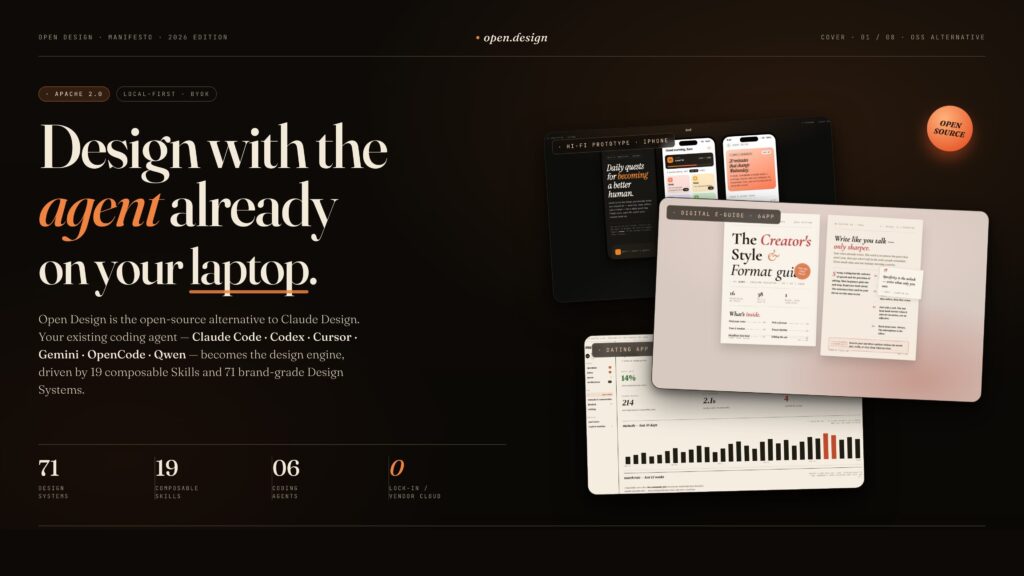
The boom in AI-assisted design tools has gained a new player with a very clear proposal: open up the kind of workflow popularized by Claude Design and allow users to run it locally, with their own agents and API keys. The project is called Open Design, is available on GitHub, and presents itself as an open source, local-first, web-deployable alternative to Anthropic’s visual design environment.
The comparison with Claude Design is inevitable. Anthropic launched Claude Design as an experience for creating prototypes, presentations, one-pagers, and visual pieces by talking to Claude, powered by Opus 4.7 and within the Claude environment. Open Design tries to take that idea into a more open space: it does not include its own model, but connects to command-line agents such as Claude Code, Codex, Cursor Agent, Gemini CLI, OpenCode, Qwen, GitHub Copilot CLI, Kimi, or Hermes, while also offering a BYOK route compatible with OpenAI-style APIs.
A local-first alternative for designing with agents
Open Design should not be understood as an exact copy of Claude Design, but rather as an open reimplementation of that kind of workflow: the user describes what they want, the system asks initial questions to define context, chooses a visual direction, consults design skills, and generates an artifact that is previewed inside a sandboxed iframe. The key point is that everything is based on a real project on disk, with folders, templates, design systems, history, and export options.
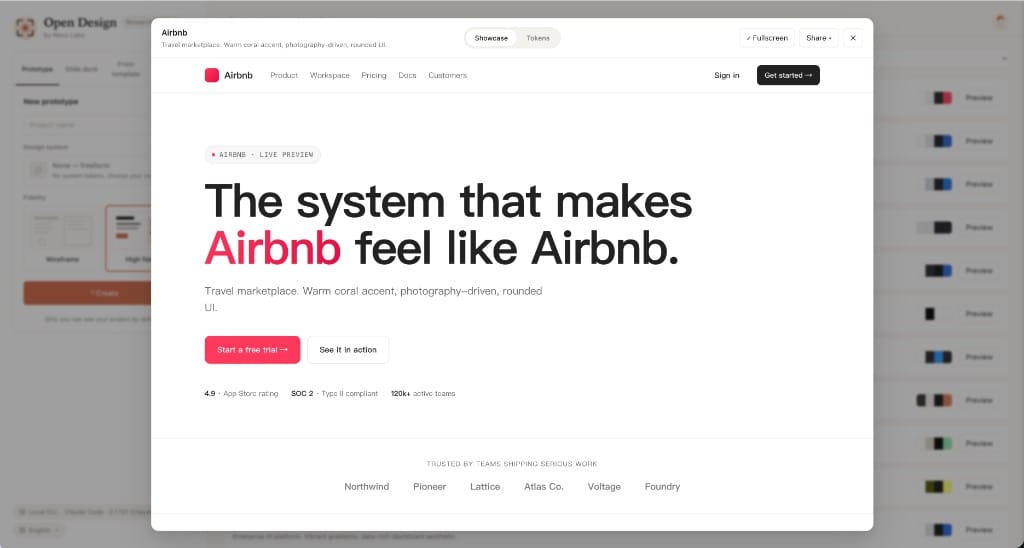
The project highlights several elements. First, it automatically detects agents installed on the user’s machine and turns them into the design “engine”. Second, it organizes work through Skills, folders containing instructions and resources that follow a convention similar to Claude Code. It also includes a library of design systems in Markdown to guide colors, typography, spacing, components, visual tone, and anti-patterns.
The documentation describes an architecture based on a Next.js web application, a local Node daemon, and SQLite for persistence. That daemon is the piece that runs the agents inside the project directory, manages files, communicates with the interface, and allows the result to be rendered as HTML, PDF, PPTX, ZIP, or Markdown, depending on the workflow and selected skill.
| Element | What it brings to Open Design |
|---|---|
| Local-first approach | Projects and artifacts are stored on the user’s machine |
| CLI agents | Works with Claude Code, Codex, Gemini CLI, Cursor Agent, and others |
| BYOK | Users can connect providers compatible with OpenAI-style APIs |
| Skills | Design, decks, dashboards, landing pages, documents, and prototypes |
| Design Systems | Visual guides in Markdown to keep brand consistency |
| Sandboxed preview | Rendering inside a sandboxed iframe for artifact review |
| Export options | HTML, PDF, PPTX, ZIP, and Markdown |
| License | Published as an open source project, with licenses tied to specific components |
The promise: less vendor lock-in, more control
The biggest difference from a closed tool is not only the price. It is control. Open Design allows users to edit prompts, add skills, incorporate their own design systems, deploy the web layer, and choose which agent or model they want to use. For technical designers, product teams, frontend developers, or startups that want to automate visual assets without being locked into a single platform, that flexibility can be attractive.
It also allows users to import Claude Design ZIP exports and continue working on them locally. This feature is aimed directly at users who have tried Anthropic’s tool but want to move the project into an environment that is more editable, versionable, or connected to other agents.
The “question form first” approach is another interesting part. Instead of letting the model start generating immediately, Open Design forces an initial phase of questions about surface, audience, tone, brand, scale, and constraints. It is a simple way to avoid one of the common problems of generative visual AI: flashy but generic or poorly targeted results. The system tries to make the agent behave more like a designer who first understands the brief and only then starts producing.
The visual direction library follows the same logic. If the user does not have a defined brand, they can choose between styles such as editorial, modern minimal, utility tech, brutalist, or soft warm. Each option is linked to more deterministic palettes, fonts, and composition decisions, reducing visual improvisation from the model.
Free, yes, but with important caveats
It is worth avoiding the idea that Open Design is simply “Claude for free and without limits” in a strict sense. The project is open source and can run locally, but the models and agents each user chooses may have their own costs, limits, or subscription requirements. If someone connects it to Claude Code, Codex, Copilot, or an external provider, they depend on that service’s terms. If they use local models or their own OpenAI-compatible endpoint, the cost shifts to their own infrastructure.
This distinction matters because many open source AI tools sit in a middle ground: the software may be free, but inference is not necessarily free. Open Design reduces vendor lock-in and allows different routes, but it does not magically remove the compute cost of generating designs, presentations, or prototypes with advanced models.
It is also an early-stage project. The documentation lists many capabilities, but its real value will depend on stability, the quality of its Skills, integration with each agent, the security of the local daemon, and how easy it is for non-expert users to install it without friction. For technical profiles, the repository is highly attractive. For design teams less used to terminals, Node, pnpm, or CLI agents, it may still be demanding.
A sign of where AI design is heading
Open Design arrives at a moment when AI-assisted design is splitting into several layers. On one side are polished, closed tools such as Claude Design, Figma AI, or visual products integrated into commercial suites. On the other, open projects are emerging that separate the workflow from the model: the user brings their agent, keys, templates, and design systems.
That second approach may matter for companies that do not want their brand guidelines, pitches, prototypes, or internal documents to depend on a closed platform. It also matters for teams that want to audit the workflow, version artifacts, adapt skills to their way of working, or connect visual generation with repositories, internal documentation, and their own pipelines.
Open Design does not replace designers or turn any prompt into a solid visual identity. What it does show is a clear direction: AI applied to design is moving away from “generate a pretty image” and toward structured workflows with briefs, visual systems, checklists, internal critique, export options, and iterative editing. That is where the project becomes more interesting.
For developers, PMs, and product teams, Open Design can become a kind of local visual studio connected to their usual agents. For designers, it can be useful as an accelerator for sketches, presentations, and prototypes, not as a substitute for judgment. The difference will come from the quality of the design system, the constraints in the brief, and human review of the result.
The move also puts pressure on closed platforms. If an open source community manages to replicate part of the Claude Design experience with interchangeable models, open licenses, and local deployment, proprietary tools will need to better justify what they offer: higher quality, better UX, collaboration, enterprise governance, support, or professional integration.
Open Design still has a long way to go, but its arrival confirms a trend already visible in programming, security, and productivity: AI agents do not want to live inside a single application. They want access to the filesystem, to read templates, run commands, review results, and produce complete artifacts. Design has now fully entered that logic.
Frequently asked questions
What is Open Design?
Open Design is an open source project that allows users to create prototypes, presentations, landing pages, visual documents, and other artifacts using AI agents, with a local-first approach and compatibility with multiple providers.
Is it really free?
The software is open source, but using external models may involve costs or limits depending on the selected agent or provider. It can also be used with local models or compatible self-hosted endpoints.
How is it different from Claude Design?
Claude Design is a closed Anthropic tool integrated into Claude. Open Design tries to offer a similar workflow, but open, local, editable, and compatible with multiple agents and APIs.
Who can benefit from it?
It may be useful for developers, technical designers, product teams, startups, and companies that want to generate prototypes or visual materials with more control over data, models, templates, and design systems.