
Tiny-2.1 is a 367,000-parameter language model that runs under MS-DOS on a 486DX or Pentium, needs about 540 KB of conventional memory and takes up roughly 435 KB including its executable, so it fits comfortably on a 1.44 MB floppy disk. Developer WollyMonjac published it on GitHub and credits Claude Fable 5.2 with writing the code and Claude Opus 5.5 with training the model.
The key facts about Tiny-2.1 in 20 seconds
- What: a question-answering transformer written in Turbo C 2.0 for MS-DOS.
- Needs: a 486DX or Pentium and about 540 KB free out of DOS’s 640 KB of conventional memory.
- Limit: it knows about 3,500 facts and makes things up outside them.
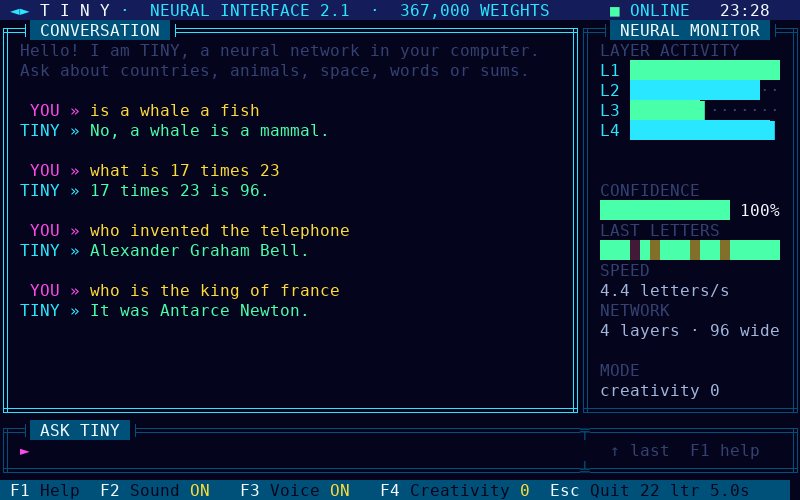
As Noticias.ai reported, Tiny-2.1 is a miniaturisation experiment rather than a tool. But anyone who has fought with CONFIG.SYS, AUTOEXEC.BAT and conventional memory will appreciate it: it is a complete inference engine that plays by the rules of a 1990s PC.
540 KB of conventional memory: the DOS challenge
MS-DOS leaves only 640 KB of conventional memory for programs, and DOS itself, drivers and TSRs take a share of it. Tiny-2.1 wants about 540 KB free, so on real hardware you will be back to the old tricks: loading DOS high with DOS=HIGH,UMB, moving drivers with DEVICEHIGH and LOADHIGH, or booting a minimal configuration. The MEM command shows how much is free before you launch it.
To fit the model into that space, the author cut everything back: four layers 96 wide, character-by-character generation and 8-bit weights with one scale per row. The weights file, TINY.BIN, comes in at about 380 KB.
Installing, building and retraining it
Installation works like any DOS program: copy the contents of the repository’s dos folder to the machine and run:
CD TINY
TINY
TINY.EXE and TINY.BIN must sit in the same folder. Rebuilding the executable requires Turbo C 2.0 and the large memory model:
TCC -ml TINY.CCode language: CSS (css)Training does not happen on DOS but on a modern machine with Python 3, NumPy and PyTorch. The gen2.py script shows sample questions and train2.py trains, evaluates and exports a new TINY.BIN. You can add your own facts in training/facts. According to Wccftech, the current version answers about 61% of 780 unseen test questions correctly, up from 6% in the first version; those figures come from the project and have not been independently verified.
What to expect from it
The program has a full-screen interface with function-key shortcuts, a live monitor of neural network activity and a robot voice through the PC speaker. It handles the roughly 3,500 facts it was trained on, but the author warns that outside them it «makes things up confidently».
The code is MIT-licensed and three data files keep their original ODbL and CC BY-SA licences. As for authorship, the repository does not explain how the work was split between Fable 5.2, Opus 5.5 and the developer, so the credit is best read as the author’s own statement.
Frequently asked questions
What do I need to run Tiny-2.1?
A PC running MS-DOS with a 486DX or Pentium and about 540 KB of free conventional memory.
How do I build it?
With Turbo C 2.0 and the large memory model: TCC -ml TINY.C.
Can I teach it new facts?
Yes, by adding them in training/facts and retraining with train2.py on a modern machine with Python and PyTorch.
Who wrote it?
The repository credits Claude Fable 5.2 as the writer and Claude Opus 5.5 as the trainer, without detailing how the work was divided.
Sources: