
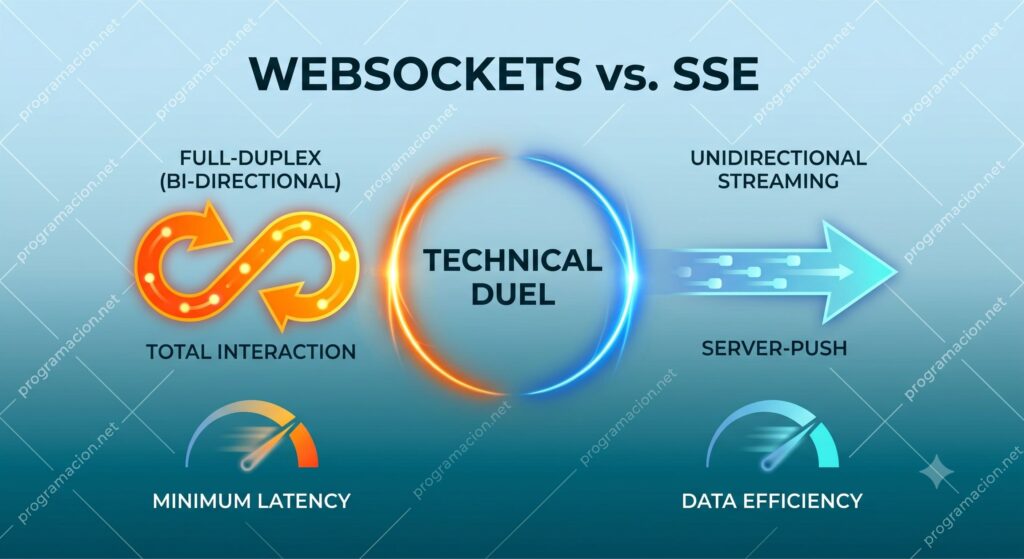
For years, WebSockets has been the automatic answer to almost any real-time requirement. A dashboard with live prices, notifications, logs, inventory, alerts, order status or AI responses appearing word by word often leads to the same decision: open a WebSocket and keep it alive. It feels like the serious option, the modern one, the one any technical team would choose without much debate.
But that decision is not always the best one. Server-Sent Events, or SSE, remains a very useful alternative when data flows in only one direction: from the server to the client. It works over HTTP, is natively supported by browsers, enables automatic reconnection with EventSource, and avoids part of the operational complexity that appears when WebSockets are deployed at scale.
The debate has resurfaced because some teams have measured meaningful memory differences when scaling to tens or hundreds of thousands of connections. In certain scenarios, SSE can use fewer resources and simplify infrastructure. But other benchmarks show the opposite: WebSockets can behave better in memory and performance, even in one-way communication, depending on the framework, server, message size, sending frequency and specific implementation.
The useful conclusion is not that SSE always wins, nor that WebSockets is the correct default. The conclusion is more uncomfortable: the choice should be based on communication pattern, infrastructure and real testing, not habit.
Two similar technologies for different problems
WebSockets creates a persistent bidirectional connection between client and server. Once established, both sides can send and receive messages at any time. It is ideal for chats, collaborative editors, multiplayer games, systems with frequent events in both directions, interactive trading tools or applications where the client needs to send constant signals to the server.
SSE keeps an HTTP connection open through which the server sends events to the client. The client listens. There is no bidirectional communication over the same channel. If the user needs to send something, the usual pattern is to do it through a regular HTTP request, such as a POST, and leave the SSE stream for the response or updates.
That pattern fits very well with AI model responses, dashboards, feeds, deployment logs, progress bars, metrics, alerts or passive notifications. In those cases, the client does not need to talk all the time. It only needs to receive.
| Use case | Most natural option |
|---|---|
| Chat with messages in both directions | WebSockets |
| Collaborative editor | WebSockets |
| Multiplayer game | WebSockets |
| Metrics dashboard | SSE or WebSockets |
| Token-by-token AI response | SSE |
| Deployment logs | SSE |
| Passive notifications | SSE |
| Frequent binary data | WebSockets |
| Market feed with heavy interaction | Depends on frequency and load |
The architectural difference matters because it eventually affects memory, load balancers, proxies, reconnection, authentication, observability and cost.
SSE wins when the server speaks and the client listens
SSE has a very clear strength: simplicity. In its basic form, the server only needs to return an HTTP response with Content-Type: text/event-stream and write events as they occur. The browser can receive them with EventSource, reconnect if the connection drops and manage event identifiers if the server implements resume support.
This design reduces code and removes decisions that tend to appear quickly with WebSockets: reconnection, backoff, heartbeat, session state, channel management, proxy compatibility and additional libraries. In many products, all that complexity is added before the team has proven it was actually needed.
Generative AI responses are a clear example. The user sends a prompt through a normal request and the server streams tokens back. There is no need to maintain a full bidirectional channel for every conversation if the main pattern is “the user asks, the server generates and the client renders”.
SSE also integrates better with much of the existing HTTP infrastructure. Headers, cookies, monitoring, traces, load balancers and observability tools understand HTTP. Even so, “it is HTTP” does not mean “it works without touching anything”. Nginx can buffer events, some load balancers are not well prepared for long-lived connections and certain blocking frameworks can exhaust threads if each open connection consumes a worker.
| SSE advantage | Practical implication |
| Works over HTTP | Less friction with existing infrastructure |
Native EventSource API | Very fast browser implementation |
| Automatic reconnection | Less client-side code |
| Suitable for server-to-client | Perfect for passive streaming |
| Simple model | Less state to maintain |
SSE is not a minor technology. It is a tool many teams forget because WebSockets became synonymous with “real-time”.
WebSockets wins when there is real back-and-forth
WebSockets remains essential when the application needs frequent communication in both directions. A chat with typing indicators, a collaborative editor, a game session, an interactive trading tool or a remote-control system does not fit well with SSE. Forcing SSE into those cases usually ends in a mix of a stream for receiving and parallel requests for sending, with more complexity than necessary.
WebSockets can also have a performance advantage when using highly optimised implementations. It has its own framing and can handle binary data better. In workloads with small, frequent messages, some tests show lower memory usage compared with SSE. If specialised servers such as uWebSockets.js or highly tuned implementations in Go, Rust or C++ are used, the ceiling for concurrent connections can be higher.
The problem appears when WebSockets is chosen for a case that does not need it. Then the team takes on persistent state, manual reconnection, backpressure, heartbeat, horizontal scaling and infrastructure configuration without getting a clear benefit. It is like building a motorway to move a one-way conveyor belt.
Performance depends too much on context
Headlines such as “SSE uses 40% less memory” or “WebSockets always performs better” should be read carefully. Both can be true in different scenarios.
In a test with 100,000 connections where the server only pushes infrequent updates, SSE can be more efficient if the HTTP implementation is lightweight and the framework handles long-lived connections well. In another environment, with Socket.IO, NestJS, Kubernetes, HTTP/2, small or large payloads and controlled tests, WebSockets can use less memory and perform better, even when used only for server-to-client delivery.
The difference is not only the protocol. It is everything around it: runtime, library, proxy, kernel, TLS, HTTP/1.1 or HTTP/2, message size, frequency, serialisation, buffer management, heartbeats, reconnection, garbage collection, container limits and observability.
| Variable | Why it changes the result |
| Message frequency | One event per second is not the same as hundreds per minute |
| Payload size | 100 bytes and 50 KB create different pressures |
| Framework | Node, Go, Java, Python or PHP handle connections differently |
| Library | Socket.IO is not the same as pure WebSocket |
| Proxy | Nginx or load balancers can buffer or cut connections |
| HTTP/2 | Multiplexes streams, but may introduce specific behaviour |
| Authentication | Cookies, headers and tokens change the implementation |
| Reconnection | Can create storms if not controlled properly |
That is why the healthiest recommendation is to measure with the expected load. Not with a demo. Not with a generic table. With the real pattern of the application.
The EventSource problem: convenient, but limited
The native EventSource API is very convenient, but it has well-known limitations. It does not allow custom headers, does not support POST, offers limited error handling and forces developers to work with GET. For many internal applications it may be enough, especially when HttpOnly cookies are used for authentication. For APIs with bearer tokens, non-browser clients or more complex flows, it can fall short.
A more modern alternative is to use fetch with streams and parse the text/event-stream format with a library such as eventsource-parser. This restores control over headers, method, errors and credentials. In exchange, the team must implement reconnection, backoff, cleanup, Last-Event-ID handling and failure management.
| Approach | Advantage | Cost |
Native EventSource | Very simple and reconnects automatically | No custom headers or POST |
SSE with fetch streams | Full control over request and errors | Reconnection must be implemented |
| Pure WebSocket | Bidirectional and flexible | More state management |
| Socket.IO | Reconnection and abstraction included | More dependency and overhead |
In production, the initial simplicity of SSE often has to be completed with details tutorials do not explain: heartbeats, timeouts, buffering disabled, connection limits and a resume strategy.
Practical rules for choosing
The first rule is to start with the direction of the flow. If the server emits and the client listens, SSE deserves to be considered. If client and server talk constantly, WebSockets will be more natural.
The second is to look at frequency. For occasional events, dashboards, notifications and text streaming, SSE is often enough. For very frequent, low-latency interaction in both directions, WebSockets makes more sense.
The third is to review the infrastructure. In Nginx, for example, buffering must be disabled so SSE events do not accumulate and arrive late. Timeouts and heartbeat messages should also be configured. In serverless environments or with managed load balancers, long-lived connections may have limits that change the decision.
The fourth is not to ignore the framework. A server that assigns one thread per connection can suffer with both SSE and WebSockets. Node.js, Go or properly configured async servers usually handle this pattern better. But if part of the handler performs synchronous I/O, the result can degrade just the same.
Less dogma, more testing
The common mistake is not choosing WebSockets. WebSockets is a great technology. The mistake is choosing it before understanding the problem. It would also be a mistake to choose SSE because of an opposite trend, assuming it will always be cheaper or lighter.
For an AI product with token streaming, SSE fits very well. For a dashboard with passive updates every second, too. For a collaborative app, it does not. For a platform with 100,000 connections, the debate cannot be settled with theory: users, payloads, frequency, reconnections, peaks and network failures must be simulated.
The right architecture is not the most popular one. It is the one that does the job with the least complexity and an acceptable cost. Sometimes that will be Content-Type: text/event-stream and a res.write(). Other times it will be WebSockets with an optimised server, well-solved backpressure and a scaling layer designed from the start.
The lesson is simple: real-time is not a technology. It is a requirement. And like any serious requirement, it must be measured before committing to a solution.
Frequently asked questions
Can SSE replace WebSockets?
Only in one-way cases where the server sends data and the client listens. For frequent bidirectional communication, WebSockets remains the natural option.
Does SSE use less memory than WebSockets?
It depends on the implementation, load, framework and message pattern. Some teams have seen lower usage with SSE at scale, while other benchmarks show better WebSocket behaviour.
Why is SSE used for streaming AI responses?
Because the user sends a request and the server progressively returns tokens. That pattern is mainly server-to-client, so SSE fits well.
What needs to be configured to use SSE in production?
Buffering should be disabled in proxies such as Nginx, timeouts should be adjusted, heartbeats added, authentication reviewed, reconnection controlled and the framework checked to ensure it supports long-lived connections without blocking resources.