
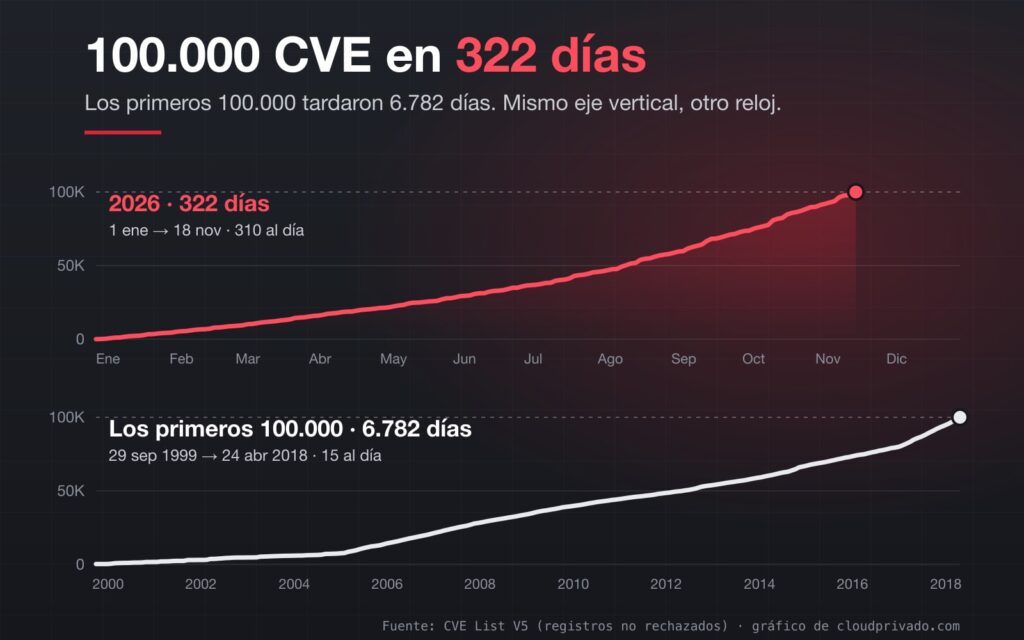
By 21 November, 102,291 CVE vulnerabilities had been published in 2026, more than double the whole of 2025, and November is running at around 593 a day. Yet only 226 of them appear in the Known Exploited Vulnerabilities (KEV) catalog maintained by CISA, the US cybersecurity agency. The figures come from an analysis by Cloud Privado (cloudprivado.com), and the practical lesson for system administrators is clear: stop reading advisories one by one and filter by real exploitation and exposure.
The key points of 2026’s 100,000 CVEs in 30 seconds
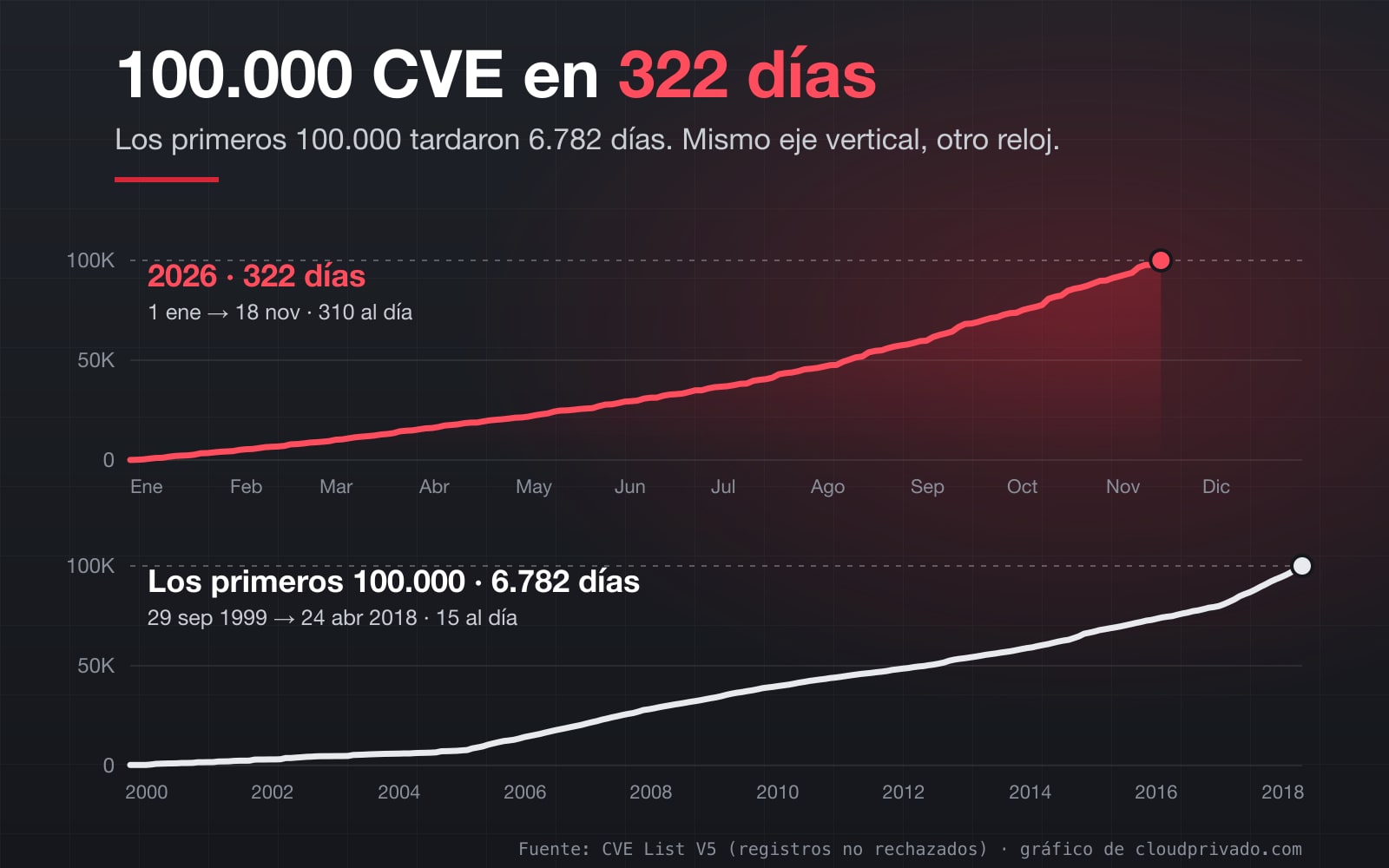
- 2026 reached 100,000 CVEs in 322 days; the first 100,000 in history took 6,782 days, from 1999 to 2018.
- Of 102,291 CVEs published this year, 226 are listed in CISA’s KEV catalog of exploited vulnerabilities.
- 114 of those exploited CVEs score below 9 on CVSS, so severity alone is a poor filter.
- Both KEV and EPSS are free and can be queried from the command line to build a manageable patch queue.
The analysis, also covered by Spanish security outlet OpenSecurity, counts only records published in the official CVE Program list and cross-references them with KEV, FIRST’s EPSS scores and public exploits from Exploit-DB and GitHub. Its author estimates that, at roughly 549 CVEs a day over the last month, reading each one for five minutes would keep about ten people busy full time.
What actually lands on a sysadmin’s desk
Much of the growth comes from a handful of issuers. The Linux kernel has published 8,777 CVEs this year, up from 5,674 in 2025, and more than 5,500 have no CVSS score: the kernel team assigns identifiers to fixes with possible security impact without rating each one. Only four are in KEV. For anyone running Linux servers, the sensible approach is to follow stable branches or the distribution’s kernels rather than triage each identifier.
GitHub (13,415) and VulnCheck (11,346) top the list of issuers, and the WordPress ecosystem adds 12,255 CVEs across Patchstack, Wordfence and WPScan, almost all for plugins, with just three in KEV. They matter if the plugin is installed and reachable; otherwise they are noise.
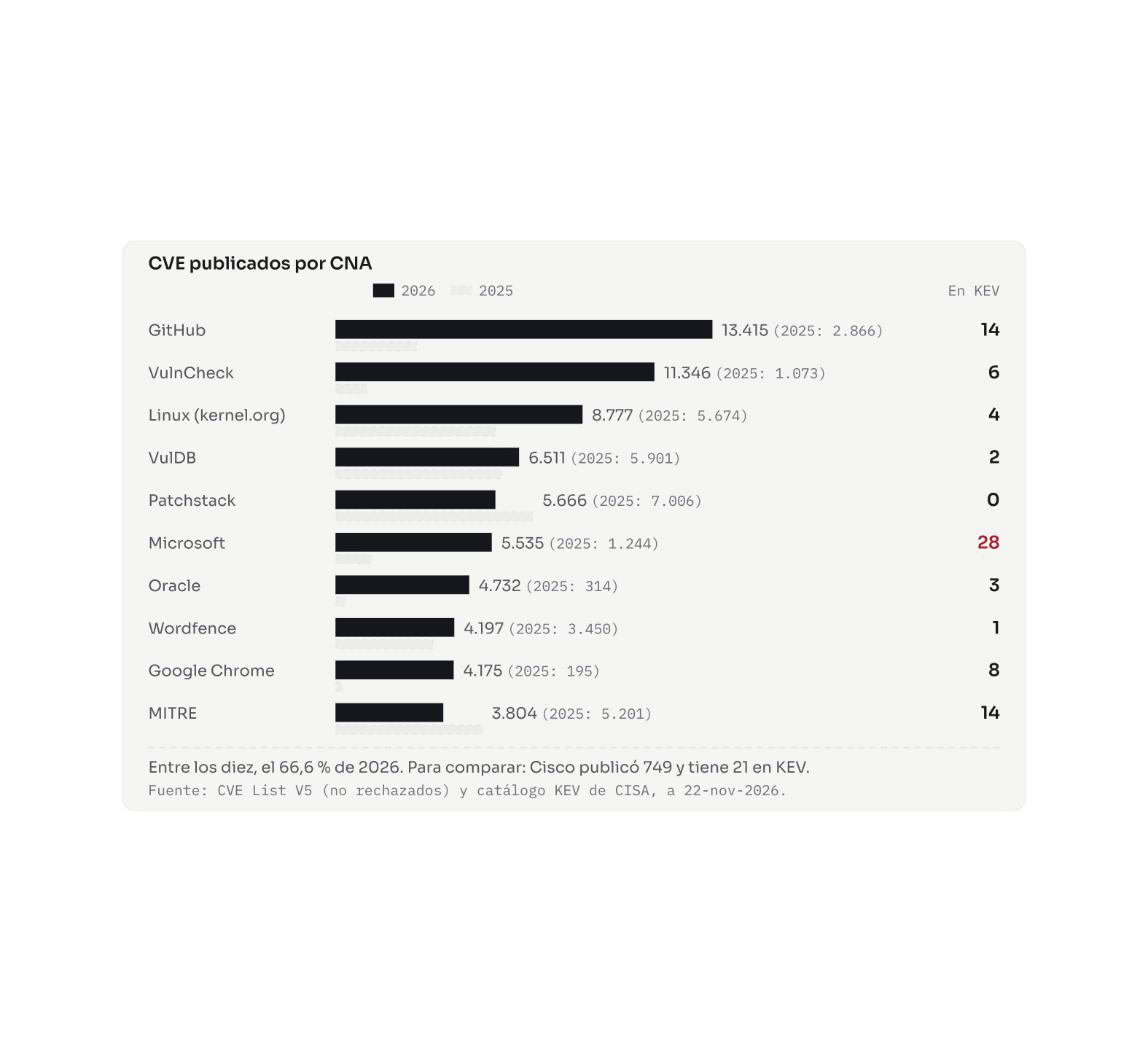
Risk concentrates at the perimeter. The vendors with the most 2026 CVEs in KEV are Microsoft (28), Cisco (20), Google (11), Fortinet (9) and Ivanti (7), followed by Adobe, Check Point and SonicWall, then VMware and NetScaler: firewalls, VPNs, gateways and hypervisors, most of them internet-facing. The median time from publication to KEV is five days, and 57 were exploited on the day of publication or earlier.
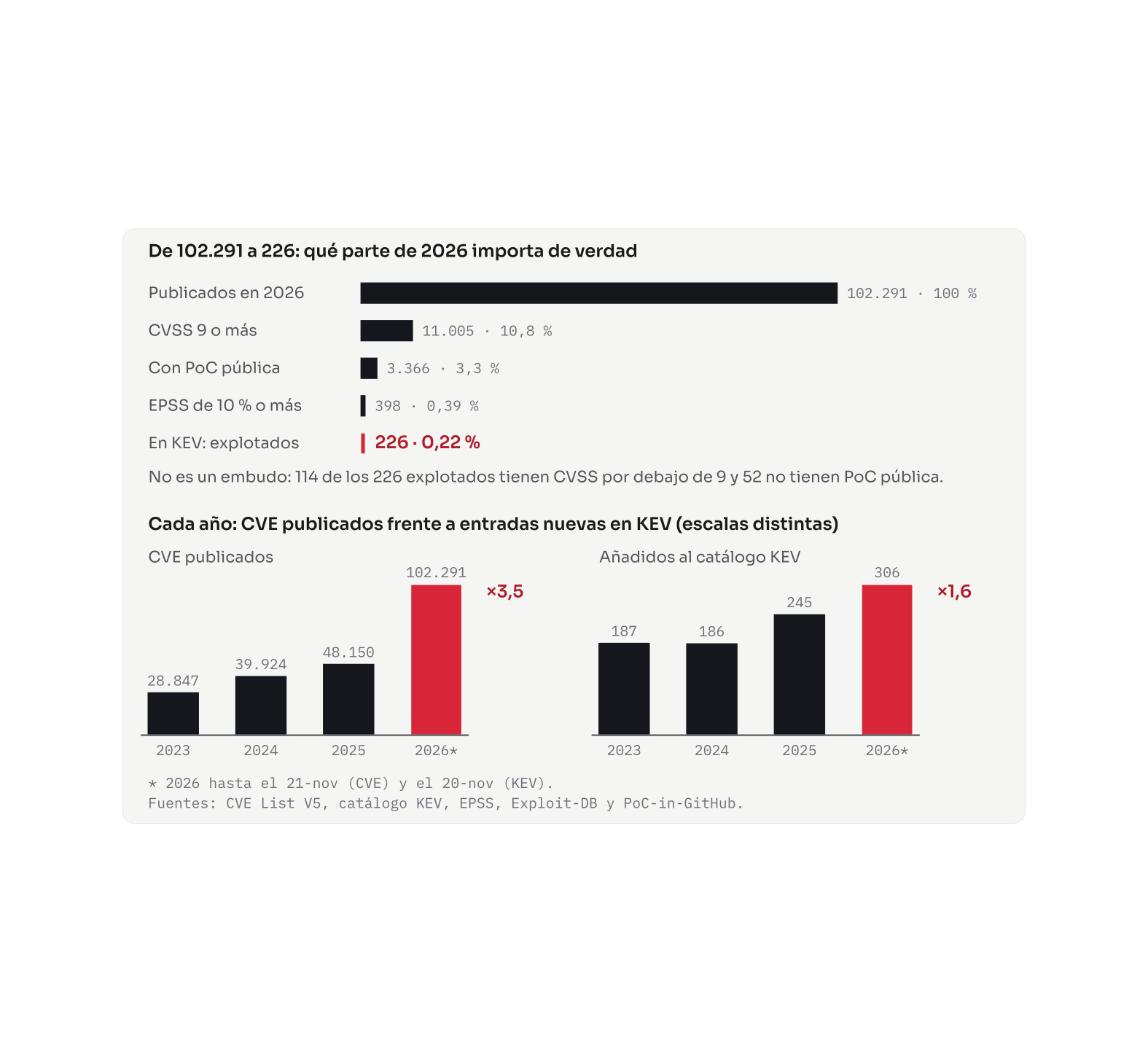
Of the 226 exploited CVEs, 114 score below 9 and 27 below 7, and 52 have no public proof of concept. Meanwhile 11,005 CVEs from 2026 score 9 or higher, an unmanageable list in which the vast majority have not been seen exploited.
Querying KEV and EPSS from the terminal
Both signals the analysis recommends are public and free. CISA publishes KEV as JSON, so curl and jq can list entries added since a given date, with vendor, product and the remediation due date for federal agencies:
curl -s https://www.cisa.gov/sites/default/files/feeds/known_exploited_vulnerabilities.json | jq -r '.vulnerabilities[] | select(.dateAdded >= "2026-11-01") | [.cveID, .vendorProject, .product, .dateAdded, .dueDate] | @tsv'Code language: JavaScript (javascript)FIRST provides an EPSS API, which estimates the probability that a CVE will be exploited in the next 30 days. This query returns CVEs above 10 %, highest first:
curl -s "https://api.first.org/data/v1/epss?epss-gt=0.1&order=!epss&limit=50" | jq -r '.data[] | [.cve, .epss, .percentile] | @tsv'Code language: JavaScript (javascript)Matching either list against an inventory of what is deployed, and above all what is exposed to the internet, produces a workable queue. It mirrors CISA’s Binding Operational Directive 26-04, issued on 10 June 2026 for US federal agencies: deadlines based on exposure and exploitation, as short as three days for the most dangerous cases, with CVSS no longer required as the prioritisation criterion.
Cloud Privado adds three more measures: shrink the exposed surface, patch along stable branches and track how long it takes to fix KEV entries affecting internet-facing systems. The study also notes its own limits: KEV does not capture all exploitation and leans towards what affects the US, and some proof-of-concept code on GitHub is fake or carries malware, so it should never be run without review.
Frequently asked questions
What is the KEV catalog?
It is CISA’s list of known exploited vulnerabilities. It is published openly, including as JSON, and is one of the most reliable signals for patch prioritisation.
What does EPSS measure?
The estimated probability that a CVE will be exploited in the next 30 days. FIRST publishes it with a free API.
Should I review every Linux kernel CVE?
It is not feasible: the kernel has published 8,777 in 2026 and only four are in KEV. Updating along stable branches or with your distribution’s kernels is the practical route.
Sources: