
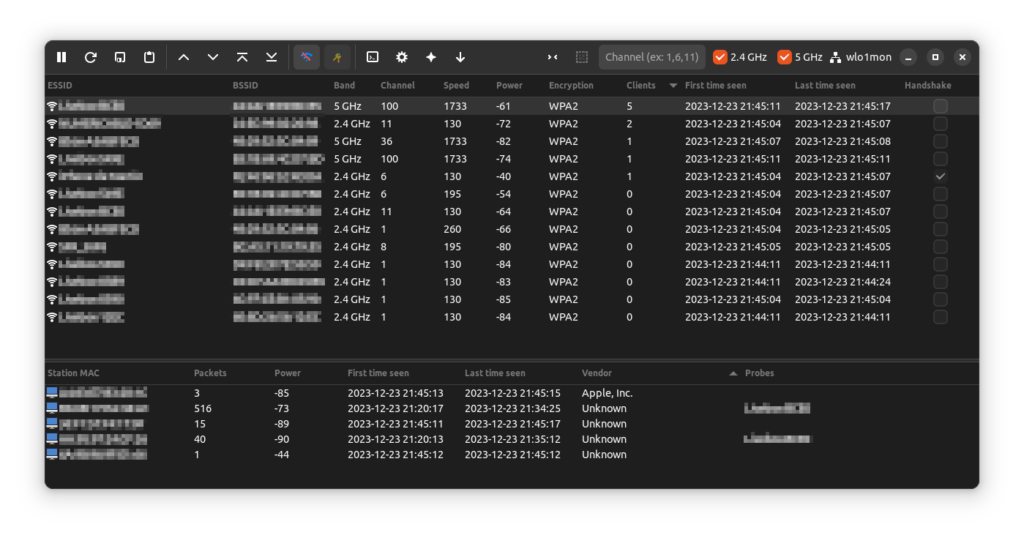
Wireless security assessments on Linux still rely heavily on command-line tools such as Aircrack-ng, Airodump-ng, and Aireplay-ng. Airgorah aims to simplify that workflow by bringing the core capabilities of the Aircrack-ng suite into a single graphical application built with Rust and GTK4. The project targets system administrators, cybersecurity professionals, and developers who need to assess the security of WiFi infrastructures without relying entirely on the terminal.
Airgorah in 30 seconds
- Airgorah is an open-source graphical frontend built on top of Aircrack-ng.
- Developed in Rust with GTK4, it runs exclusively on Linux.
- It can discover nearby access points, identify connected clients, capture WPA/WPA2 handshakes, and manage wireless security assessments from a single interface.
- It requires a wireless adapter that supports monitor mode and packet injection.
- Rather than introducing new attack techniques, it streamlines the use of well-established wireless auditing tools.
For many Linux administrators, auditing a wireless network means constantly switching between airmon-ng, airodump-ng, aireplay-ng, and aircrack-ng, while keeping track of interfaces, capture files, and command-line options. Although these tools remain industry standards, they also come with a learning curve, particularly for professionals who only perform wireless assessments occasionally.
Airgorah is not designed to replace Aircrack-ng. Instead, it provides a graphical layer that automates much of the typical workflow while reducing the need to manually execute multiple commands.
A graphical frontend for the entire wireless auditing workflow
The application consolidates the different stages of a wireless security assessment into a single interface.
Its main capabilities include:
- Discovering nearby WiFi networks.
- Identifying clients connected to each access point.
- Capturing WPA and WPA2 handshakes.
- Managing deauthentication tests on authorized networks.
- Launching password analysis using Aircrack-ng.
Instead of opening several terminal windows, administrators can perform the complete assessment from a single GUI while monitoring capture progress and connected devices in real time.
Behind the scenes, Airgorah still relies on the original Aircrack-ng utilities. As a result, its functionality ultimately depends on the capabilities of the Aircrack-ng suite and the underlying wireless hardware.
Rust continues expanding into security tooling
One of the project’s most interesting aspects is its technology stack.
Airgorah is written entirely in Rust, a language that continues gaining traction across infrastructure software, cloud-native applications, and cybersecurity tools.
For projects like this, Rust offers several advantages:
- memory safety without requiring a garbage collector;
- reduced risk of memory-related vulnerabilities;
- high native performance;
- easier long-term maintainability.
The graphical interface is built with GTK4, allowing Airgorah to integrate naturally with modern Linux desktop environments.
Beyond aesthetics, the GUI lowers the entry barrier for IT operations teams and administrators who may not specialize in penetration testing but still need to perform routine wireless security assessments.
System requirements
Airgorah shares most of the same prerequisites as Aircrack-ng.
| Requirement | Description |
|---|---|
| Operating System | Linux |
| Privileges | Root access |
| Wireless Adapter | Must support monitor mode |
| Packet Injection | Required for certain testing functions |
| Aircrack-ng | Must be installed |
One of the most common misconceptions among newcomers is assuming that any USB WiFi adapter will work.
Unfortunately, that is not the case.
Many integrated laptop chipsets do not fully support monitor mode or packet injection. Before deploying Airgorah, administrators should verify hardware compatibility using utilities such as iw, iwconfig, or the vendor’s documentation.
A practical tool for labs, homelabs, and enterprise assessments
Airgorah can be particularly useful in several real-world environments, including:
- periodic enterprise WiFi security assessments;
- cybersecurity training labs;
- homelab environments;
- WPA/WPA2 security validation;
- enterprise wireless infrastructure testing;
- classroom demonstrations and workshops.
Its graphical interface also makes it suitable for educational environments where instructors want to explain wireless auditing concepts before introducing students to the underlying command-line tools.
A GUI does not replace protocol knowledge
While Airgorah simplifies the workflow, it does not remove the need to understand how wireless security protocols operate.
Capturing a WPA handshake does not guarantee that a password can be recovered.
Successful password recovery still depends on factors such as:
- password complexity;
- dictionary quality;
- authentication configuration;
- capture integrity;
- cracking methodology.
Likewise, deauthentication testing should only be performed on networks that the user owns or has explicit authorization to assess.
The developer clearly states in the project’s repository that Airgorah is intended exclusively for security testing on authorized wireless networks.
An open-source project with room to grow
Airgorah is released under the MIT License, making it easy for organizations and developers to adopt, modify, and contribute to the project.
Its Rust codebase also provides a solid foundation for future enhancements beyond simply orchestrating external command-line tools. Potential future additions could include:
- automated report generation;
- integration with vulnerability management platforms;
- support for newer WiFi standards;
- scheduled wireless assessments;
- compatibility with additional security analysis frameworks.
Today, its biggest strength lies in providing a modern, user-friendly interface for one of the most widely used wireless auditing toolkits available on Linux.
It does not change what Aircrack-ng can do—but it can significantly improve usability and reduce the time spent managing repetitive wireless security assessment tasks.
Frequently Asked Questions
What is Airgorah?
Airgorah is an open-source graphical frontend for Linux that centralizes multiple Aircrack-ng tools into a single Rust-based desktop application.
Does Airgorah require Aircrack-ng?
Yes. Airgorah acts as a frontend and relies on the Aircrack-ng tool suite to perform wireless auditing operations.
Is it available for Windows or macOS?
No. The project currently supports Linux only.
Can it be used against any WiFi network?
No. It should only be used on networks you own or where you have explicit authorization to perform security testing.