
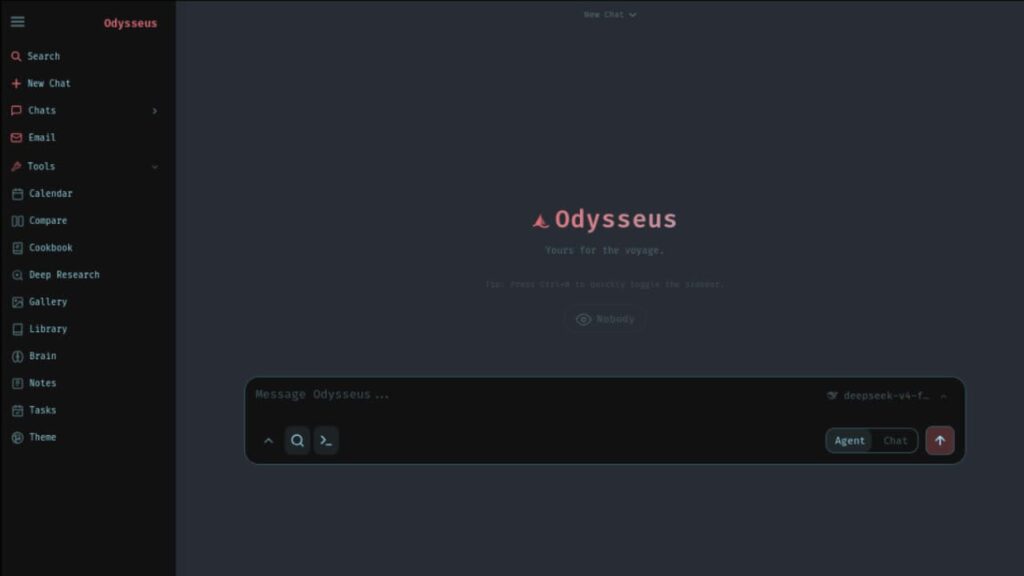
Odysseus has emerged as one of those projects that connects with an increasingly clear trend: many advanced users, developers, and system administrators want an experience similar to ChatGPT or Claude, but running under their own control, with their own data and, whenever possible, on local models. The project, promoted from the ecosystem of well-known creator PewDiePie, presents itself as a self-hosted, local-first AI workspace focused on privacy.
The idea is easy to explain and quite ambitious to build. Odysseus does not want to be just a chat interface for talking to a model. It aims to bring together conversation, agents with tools, MCP, files, persistent memory, documents, deep research, email, calendar, notes, tasks, and model comparison in a single application. All of this is designed to run on Windows, macOS, and Linux, either through Docker or natively.
At a time when most generative AI is consumed through cloud services, Odysseus moves in the opposite direction: bringing the experience to the user’s own machine or server. It does not remove the option of connecting to external APIs such as OpenAI, OpenRouter, or compatible providers, but its main value lies in enabling work with local models through Ollama, llama.cpp, or vLLM.
A local alternative to major AI platforms
The rise of tools such as ChatGPT, Claude, Gemini, and Copilot has shown that users want more than a model. They want a comfortable interface, history, memory, file uploads, tools, browsing, document generation, and complete workflows. The problem is that almost all of this usually depends on closed platforms and external servers.
Odysseus tries to replicate part of that experience in a self-hosted environment. Its README describes it as a self-hosted version of the user experience offered by ChatGPT and Claude, although with a deliberately more informal tone. That philosophy fits well with the local AI community: less dependence on centralised services, more control over data, and more room to experiment.
The project allows users to chat with local or remote models, add providers easily, and use different inference backends. For those already working with Ollama or llama.cpp, it can become a productivity layer above the model. For those who prefer vLLM or external APIs, it can work as a unified operations hub.
One of its most interesting features is Cookbook, a tool that analyses the available hardware, recommends models, and helps download and serve them. This matters because one of the barriers to local AI is still knowing which model fits each machine, which format to use, and which backend offers the best performance. Odysseus includes VRAM-aware calculation and support for formats such as GGUF, FP8, and AWQ.
| Feature | What it offers |
|---|---|
| Chat | Conversations with local models or external APIs |
| Agent | Agents with tools, files, shell, MCP, skills, and memory |
| Cookbook | Model recommendation and download based on hardware |
| Deep Research | Multi-step research with sources and visual reports |
| Compare | Blind side-by-side model comparison |
| Documents | Document editor with AI assistance |
| Memory / Skills | Persistent memory and reusable skills |
| IMAP/SMTP with summaries, triage, and assisted drafts | |
| Calendar | Local-first calendar with CalDAV sync |
| Notes & Tasks | Notes, reminders, and scheduled tasks |
Agents with tools, MCP, and memory
The agent layer is one of the project’s most powerful areas. Odysseus allows users to give tools to an agent so it can complete full tasks. According to the documentation, it is built on opencode, MCP, web, files, shell, skills, and memory. In other words, it is not limited to generating text: it can act on the environment if the user authorises and configures it properly.
This brings it close to the new generation of agentic AI workspaces. A local assistant can read files, work with documents, consult tools connected through MCP, remember preferences, use saved skills, and execute scheduled tasks. For a developer, it can serve as a support environment for reviewing code, generating documentation, or automating small operations. For a system administrator, it can act as an assisted console, provided it is deployed with the right precautions.
MCP, the Model Context Protocol, is especially relevant. This standard is gaining traction as a way to connect AI models with tools, data, and external services. The fact that Odysseus includes it from the start places the project within a clear trend: AI assistants will stop being isolated chat windows and will become interfaces capable of interacting with real systems.
Memory is another differentiating piece. Odysseus uses ChromaDB and fastembed to combine vector retrieval and keyword search, with import and export options. In practice, this allows the agent to evolve with the user, remember context, and use persistent information without depending on memory managed by an external platform.
Documents, email, calendar, and tasks: more workspace than chatbot
Odysseus does not stop at chat. It includes a document editor with tabs, Markdown, HTML, CSV, syntax highlighting, suggestions, and AI-assisted editing. The project’s stated philosophy is interesting: the user writes the text and AI helps, not the other way around. That is an important nuance at a time when many tools push towards massive automated generation.
It also includes email through IMAP and SMTP, with AI-assisted classification, urgency reminders, automatic tagging, summaries, draft replies, and spam filtering. Calendar integration through CalDAV makes it possible to sync with Radicale, Nextcloud, Apple, or Fastmail, as well as import and export .ics files. On top of that, it adds quick notes, task lists, and cron-style scheduled jobs.
This combination turns Odysseus into something closer to a personal AI productivity environment than a simple frontend for local models. The approach makes sense: if agents are going to be useful, they need to touch email, calendar, documents, files, tasks, and personal context. The difference is that here everything is designed from a self-hosted perspective.
The project also works on mobile as a responsive PWA, making it easier to use from a phone if deployed on a local network, VPN, or behind a secure proxy. That may be useful for anyone who wants a personal assistant accessible from multiple devices without relying on a closed commercial app.
Easy to install, but with clear responsibilities
Odysseus recommends installation via Docker. The basic process consists of cloning the repository, copying the environment file, and starting the containers with Docker Compose. By default, the web interface binds to 127.0.0.1 and opens on port 7000, a sensible decision because the project includes sensitive tools.
It can also run natively on Linux and macOS with Python 3.11 or higher. On Apple Silicon, the project recommends native execution if users want to take advantage of GPU acceleration with Metal, since Docker on macOS cannot use Apple’s GPU in the same way. On Windows, there is a PowerShell launcher that creates the virtual environment, installs dependencies, runs setup, and starts the server. For local models on Windows, the easiest route is Ollama.
The documentation insists on several security points. Odysseus should be treated like an admin console, because it can handle shell access, files, uploads, models, web searches, email, calendar, API tokens, and MCP tools. Keeping authentication enabled, not exposing it directly to the Internet, using HTTPS through a reverse proxy, and reviewing user permissions are not secondary recommendations: they are basic conditions for using it responsibly.
This point is essential for a tech audience. The appeal of self-hosting does not remove risk. Running a workspace with agents and access to local tools can be extremely powerful, but also dangerous if published without protection or configured with excessive permissions. An agent with shell and file access can help a lot, but it can also cause damage if given malicious instructions or exposed to unauthorised users.
Why Odysseus arrives at the right time
The emergence of projects such as Odysseus fits several trends at once. The first is the maturity of local models. There are now open models capable of performing useful tasks on home computers, workstations, and modest servers. They do not always replace the most advanced cloud models, but they are good enough for many personal, technical, and business uses.
The second is subscription fatigue. Every new AI tool wants its own account, monthly payment, interface, and limits. A self-hosted workspace can centralise models, APIs, and workflows under one experience, with more control over costs and data.
The third is concern over privacy. Uploading emails, documents, notes, code, calendars, or internal files to external platforms is not always acceptable. Odysseus offers a way to work with sensitive information on infrastructure under the user’s own control, although final security will depend on how it is installed and administered.
The fourth is the arrival of agentic AI for advanced users. Agents are no longer just a promise from major platforms. Tools are beginning to appear that allow technical users to build their own environment with MCP, memory, skills, and automation. Odysseus sits right there: a practical laboratory for building a personal or team assistant that does not depend entirely on third parties.
It remains to be seen how the project evolves in terms of stability, security, community, and its ability to keep up with alternatives such as Open WebUI, AnythingLLM, LibreChat, LobeChat, or Jan. But its proposal is clear: if ChatGPT and Claude have defined how we want to interact with models, Odysseus tries to bring that experience into the self-hosted world, with more tools, more control, and a local-first approach.
For developers, system administrators, and local AI enthusiasts, Odysseus is worth watching. Not because it will immediately replace the major platforms, but because it shows where part of the community is heading: personal assistants with memory, agents with tools, and data under user control. Local AI no longer wants to be just a chat window. It wants to become a real workspace.
Frequently asked questions
What is Odysseus?
Odysseus is a self-hosted AI workspace that aims to offer an experience similar to ChatGPT or Claude, but running on your own hardware and with local control over your data.
Which models can it use?
It can connect to local models or APIs through vLLM, llama.cpp, Ollama, OpenRouter, OpenAI, and other compatible providers.
Does it work on Windows, macOS, and Linux?
Yes. It can run through Docker or natively. On Windows, Ollama is recommended for local models, while on Apple Silicon native execution is recommended to take advantage of Metal.
Is it safe to expose Odysseus to the Internet?
It should not be exposed directly without protection. The documentation recommends keeping authentication enabled, using HTTPS through a reverse proxy, and treating it like an admin console because of its sensitive tools.
Sources:
- GitHub, “pewdiepie-archdaemon/odysseus: Self-hosted AI workspace”.