
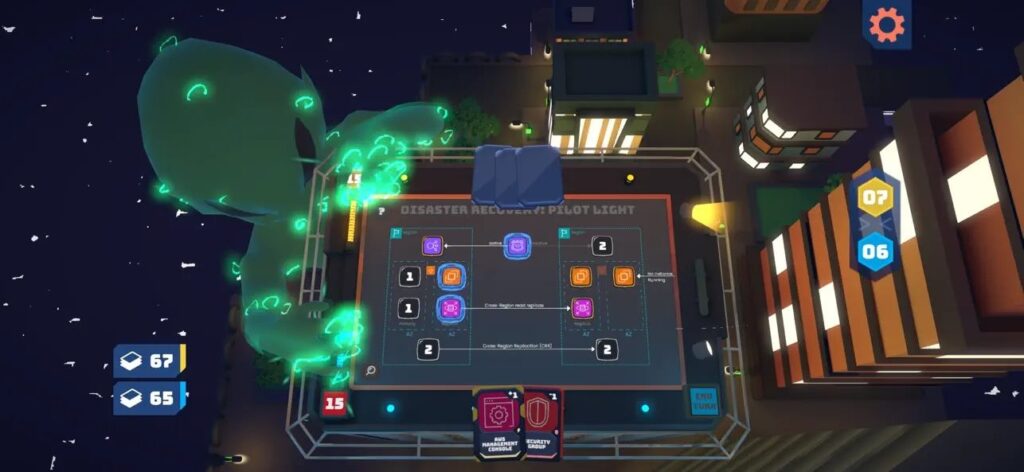
Amazon Web Services (AWS) has an unusual way to learn cloud architecture: AWS Card Clash, a free game where players place AWS service cards into different architecture diagrams. The idea is to practice which service fits each scenario and understand how AWS components work together without starting directly with documentation, labs, or certification questions. The game is available through AWS Skill Builder and as an app for iOS and Android.
The key points of AWS Card Clash in 20 seconds
- AWS Card Clash turns cloud architecture diagrams into games built around AWS service cards.
- Players must decide which AWS component belongs in each part of a solution.
- It includes both single-player and multiplayer modes.
- AWS launched the iOS and Android apps in September 2025.
- In August 2026, it added Contests and Tournaments for practicing and competing with other players.
The concept makes particular sense for people starting with AWS. One of the first challenges is usually not learning what Amazon Simple Storage Service (S3), AWS Lambda, or Amazon DynamoDB do individually, but understanding why they appear together in an architecture and what role each service plays within the system.
AWS Card Clash turns those relationships into a game mechanic. Players are presented with an incomplete architecture and a selection of cards representing AWS services. To progress, they have to identify which service belongs in each available position.
It does not replace deploying real infrastructure, but it helps users practice something that appears constantly when designing cloud systems: recognizing patterns.
From memorizing services to understanding architectures
AWS offers hundreds of services and features. Trying to learn them as a list of names can quickly become an exercise in memorization with little connection to the problems engineers later encounter in real projects.
Card Clash takes a different approach.
Instead of simply asking what a particular service does, it presents architectures inspired by real-world solutions. The player has to analyze the diagram and decide which card should be placed in each position.
That difference may sound small, but it forces the learner to think about relationships.
A typical serverless application, for example, might use Amazon API Gateway to receive requests, AWS Lambda to execute logic, and DynamoDB to store information. Amazon Cognito might handle identity, while CloudWatch provides part of the observability layer.
AWS’s own documentation uses these kinds of combinations in its reference architectures. In the Games Industry Lens, for example, AWS describes a serverless gaming architecture where Cognito authenticates players, API Gateway receives requests, Lambda executes application logic, and DynamoDB stores information about games, player progress, and leaderboards.
Card Clash tries to teach users to recognize those relationships visually.
| Traditional learning | AWS Card Clash |
|---|---|
| Study services individually | Connect services within an architecture |
| Read completed diagrams | Complete architecture diagrams |
| Memorize features | Choose the service that solves each requirement |
| Answer theoretical questions | Make decisions during a game |
| Individual study | Single-player and multiplayer |
AWS describes Card Clash as an Architecture Design Game. It should not be confused with a full simulator where users configure actual AWS infrastructure.
Players are not creating a VPC, writing an AWS Identity and Access Management (IAM) policy, or deploying a Lambda function. They are learning to identify the components that would make up such a solution.
A free game that also works on mobile
AWS Card Clash originated within AWS Skill Builder and expanded to mobile devices in September 2025 with applications for iOS and Android.
AWS describes it as a virtual 3D card game designed to teach cloud architecture and solution design through relatively short gaming sessions.
The single-player mode allows users to practice independently. Multiplayer adds a competitive element that can work well for training sessions, study groups, or technical teams.
AWS expanded this side of the game during 2026.
On August 25, it introduced Contests and Tournaments. Contests allow challenges to remain open for a defined period, meaning participants do not need to connect at the same time. Tournaments are designed for live competitions with head-to-head matches and elimination rounds.
That distinction allows the same game to be used in very different situations.
A team distributed across several countries can keep a contest open for a few days, while a company, conference, or AWS user group can organize a live tournament.
AWS has also incorporated artificial intelligence into some of these competitive experiences. According to the company, Contests can present participants with AI-generated scenarios that they have to solve by correctly placing services within an architecture.
It can help with AWS certifications, but it does not replace labs
Card Clash can be useful for people preparing for AWS certifications because several exams require candidates to recognize which services and architectural patterns best fit particular requirements.
However, the two things should not be confused.
AWS does not present Card Clash as a replacement for official exam preparation or as a certification itself. It is a complementary learning tool within the company’s broader training offering.
Working with AWS in a real production environment still requires going several levels deeper.
Recognizing that an architecture needs Amazon S3 is different from configuring access policies for a bucket. Knowing that Lambda can execute a function does not by itself teach someone how to manage concurrency, execution time limits, IAM permissions, observability, or costs.
The same applies to databases.
A card might show that DynamoDB is the appropriate component for a diagram, but correctly designing partition and sort keys, secondary indexes, capacity, and access patterns requires knowledge that the game is not intended to provide.
Card Clash therefore fits best as a tool for developing architectural intuition.
First, the learner recognizes the pattern. Then they can reproduce a simplified version using real infrastructure through the AWS Management Console, AWS Command Line Interface (CLI), CloudFormation, AWS Cloud Development Kit (CDK), or third-party tools such as Terraform.
That second step remains necessary.
AWS Skill Builder also provides labs and immersive learning experiences for scenarios closer to real cloud work. The platform currently offers more than 1,000 free learning resources, although full access to some experiences requires a subscription.
Card Clash itself is available for free, including its mobile applications.
The combination can be particularly useful for someone starting from scratch: play through an architecture, understand why particular services appear in it, and then try to build a simple version in a lab.
AWS has published reference architecture diagrams for years. Card Clash introduces one simple difference: it removes some of the pieces and makes the learner decide what is missing.
It is a less conventional way to study cloud computing, but it is also surprisingly close to a question every cloud architect eventually has to answer over and over again: which service belongs in each part of the system, and why?