
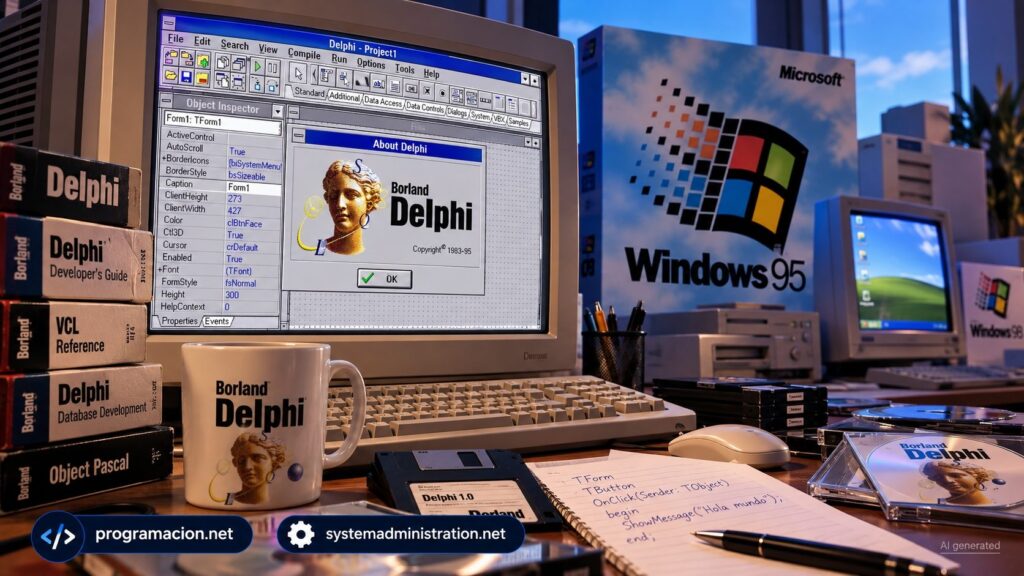
In 1995, Borland launched Delphi and changed the way Windows applications were built. A form, a few components, some Object Pascal code, and a native compiler could turn an idea into a working program within hours. For many developers, it was a particularly attractive alternative to Visual Basic and Visual C++. But while Delphi kept improving the development tool, Microsoft was building something much harder to compete with: an entire ecosystem around Windows.
The key points about Delphi for developers in 20 seconds
- Delphi arrived in 1995 with Object Pascal, a visual designer, and native compilation.
- Its main advantage was dramatically reducing the work required to build Windows applications.
- Anders Hejlsberg, creator of Turbo Pascal and a key figure behind Delphi, eventually joined Microsoft.
- The arrival of .NET and C# changed the rules of Windows development.
- Delphi survived for decades, but it stopped setting the direction for Windows development.
For a generation of programmers, Delphi represented a very specific idea: the development environment could handle much of the complexity of Windows without completely hiding what was happening underneath. Developers could work visually with forms and components while still having a compiled language and a programming model that felt familiar to those coming from Pascal.
The source material used for this story places that evolution around several key moments: the birth of Delphi, its competition with Visual Basic and Visual C++, Anders Hejlsberg’s move to Microsoft, Borland’s change to Inprise, the attempt to bring the Delphi model to Linux with Kylix, the arrival of .NET, and the subsequent sale of CodeGear to Embarcadero.
Before Delphi came Turbo Pascal
The story begins long before Delphi’s visual designer.
Niklaus Wirth created Pascal in 1970 as a language intended to make structured programming and the teaching of programming clearer. Borland later turned Pascal into a commercial development environment that would have enormous influence among programmers during the 1980s and 1990s.
Turbo Pascal stood out by combining an editor, compiler, and development tools in a single environment. The speed with which it allowed developers to write and compile code became one of the defining characteristics of Delphi’s development philosophy.
The evolution toward object-oriented programming prepared the ground for Object Pascal. Borland no longer had simply a language used to learn programming. It had a foundation from which it could build a professional development tool for Windows.
From Pascal to Delphi
| Year | Milestone | Why it mattered to developers |
|---|---|---|
| 1970 | Pascal | Niklaus Wirth publishes the language |
| 1983 | Turbo Pascal | Borland popularizes a fast development environment |
| 1980s | Evolution of Turbo Pascal | The language and compiler gain new capabilities |
| 1989 | Object-oriented programming | Turbo Pascal adds capabilities that move the language toward Object Pascal |
| 1993 | Borland Pascal 7.0 | Pascal expands its presence on Windows |
| 1995 | Delphi | Borland brings Object Pascal to a visual IDE focused on Windows |
| 1996 | Delphi 2 | Evolution toward 32-bit Windows applications |
| 1997 | Delphi 3 | Improvements to visual development and database access |
| 1998 | Delphi 4 | Continued evolution of the Windows development environment |
| 1999 | Delphi 5 | Delphi maintains an established developer community |
| 2000 | Borland becomes Inprise | Change in corporate strategy and identity |
| 2001 | Delphi 6 | Borland expands the platform’s scope |
| 2001 | Kylix | Attempt to bring the Delphi model to Linux |
| 2002 | Delphi 7 | One of the most widely used and remembered versions |
| 2002 | Borland returns to its original name | The Inprise brand loses prominence |
| 2002 | Hejlsberg joins Microsoft | The creator of Turbo Pascal moves to Borland’s rival |
| 2002-2003 | .NET and C# | Microsoft introduces a new model for Windows development |
| 2003 | Delphi 8 for .NET | Borland attempts to adapt Delphi to the new environment |
| 2006 | CodeGear | Borland separates its development tools |
| 2007 | Embarcadero acquires CodeGear | Delphi changes ownership |
| 2010 | Cross-platform expansion | Delphi broadens its target beyond traditional Windows |
This timeline brings together the milestones described in the source material and organizes them from the evolution of Pascal and Turbo Pascal through Delphi’s later years.
The IDE that reduced Windows to a form
To understand why Delphi became so popular among programmers, it helps to look at what Windows development was like in the mid-1990s.
Building a graphical Windows application could involve working with APIs, messages, controls, resources, and a considerable amount of code that had little to do with the application’s actual business logic.
Delphi changed that relationship with the operating system.
A developer could open the designer, place a button, add a text box, configure properties, and write the code associated with an event. The interface stopped being a collection of structures that had to be built manually and became something that could be manipulated visually.
The concept was not entirely new. Visual Basic had already popularized a visual development experience.
The difference was the combination Delphi offered.
Object Pascal, visual components, native compilation, and database access formed a particularly effective environment for building business applications.
The result was an environment where many common tasks could be handled with a few clicks and lines of code.
For a developer, that productivity had direct value. Time that would previously have been spent building the interface could instead be used to implement application logic.
Delphi versus Visual Basic and Visual C++
The competition with Microsoft had three distinct fronts.
Visual Basic emphasized ease of use. Visual C++ targeted developers who needed the capabilities and control of C++. Delphi occupied a middle ground.
It offered the accessibility of a visual environment while using a compiled, structured language. For many programmers, that provided an interesting balance between productivity and control.
Database access was another area where Delphi could be particularly attractive.
A developer could create a business application with forms, controls, and database connectivity without having to build much of the surrounding infrastructure from scratch.
At the time, that difference could determine which tool a development team chose.
But it also concealed a vulnerability.
Delphi depended on Windows.
And Windows belonged to Microsoft.
The problem was not the compiler
The later history of Delphi is interesting precisely because its decline cannot simply be explained by a loss of technical quality.
Borland continued improving Delphi.
The problem was that Microsoft could change the level at which the tools competed.
During the early years, the question could be which environment provided the best way to develop for Windows. With .NET, Microsoft began offering something different: a complete application development platform.
Language, libraries, tools, runtime, and operating system could evolve together.
C# became a central part of that model. Visual Studio could integrate it directly with Microsoft’s technologies and with the rest of the Windows platform.
For Borland, competing meant convincing developers that using an external alternative still offered advantages.
For Microsoft, the developer was already inside its ecosystem.
That difference eventually mattered more than many individual comparisons between IDE features.
The creator of Turbo Pascal ends up at Microsoft
One of the most striking chapters in the story was Anders Hejlsberg’s departure.
Hejlsberg had created Turbo Pascal and played a central role in the evolution that led to Delphi. In 2002, he joined Microsoft.
He would later play a major role in the development of C# and other technologies associated with .NET.
For the developer community, the move carried a strong symbolic element. One of the people most closely associated with the philosophy that had made Pascal a popular development tool was now working for the company competing directly for the future of Windows development.
His departure does not explain Delphi’s decline by itself. But it was part of a period in which Microsoft was concentrating talent, tools, and technologies around .NET.
Kylix tried to bring Delphi to Linux
Borland also recognized that the future might exist outside Windows.
Kylix was the company’s attempt to bring the Delphi experience to Linux. The idea was attractive: reuse the language and visual development model on a platform that was gaining importance among developers and in server environments.
But Kylix failed to become the Linux development center Borland needed.
The Linux market had a different tool culture and a strong presence of open-source software and technologies rooted in the Unix ecosystem. Delphi’s appeal on Windows did not automatically transfer to that environment.
The project ultimately became another example of an opportunity that failed to change Borland’s position.
Borland changes its name and changes direction
In 2000, Borland changed its name to Inprise.
The move was intended to reflect a stronger enterprise focus, but the Borland name already had enormous recognition among programmers. The company later returned to the Borland name.
These corporate changes coincided with a period of transformation for the business.
The company still had well-known developer products, but Microsoft had succeeded in placing Visual Studio and .NET at the center of its software strategy.
The difference between the two companies was no longer simply technological.
It was about scale and control over the ecosystem.
CodeGear and the final change of ownership
Borland eventually separated its development tools into an organization called CodeGear.
The new structure allowed the company to focus on products such as Delphi and C++Builder, but it did not restore the position the platform had enjoyed during the 1990s.
In 2007, Embarcadero acquired CodeGear for approximately $23 million.
Delphi continued to exist and evolve under its new owner. The platform later expanded its ability to create applications for different operating systems.
But the battle had already changed.
Delphi stopped being one of the tools defining Windows development and became a platform with a specific community and a base of business applications that still depended on it.
What Delphi got right, and Borland could not turn into a platform
The Delphi paradox is particularly interesting for a publication aimed at programmers.
Delphi solved the developer’s problem very well. Borland did not manage to turn that solution into control over the platform.
The IDE was productive. Object Pascal was accessible and powerful. The compiler generated native code. Database access simplified an entire category of business applications.
But Microsoft had Windows.
And then it had .NET.
As development became organized around complete platforms, having the best IDE was no longer enough to compensate for the position held by the operating system’s owner.
The story of Delphi also demonstrates something programmers know well: a technology can be technically strong and still lose relevance because of factors outside the code.
Borland had to compete against a company that could simultaneously control the evolution of the operating system, APIs, development tools, languages, and libraries.
Delphi did not disappear.
What disappeared was the possibility that Delphi would remain the center around which Windows application development revolved.
For those who programmed with Delphi in the 1990s, the difference can feel enormous. For those who came later, it may be easier to understand by looking at the whole map: Pascal gave Borland the language, Turbo Pascal gave it the compiler, Delphi gave it the IDE, and Microsoft ultimately had the platform.
Frequently asked questions
Why was Delphi so popular among programmers?
Because it combined a visual designer, Object Pascal, native compilation, and database tools. This allowed developers to build Windows applications with far less complexity than working directly with much of the operating system’s API.
Was Delphi better than Visual Basic?
Delphi and Visual Basic pursued similar goals around developer productivity, but used different technologies and languages. Delphi stood out through Object Pascal and native compilation, while Visual Basic placed particular emphasis on ease of development within Microsoft’s ecosystem.
What happened to the creator of Turbo Pascal?
Anders Hejlsberg, creator of Turbo Pascal and a key figure behind Delphi, joined Microsoft in 2002. He later played an important role in the development of C# and other .NET technologies.
Who owns Delphi today?
Delphi passed from Borland to CodeGear and later to Embarcadero, which acquired CodeGear in 2007. The product continued to be developed after the acquisition.