
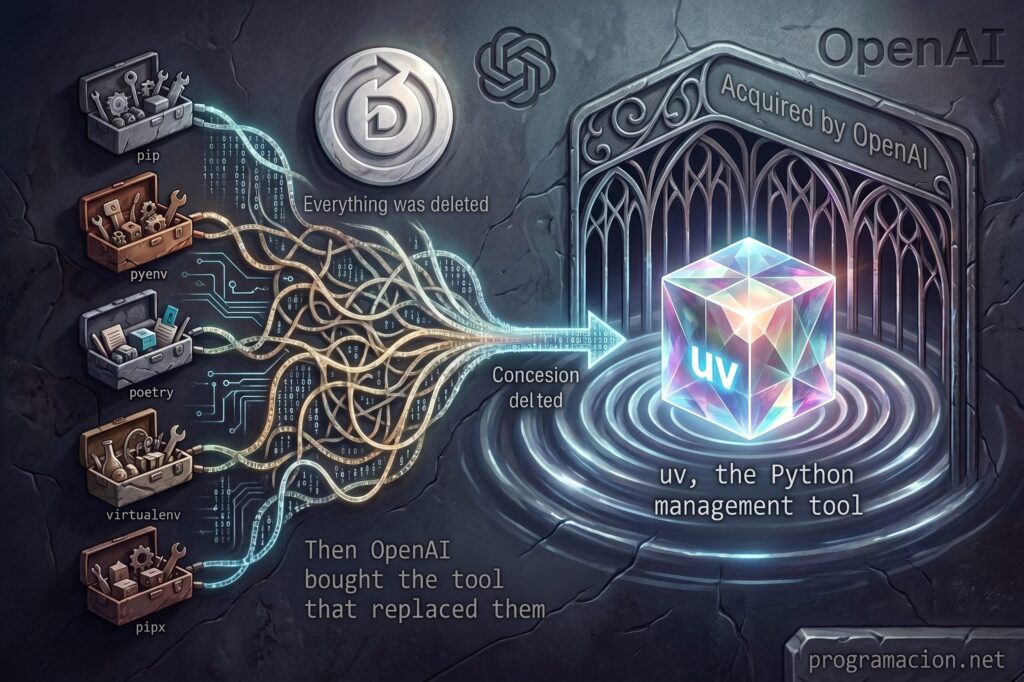
For years, working with Python often meant combining several tools to solve different problems: one to install Python versions, another to create virtual environments, another to install packages, and yet another to lock dependencies or run global utilities. uv has brought much of that workflow into a single tool written in Rust, and the story took on a new dimension when OpenAI announced in March 2026 an agreement to acquire Astral, the company behind uv, Ruff, and ty, and bring its team into the Codex organization.
The key points about uv and OpenAI’s Astral deal in 30 seconds
- uv can replace many of the functions provided by
pip,pip-tools,pipx, Poetry, pyenv, and virtualenv. - It manages Python versions, environments, dependencies, tools, and a lockfile from a single executable.
- Astral says uv can be 10 to 100 times faster than pip in its benchmarks.
- OpenAI announced an agreement to acquire Astral on March 19, 2026, with the team set to join Codex.
- OpenAI and Astral say the open-source tools will continue to be developed as open source after the deal closes.
- For CI and Docker, pinning versions and using the lockfile reproducibly remains good practice.
The story is interesting because this is not simply another fast package manager.
Astral describes uv as a tool capable of replacing pip, pip-tools, pipx, Poetry, pyenv, Twine, virtualenv, and other parts of the traditional Python toolchain. It can install Python, automatically create a project environment, resolve dependencies, generate a lockfile, execute commands inside the environment, and install command-line tools. It can do all of this from an executable that does not require Python or Rust to be installed beforehand.
That level of integration addresses one of the Python ecosystem’s long-standing pain points: there has not necessarily been a single tool covering the entire development workflow.
A project might use pyenv to select Python, venv to isolate packages, pip to install them, pip-tools to pin versions, and pipx for global tools. Poetry brought some of those pieces together, but introduced its own workflow.
With uv, a basic sequence can look like this:
uv python install 3.13
uv init my-service
cd my-service
uv add fastapi
uv run pytestCode language: CSS (css)
And to execute a tool without permanently installing it:
uvx ruff check .One tool for several layers of the Python stack
The first change concerns management of Python itself.
With uv, a specific version can be installed directly:
uv python install 3.13Code language: CSS (css)The tool can also respect the Python version defined by a project and use it in both development and continuous integration. Astral’s official documentation includes this workflow for GitHub Actions as well.
The second change is virtual environment management.
When adding a dependency inside a project:
uv add fastapiuv can automatically create .venv and manage the environment without requiring the developer to first run python -m venv.
Then:
uv run python app.pyCode language: CSS (css)runs the command inside the corresponding environment.
The third piece is dependency resolution.
Projects use pyproject.toml to declare their requirements and uv.lock to record the concrete resolution. Astral describes the latter as a universal lockfile intended to maintain a consistent resolution across compatible platforms and environments.
To synchronize the project:
uv syncAstral’s documentation explains that uv run automatically locks and synchronizes the project before executing a command unless instructed otherwise.
The result is a considerably shorter workflow than manually maintaining several requirements.txt files and multiple tools around them.
An important detail: --locked and --frozen are not the same
There is one simplification commonly found in uv guides that deserves clarification.
A frequent recommendation is:
uv sync --frozento ensure production uses exactly what is in the lockfile.
The intention makes sense, but --frozen and --locked behave differently.
According to Astral, --locked checks that the lockfile remains compatible with the project’s current metadata and fails if it is outdated:
uv sync --locked--frozen, by contrast, uses the existing lockfile without checking whether it is up to date with pyproject.toml.
For CI, where teams often want to detect when someone has changed dependencies without regenerating uv.lock, --locked can therefore be the stricter option.
The lockfile can also be checked explicitly:
uv lock --checkThis distinction matters because reproducibility does not simply mean “do not update packages.” It also means knowing whether the project definition and its lockfile still describe the same state.
Where uv can save more time: CI
A faster installation on a developer laptop is convenient.
A faster installation every time a CI runner is created has clearer operational and financial consequences.
Astral says uv can be between 10 and 100 times faster than pip depending on the operation and cache state. Those numbers come from Astral’s own benchmarks and should not be treated as a universal promise for every pipeline.
Real-world improvements depend on the dependency tree, packages that require compilation, architecture, network connectivity, and caching strategy.
But uv includes a global cache designed to deduplicate dependencies and has official integration with GitHub Actions.
Astral currently recommends using a setup along these lines:
- uses: astral-sh/setup-uv@...
  with:
    version: "0.12.4"Code language: JavaScript (javascript)
and considers pinning a specific uv version in CI a good practice.
That recommendation makes particular sense because uv is still evolving quickly.
As of August 14, 2026, Astral’s official documentation uses uv 0.12.4 in its installation and CI examples.
The 0.11.18 referenced in some articles published in June is therefore already outdated.
It can simplify Docker too
Astral publishes an official image at:
ghcr.io/astral-sh/uvA Docker build can copy the executable from that image and use normal Docker layer caching to separate dependency installation from application code.
For example:
FROM python:3.13-slim

COPY --from=ghcr.io/astral-sh/uv:0.12.4 /uv /uvx /bin/

WORKDIR /app

COPY pyproject.toml uv.lock ./

RUN uv sync --locked --no-dev

COPY . .

CMD ["uv", "run", "python", "main.py"]Code language: JavaScript (javascript)
There is no single Docker recipe that is correct for every project, and Astral maintains dedicated Docker guidance. The underlying principle remains familiar: copy dependency metadata first to maximize cache reuse, then copy application code that changes more frequently.
For larger services, removing several bootstrap steps can also reduce differences between developer machines and CI environments.
uv does not require abandoning pip overnight
Another important point is that adopting uv does not necessarily mean restructuring an entire project on day one.
It provides an interface compatible with the pip workflow:
uv pip install fastapior:
uv pip sync requirements.txtCode language: CSS (css)Astral presents this layer as a way to accelerate existing operations while retaining a familiar CLI.
That gives organizations two possible migration paths.
A company can initially use uv as a faster replacement for pip in existing pipelines while retaining requirements.txt.
Or it can progressively migrate toward the complete project model based on:
pyproject.toml
uv.lockCode language: CSS (css)
The second approach uses more of uv’s capabilities, but there is no need to migrate an entire organization at once.
uvx also moves into pipx territory
Global command-line tools are another historical source of small Python environment problems.
Installing Ruff, Black, HTTPie, or another utility using pip install in a global Python environment can pollute that environment. pipx was created specifically to isolate each tool.
uv includes an equivalent approach:
uvx ruff check .and tools can also be installed persistently:
uv tool install ruffAstral documents both approaches.
That removes another common reason for keeping a separate package-management tool alongside pip.
Then OpenAI announced the Astral acquisition
On March 19, 2026, the story took an unexpected turn.
OpenAI announced an agreement to acquire Astral and bring its tools into the Codex environment. Charlie Marsh, Astral’s founder, said the same day that the team would join the Codex organization.
The deal makes considerable technical sense.
Codex does not simply generate source code. An agent needs to create environments, install dependencies, execute tests, inspect failures, and validate the modifications it has just made.
Python is one of the most widely used languages in artificial intelligence, data science, automation, and backend development.
As a result, the tool responsible for installing and resolving Python dependencies becomes part of the operational runtime of a coding agent.
OpenAI has explained that it wants Codex to move beyond code generation toward systems capable of participating across the development lifecycle: planning changes, modifying repositories, executing tools, checking results, and maintaining software. The company says Astral’s tools fit directly into that workflow.
The announcement also included a figure that helps explain OpenAI’s interest. In March, the company said Codex had tripled its user base since the beginning of 2026, increased usage fivefold, and exceeded 2 million weekly active users.
Any seconds saved while preparing a Python environment become substantial when the same operation is executed millions of times.
OpenAI is not only getting uv: Ruff and ty matter too
The acquisition should not be viewed solely as the purchase of a fast package manager.
Astral maintains three particularly relevant pieces of infrastructure:
- uv, for packages, projects, environments, and Python.
- Ruff, for linting and formatting.
- ty, its type checker and language server.
OpenAI explicitly mentioned all three tools in its acquisition announcement.
The combination fits naturally with an agent.
Codex can generate code.
Ruff can inspect and format it.
ty can identify type-related problems.
uv can build the environment, resolve dependencies, and execute tests.
From this perspective, the acquisition looks less like buying “a faster pip” and more like bringing a substantial part of the Python toolchain that an autonomous coding agent needs under the same roof.
Will uv remain genuinely independent?
That is probably the most interesting question for teams already treating it as infrastructure.
OpenAI says it will continue supporting Astral’s open-source projects after the transaction closes. Charlie Marsh has also said the team will continue developing the tools publicly and alongside the Python community.
That is the official position today.
It does not tell us how project priorities will evolve over the next five years.
There is no evidence that uv is about to become closed source or exclusive to Codex. There is equally no basis for guaranteeing that its roadmap will remain entirely independent from OpenAI’s requirements.
For companies, the practical question is simpler.
uv remains open-source software, with publicly available code and a substantial community. Astral says Ruff, uv, and ty have gone from zero to hundreds of millions of monthly downloads.
That significantly reduces the risk that a future strategy change could make the tool disappear overnight.
But it does not remove governance risk.
Who owns the project and employs the team deciding its priorities still matters, even when the repository remains open.
Software supply-chain security is becoming part of uv
Another relevant development has appeared since the OpenAI announcement.
In June, Astral introduced additional capabilities related to dependency security.
Its blog highlighted uv audit for checking locked dependencies against known vulnerabilities, alongside experimental mechanisms intended to prevent installation of packages identified as malware.
This is a logical direction.
A package manager occupies a particularly sensitive position: it downloads third-party code and puts it directly onto developer machines and CI runners.
The security of the package manager itself, and the verification mechanisms around it, therefore become part of the software supply chain.
Astral has also been hardening different areas of uv and maintains specific guidance around open-source security.
These features should still be evaluated according to their individual maturity. The fact that a capability exists does not necessarily mean it has the same stability as uv’s core dependency-management commands.
Does it make sense to delete pip, pyenv, or Poetry?
This is where the headline needs some nuance.
uv does not make pip, venv, pyenv, or Poetry disappear, nor does it require developers to stop using them.
What has changed is that many projects no longer need all of them in their normal workflow because uv covers their main use cases.
Astral itself still documents installing uv with:
pip install uvand recommends pipx install uv when installing it from PyPI.
Python is not going to remove venv because uv exists.
And an organization with hundreds of Poetry projects should not start a mass migration simply because another tool is faster.
Teams still need to evaluate migration costs, compatibility with private indexes, internal builds, publishing workflows, and existing tooling.
Where uv offers a particularly compelling proposition is in new projects, CI-heavy environments, containers, and teams tired of maintaining several different layers to solve one operational problem.
What changes for DevOps teams
For infrastructure and platform teams, speed may not even be the biggest advantage.
Simplification can matter more.
Instead of documenting a process like:
install pyenv
install Python
create virtualenv
activate it
install pip-tools
compile requirements
install requirements
install CLI tools with pipxCode language: JavaScript (javascript)
the workflow can move closer to:
uv python install
uv sync --locked
uv run pytest
Fewer components mean fewer versions to maintain and fewer differences between developer workstations and pipelines.
But precisely because uv concentrates so many responsibilities, more of the workflow now depends on it.
Previously, a pyenv failure affected Python version selection while a pip problem affected package installation.
When a single tool manages Python, dependencies, tools, environments, and lockfiles, that tool becomes critical team infrastructure.
That makes it sensible to:
- pin the uv version in CI and Docker;
- upgrade it deliberately;
- keep
uv.lockin Git; - review release changes;
- test upgrades before deploying them;
- understand how to rebuild the environment if the tool changes.
That is not distrust of uv.
It is the same discipline that should apply to any component sitting near the bottom of a build chain.
OpenAI has not simply bought a fast developer tool
This may be the most interesting interpretation of the deal.
Competition between major AI labs is no longer only about having the model that writes the best code.
Agents need an entire environment around them.
They need terminals.
Repositories.
Package managers.
Linters.
Compilers.
Tests.
Browsers.
Isolated environments.
Tools for inspecting results.
OpenAI is placing Astral inside Codex at exactly that layer.
The acquisition of uv, Ruff, and ty suggests that the next stage of competition in AI-assisted programming may be fought as much through the tools that execute code as through the models that write it.
For an individual developer, uv can remain simply a much more convenient way to manage a Python project.
For OpenAI, it can potentially be something more.
It is a piece of infrastructure that its agents may use millions of times.
And when a tool ends up sitting underneath millions of automated executions, saving a few seconds is no longer just a matter of convenience.
It becomes infrastructure.
Frequently asked questions
What is uv in Python?
uv is a Rust-based Python package and project manager developed by Astral. It can manage Python versions, virtual environments, dependencies, lockfiles, and command-line tools while also providing a pip-compatible interface.
Does uv really replace pip and Poetry?
It can replace many of their functions in a large number of projects, and Astral also presents it as an alternative to pip, pip-tools, pipx, Poetry, pyenv, and virtualenv. Those tools still exist, however, and not every project needs to migrate.
Has OpenAI already acquired Astral?
OpenAI announced an agreement to acquire Astral on March 19, 2026. Both companies described the integration at the time as a transaction that would close subsequently, so the announcement of the agreement should be distinguished from the effective closing of the acquisition.
What version of uv is currently available?
As of August 14, 2026, Astral’s official documentation uses uv 0.12.4 in its installation and GitHub Actions examples. Because the project releases frequently, teams should check the current version before pinning it in a pipeline.