
OCaml has never had the media noise of Python, JavaScript, Rust or Go. Nor does it usually appear in popular debates about which language to learn first. Yet for decades it has occupied a very particular place in the history of programming: that of a language born in academia that eventually found its way into finance, static analysis, formal verification, file synchronization, cloud infrastructure and even the early stages of Rust.
Its original full name, Objective Caml, already hints at its origins. OCaml extends Caml, a dialect of the ML family, with object-oriented features. It was created in 1996 by researchers linked to Inria, including Xavier Leroy, Jérôme Vouillon, Damien Doligez and Didier Rémy. Its proposal combined functional, imperative, modular and object-oriented programming under a static, strong and inferred type system.
At first glance it may look like a niche language. In practice, OCaml has been one of those quiet technologies whose influence is far greater than its apparent popularity suggests. It has served as a conceptual or technical foundation for languages such as F#, Scala and Rust, and it has been used in relevant tools such as Coq, Frama-C, Infer, Flow, MirageOS, Tezos, Unison, parts of Docker Desktop and the original Rust compiler.
From ML to OCaml: a language born from verification
To understand OCaml, it is worth looking first at ML, Meta Language. In the 1970s and 1980s, Robin Milner, a Turing Award winner, worked on theorem-proving systems at the University of Edinburgh. In that environment, there was a need for a language capable of helping build valid proofs with formal guarantees. ML was born as a metalanguage for LCF, Logic for Computable Functions, and eventually became a family of languages in its own right.
Caml came later, driven by Inria’s Formel team. The first implementation appeared in 1987. In the following years, Xavier Leroy designed new versions such as Caml Light and Caml Special Light, with a native-code compiler and performance improvements that brought this family of functional languages closer to practical use.
Objective Caml appeared in 1996 with the addition of an object and class system with static typing. Years later, the name was shortened to OCaml. The result was a language that retained the power of ML while adding tools for building larger programs with different programming styles.
| Milestone | Year | Why it mattered |
|---|---|---|
| First Caml implementation | 1987 | Beginning of the Caml family at Inria |
| Caml Light | 1990-1991 | More portable bytecode-based implementation |
| Caml Special Light | 1995 | Performance boost through native compilation |
| Objective Caml | 1996 | Adds objects and classes to the language |
| Renamed OCaml | 2011 | Consolidation of the current name |
| OCaml 4.0 | 2012 | GADTs and first-class modules |
| OCaml 5.0 | 2022 | New runtime, parallelism and effects |
| ACM SIGPLAN award | 2023 | Recognition for the OCaml compiler |
OCaml’s history is closely tied to research, but it did not remain locked inside it. The language gained industrial uses because it solved a very difficult problem: writing expressive software with type guarantees, good performance and powerful tools for building compilers, analyzers and complex systems.
The type system as a way of thinking
OCaml is known for its static type system with inference. This means the compiler can deduce many types without the programmer having to write them explicitly. Unlike dynamic languages, where certain errors appear at runtime, OCaml detects many problems before the program is executed.
That philosophy can be seen across the language. Pattern matching, algebraic data types, options for representing missing values, higher-order functions and tail recursion make it possible to express algorithms in a compact and safe way.
A simple example is the option type, which forces the programmer to explicitly handle the possibility that a value may not exist. Instead of hiding a null value that may explode later, OCaml makes the programmer deal with the Some or None case.
| Feature | What it provides |
| Static typing | Detects errors before execution |
| Type inference | Reduces manual type annotations |
| Pattern matching | Expresses complex decisions clearly |
| Algebraic data types | Models data precisely |
| Higher-order functions | Enables compact abstractions |
| Modules and functors | Helps organize large programs |
| Garbage collection | Avoids manual memory management |
| Native compilation | Improves performance compared with interpreted languages |
This discipline has a cost. OCaml is not a language designed to feel immediately familiar to someone coming from JavaScript or Python. It requires thinking about types, data structures, composition and functions. In return, it offers a feeling highly valued by its users: if the program compiles, many common errors have already been ruled out.
Performance without giving up expressiveness
One common misunderstanding about functional languages is assuming that they are slow or purely academic. OCaml was designed with explicit concern for performance. Its native compiler, ocamlopt, generates optimized machine code for different architectures, and its runtime has evolved to better support real-world programs.
OCaml 5.0 was a major change because it introduced a new runtime, removed the global garbage collector lock and added support for shared-memory parallelism through domains. It also introduced algebraic effects, an advanced feature that enables new ways of managing concurrency and control flow.
| Tool or component | Function |
ocaml | Interactive environment or REPL |
ocamlc | Bytecode compiler |
ocamlopt | Optimized native compiler |
| OPAM | Package manager |
| Dune | Build system |
| ocamllex / ocamlyacc | Lexical and parser-generation tools |
| PPX | Syntax-extension system |
| Reversible debugger | Runtime error analysis |
That balance between theory and practice explains why OCaml has been so useful in compilers, verifiers, code analyzers and systems where correctness matters as much as performance. It does not try to compete for popularity with general-purpose mainstream languages, but it offers a very solid set of tools for complex problems.
From Rust to F#: OCaml’s quiet influence
OCaml has influenced several modern languages. F#, for example, is based on OCaml and brought many ideas from the ML family to the .NET environment. Scala also received influences from functional languages with powerful type systems. Rust, although it now has a very different identity, also owes part of its history to OCaml.
The original Rust compiler was initially implemented in OCaml before Rust became self-hosting. This connection is not anecdotal. Rust inherited or reinterpreted several ideas from the ML world: algebraic data types, pattern matching, type inference and a stricter way of thinking about safety and program structure.
| Language or project | Relationship with OCaml |
| F# | .NET language based on OCaml |
| Rust | Its initial compiler was implemented in OCaml |
| Scala | Influenced by ML and functional languages |
| Coq | Formal proof system linked to the OCaml ecosystem |
| Reason / ReScript | Alternative syntax created at Facebook |
| Flow | Static analyzer for JavaScript developed at Facebook |
| Hack | Meta language with a compiler written in OCaml |
| Frama-C | Platform for analyzing C programs |
OCaml’s influence often arrives indirectly. Many developers may never have used it, but they work with languages or tools that adopted ideas born in the ML tradition.
OCaml in industry: less visible, more present than it seems
OCaml does not dominate popularity rankings, but it has a relevant presence in specific sectors. Jane Street, a financial firm specialized in trading, is perhaps the best-known case. It adopted OCaml as its main language and has spent years proving that it can be used in highly demanding industrial systems.
Facebook, now Meta, used OCaml in tools such as Flow, Infer, Hack and Reason. Docker has used it in components of its desktop editions for macOS and Windows. Citrix used it in the XenServer environment. Bloomberg created BuckleScript, an OCaml compiler backend targeting JavaScript. Tezos, a blockchain platform, is also among the notable projects written in OCaml.
| Organization or project | Notable use |
| Jane Street | Financial systems and trading |
| Meta / Facebook | Flow, Infer, Hack, Reason |
| Docker | Components of Docker Desktop |
| Citrix | XenServer / Citrix Hypervisor |
| Bloomberg | BuckleScript |
| Tezos | Smart contract platform |
| Unison | File synchronization |
| MirageOS | Unikernels written in OCaml |
| Frama-C | Analysis of C programs |
| Coq | Formal proofs |
The list shows a clear pattern: OCaml appears where correctness, reliability, static analysis, compilers and the ability to model complex systems are highly valued. It is not usually the language chosen for a simple web application, but it is often used to build tools that other developers end up relying on.
Why it is not more popular
The inevitable question is why OCaml has not become a mass-market language. The answer has several layers. The first is cultural: OCaml comes from a functional and academic tradition that can intimidate many developers. The second is market-driven: for years, the dominant enterprise languages were Java, C#, JavaScript, Python, C and C++. OCaml never had behind it a commercial platform as massive as .NET, the web or Android.
Its learning curve also matters. Although type inference reduces noise, it requires understanding concepts that are not always taught early: pattern matching, algebraic types, modules, functors, higher-order functions and recursive programming. For some teams, that investment is not worth it if the problem can be solved with more familiar tools.
| Barrier | Effect |
| Smaller community than Python or JavaScript | Fewer beginner resources |
| Functional tradition | Steeper initial learning curve |
| Less visible job demand | Lower incentive to learn it |
| More specialized ecosystem | Less attractive for common projects |
| Different syntax | Feels unusual to new users |
| Competition from F#, Scala, Rust or Go | Some of its ideas arrive through other paths |
Even so, popularity does not always measure influence. Some languages are important because millions of people use them. Others are important because they shaped tools, ideas and practices that eventually reached the entire industry.
A discreet language for difficult problems
OCaml occupies a rare and valuable position. It is not a fashionable language, nor does it try to be one. Its strength lies in offering a solid environment for software where the cost of being wrong is high: analyzers, compilers, verifiers, financial systems, infrastructure tools and programs that need to combine abstraction with performance.
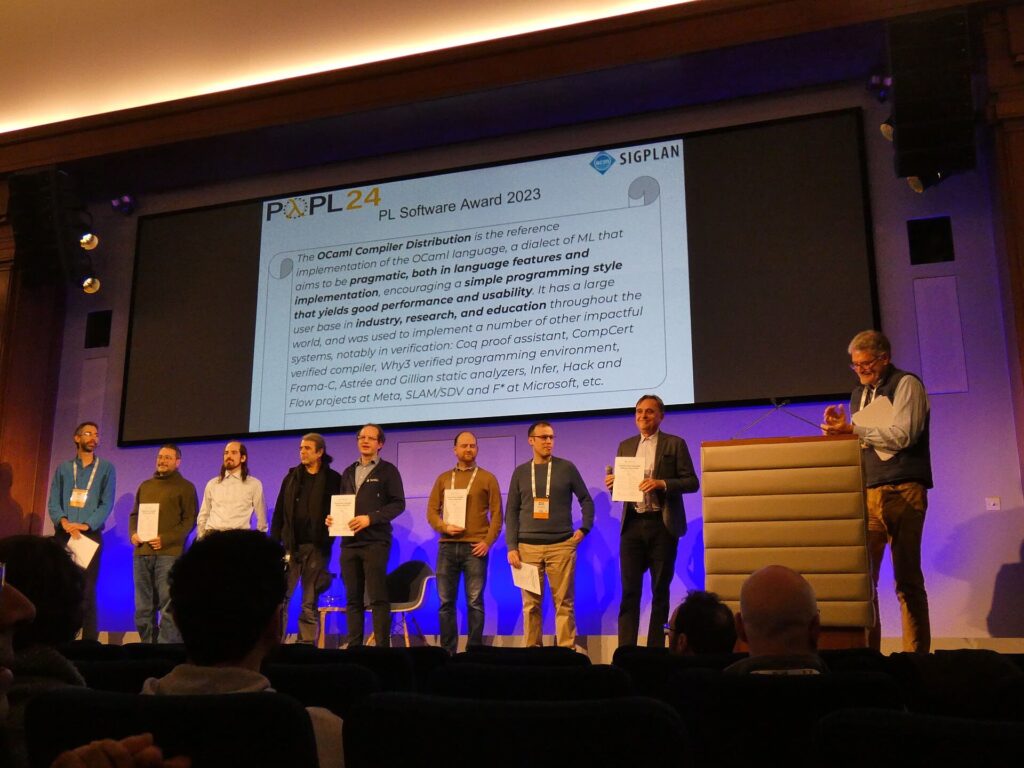
The evolution of OCaml 5 shows that the project is not frozen in the past. The new runtime, domains and effects show an attempt to adapt to today’s needs for concurrency and parallelism without giving up the language’s identity. The ACM SIGPLAN award for the compiler also reinforces its technical value within the programming languages community.
OCaml may never be the language everyone learns in a bootcamp. But it will remain an important piece of modern programming history. It has influenced more popular languages, served to build critical tools and maintained a community that values semantic clarity and correctness more than mass adoption.
At a time when the industry is once again talking about security, type systems, verification, reliability and safer languages, OCaml deserves a less superficial reading. It is not an academic relic. It is one of the quiet roots of many ideas we now consider modern.
Frequently asked questions
What is OCaml?
OCaml is a general-purpose, multiparadigm programming language with static typing and type inference. It combines functional, imperative, modular and object-oriented programming.
Who created OCaml?
OCaml was created in 1996 by researchers linked to Inria, including Xavier Leroy, Jérôme Vouillon, Damien Doligez and Didier Rémy, based on the Caml and ML family.
What is the relationship between OCaml and Rust?
The original Rust compiler was implemented in OCaml before Rust became self-hosting. Rust also shares some ideas from the ML tradition, such as algebraic data types and pattern matching.
What is OCaml used for in industry?
OCaml is used in finance, static analysis, formal verification, compilers, development tools, cloud infrastructure and projects such as Tezos, MirageOS, Frama-C, Coq, Flow, Infer and Unison.
Why is OCaml not as popular as Python or JavaScript?
Because it has a more specialized learning curve, a smaller community and is mainly used in areas where correctness, types and performance matter. Even so, its technical influence is greater than its popularity.