
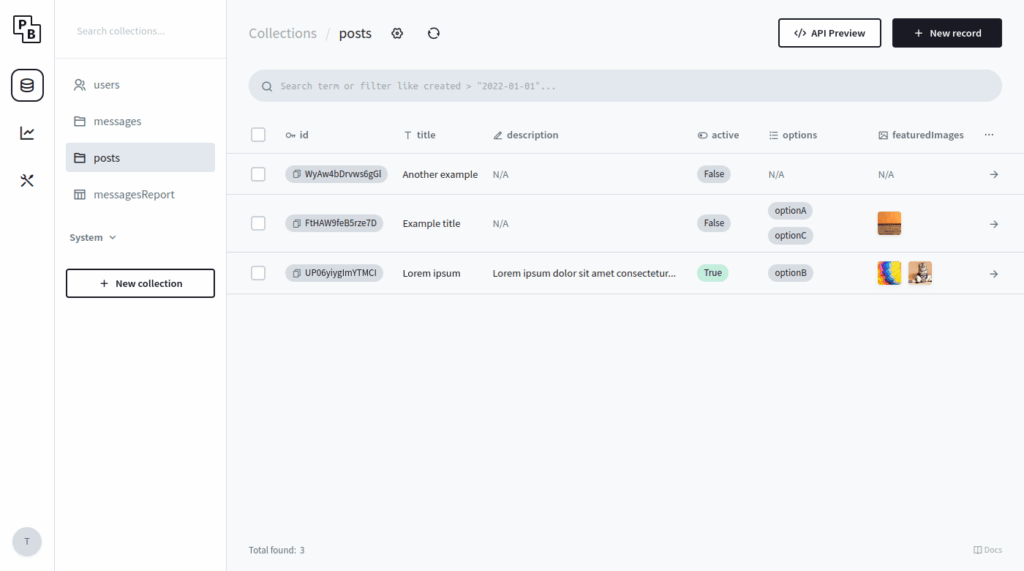
The market for backend services for web and mobile apps has long been dominated by a small group of familiar names, especially Firebase and, more recently, Supabase. But alongside those platforms, interest is growing in lighter, self-hosted tools that are easier to deploy without tying a project to a specific cloud vendor. That is where PocketBase is finding its place: an open source backend packaged as a single binary, with a realtime database, authentication, file storage, and a built-in admin dashboard.
The pitch is easy to understand. PocketBase presents itself as a “backend in one file” and promises to deliver several of the building blocks many projects need from day one. Its official site highlights five core features: a realtime database, authentication, file storage, an admin dashboard, and an API that can be used through its official JavaScript SDK.
What PocketBase actually offers
PocketBase is written in Go, and its official repository describes it as an open source backend that includes an embedded SQLite-based database with realtime subscriptions, integrated file and user management, an admin panel, and a REST-style API. In other words, it is not just a database server or a framework for building a backend. It is a more opinionated, ready-to-run backend product.
Its official documentation reinforces that positioning. PocketBase allows developers to create collections, define schemas, apply validation rules, work with user authentication, and expose everything through its API and SDKs. It also handles file uploads, with configurable limits per field, and includes an admin interface that removes the need to build many internal management tools from scratch.
In practice, that makes it especially appealing for prototypes, internal tools, small and mid-sized applications, early-stage products, and developers who want to self-host a backend without introducing a heavier stack from the start. The existence of an official JavaScript SDK for both browser and Node environments also makes integration with modern frontend frameworks relatively straightforward.
The main difference from Firebase and Supabase
PocketBase is often described as an alternative to Firebase and Supabase, but that comparison needs some context. Compared with Firebase, its main advantage is self-hosting simplicity and transparency: it does not depend on Google’s ecosystem or on a closed backend platform. Compared with Supabase, it aims to be even lighter and more direct, with fewer moving parts and less friction to get a working backend up and running quickly. That ease of deployment is a central part of its public positioning.
That said, the comparison also has limits. Firebase and Supabase are broader platforms, with more surrounding services, more integrations, and a higher level of maturity in enterprise environments. In PocketBase’s case, the official documentation includes an important warning: the project is still under active development and has not yet reached version 1.0, which means full backward compatibility is not guaranteed. Its maintainers explicitly state that they do not recommend it yet for mission-critical production applications, unless teams are willing to follow the changelog closely and handle manual migrations when necessary.
That caveat matters. It changes the conversation from “PocketBase can replace Firebase or Supabase everywhere” to something more realistic: PocketBase is a promising lightweight backend, but it still carries the trade-offs of a fast-moving pre-1.0 project.
A living project, but still evolving
PocketBase does not look like an abandoned side project. Its official website currently lists version 0.36.7, and GitHub shows the same release as the latest published version, including recent fixes such as memory usage improvements for large file uploads. The official JavaScript SDK is also actively maintained, with its own recent releases.
That suggests continuity and an active development pace, but it also confirms that PocketBase remains in a rapid-evolution phase. In practical terms, it offers a lot of agility, but with a greater degree of volatility than many large companies would accept for workloads that require strict long-term compatibility, contractual support, and minimal migration risk.
Where it fits best today
Taken in perspective, PocketBase seems especially well suited to a specific kind of project: small teams, full stack developers, startups in early stages, side projects, internal dashboards, MVPs, and self-hosted apps where speed of development and deployment control matter more than the breadth of a wider cloud platform. It is also likely to appeal to developers who want a backend-as-a-service style experience without becoming dependent on a single hosted provider.
For business-critical systems or deployments that require a more stable roadmap, formal enterprise support, and fewer breaking changes, PocketBase’s own documentation points to a more cautious approach. That honesty is arguably one of its strengths. It promises a lot, but it is also clear about where its current limits are.
Frequently Asked Questions
What exactly is PocketBase?
PocketBase is a self-hosted open source backend packaged as a single binary. It includes an embedded database with realtime subscriptions, authentication, file storage, an admin dashboard, and an API.
Does PocketBase have an official JavaScript SDK?
Yes. PocketBase maintains an official JavaScript SDK for both browser and Node environments, designed to work with its API from frontend and backend applications.
Can PocketBase be used in production?
It can be deployed, but its own documentation warns that the project is still below version 1.0 and is not yet recommended for mission-critical production applications unless teams are prepared to manage manual migrations and compatibility changes.
How is PocketBase different from Firebase or Supabase?
The main difference is that PocketBase focuses on a lightweight, self-hosted backend packaged in a single binary, while Firebase and Supabase provide broader platforms with more services and integrations, but also more ecosystem dependency or operational complexity.