
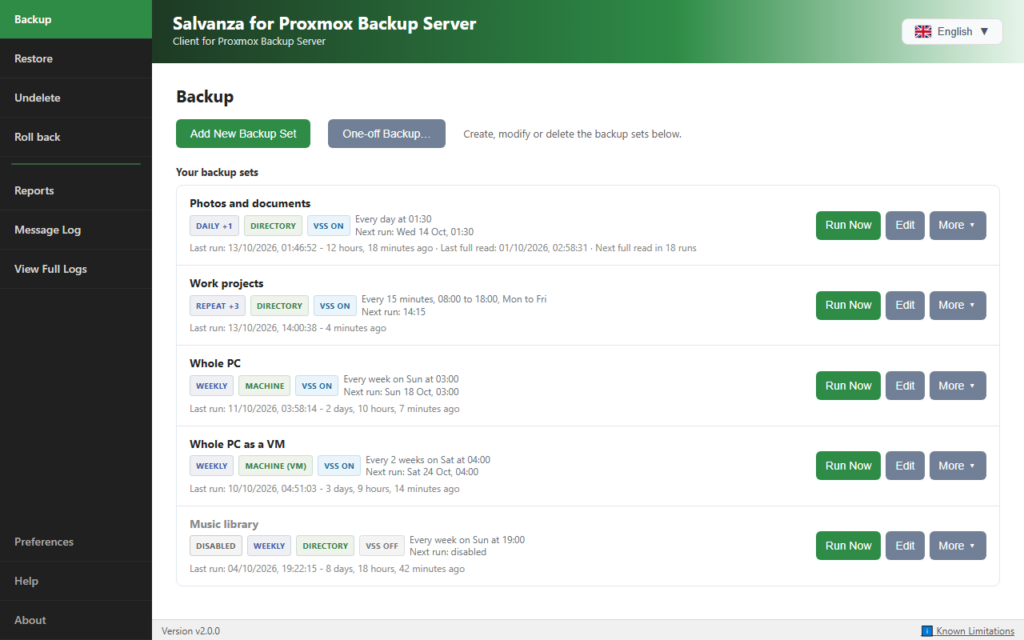
Salvanza, the community client that backs up Windows and Linux machines to Proxmox Backup Server (PBS), has reached version 2.0 with a new name, a reworked graphical interface that now also runs on Linux, and a single command-line tool, salvanza-cli. The project, previously called Proxmox Backup Client, remains free and open source under the GPLv3 license.
Salvanza 2.0 key points in 30 seconds
- Backs up folders and whole Windows and Linux machines to PBS.
- Ships a Clonezilla-based ISO for bare-metal restores to physical disks.
- Can restore a physical machine backup as a Proxmox VE virtual machine.
- Linux now gets the GUI and block-consistent snapshots, except on btrfs.
- GPLv3 with no enterprise edition, though the GitHub repository still labels it alpha quality.
The gap it targets is familiar to anyone running Proxmox: the official PBS client works on Linux, but there is no official Windows client with a GUI. Earlier this year we covered how a Windows client for Proxmox Backup Server was taking shape as an alpha Go project with VSS full-machine backups. Salvanza is where that community effort has gone, with many more contributors and a much broader feature set.
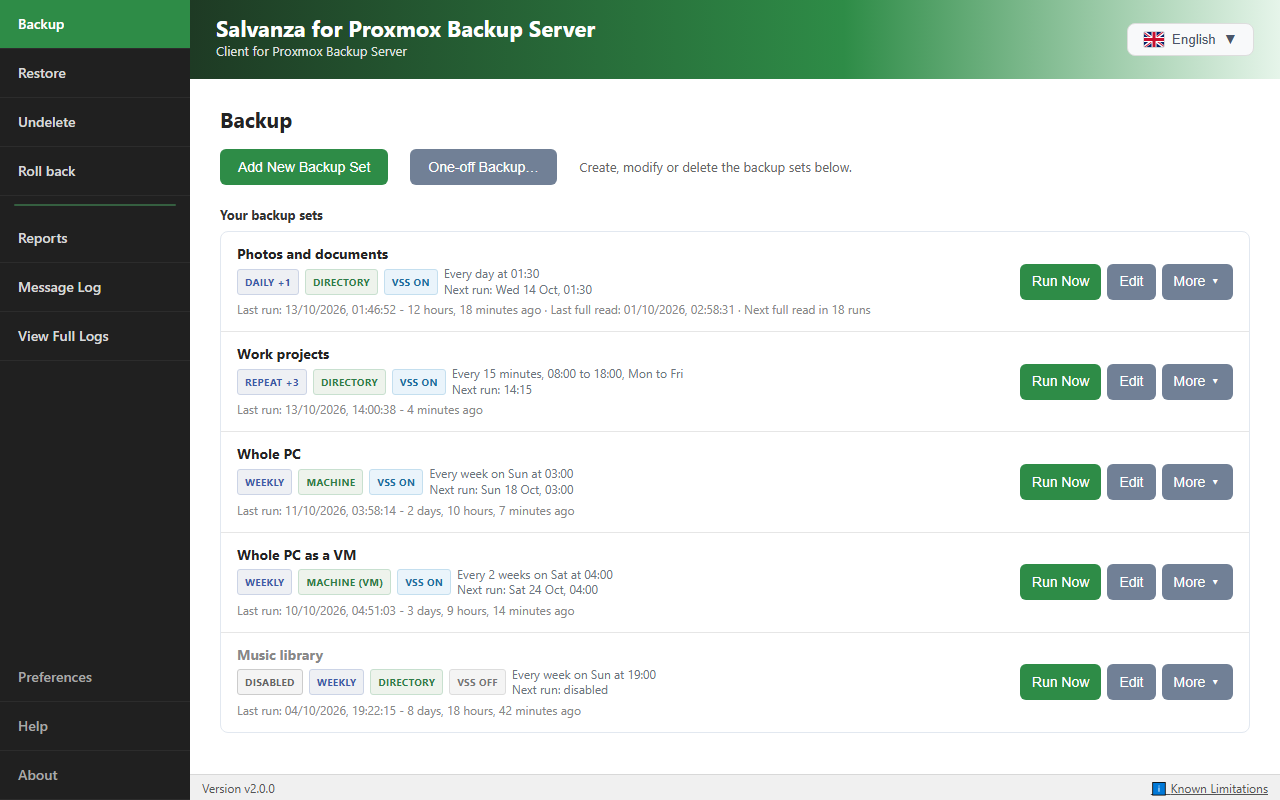
File backups, full-disk images and P2V
Salvanza handles two kinds of backup. Folder backups use PBS metadata mode to skip unchanged files and reuse data from the previous snapshot. Machine backups produce whole-disk images without reading free space, and those images can be restored to the original hardware, to different hardware, or as a Proxmox VE virtual machine, which turns the tool into a physical-to-virtual (P2V) migration path.
For consistent point-in-time copies of running systems, it uses Volume Shadow Copy Service (VSS) on Windows and the elastio-snap or dattobd kernel modules on Linux. Block-consistent snapshots on Linux are one of the headline additions, with one important caveat: neither module can snapshot btrfs, and the backup run says so. Linux machine backups also need root and one of those modules unless snapshots are disabled.
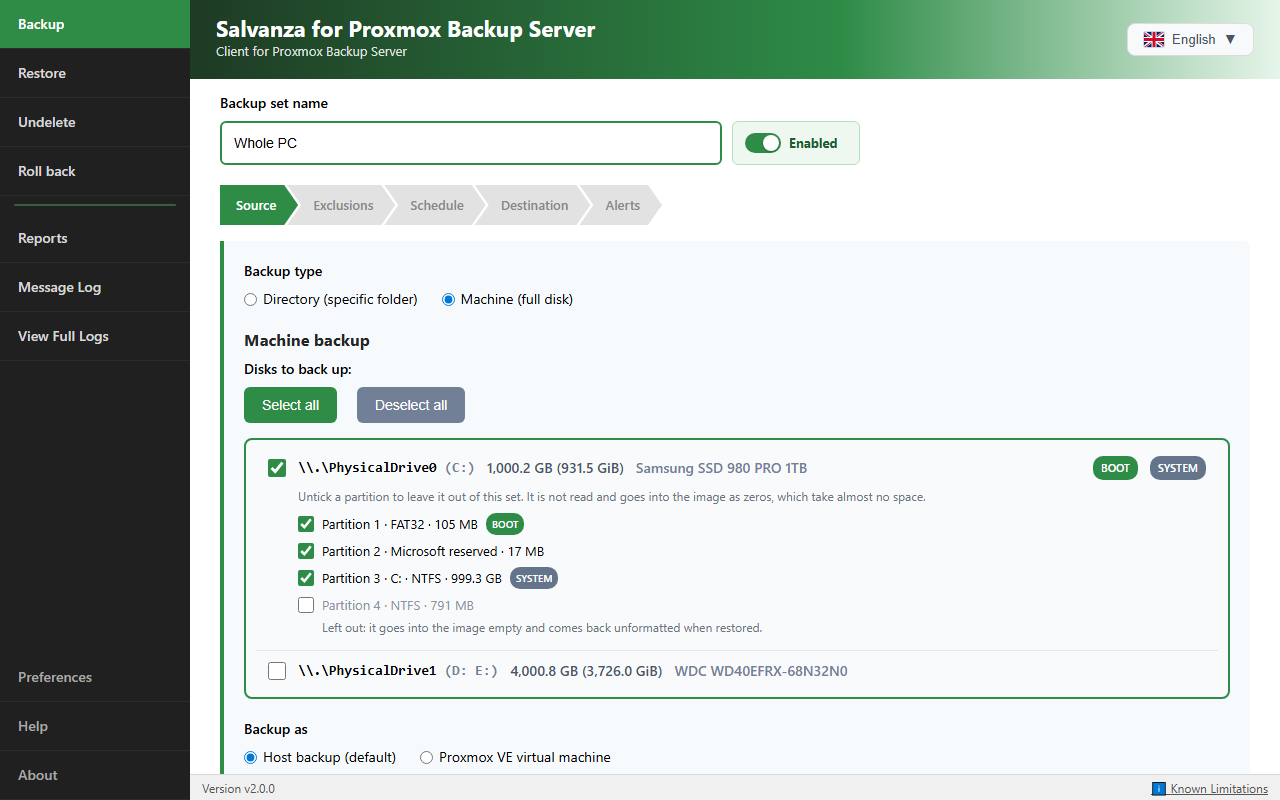
Bare-metal recovery relies on its own ISO, Salvanza-BMR, built on Clonezilla Live and weighing about 488 MB. You boot it on the target machine, connect to PBS and write a machine backup onto the physical disk, whether the source was a physical host or a VM.
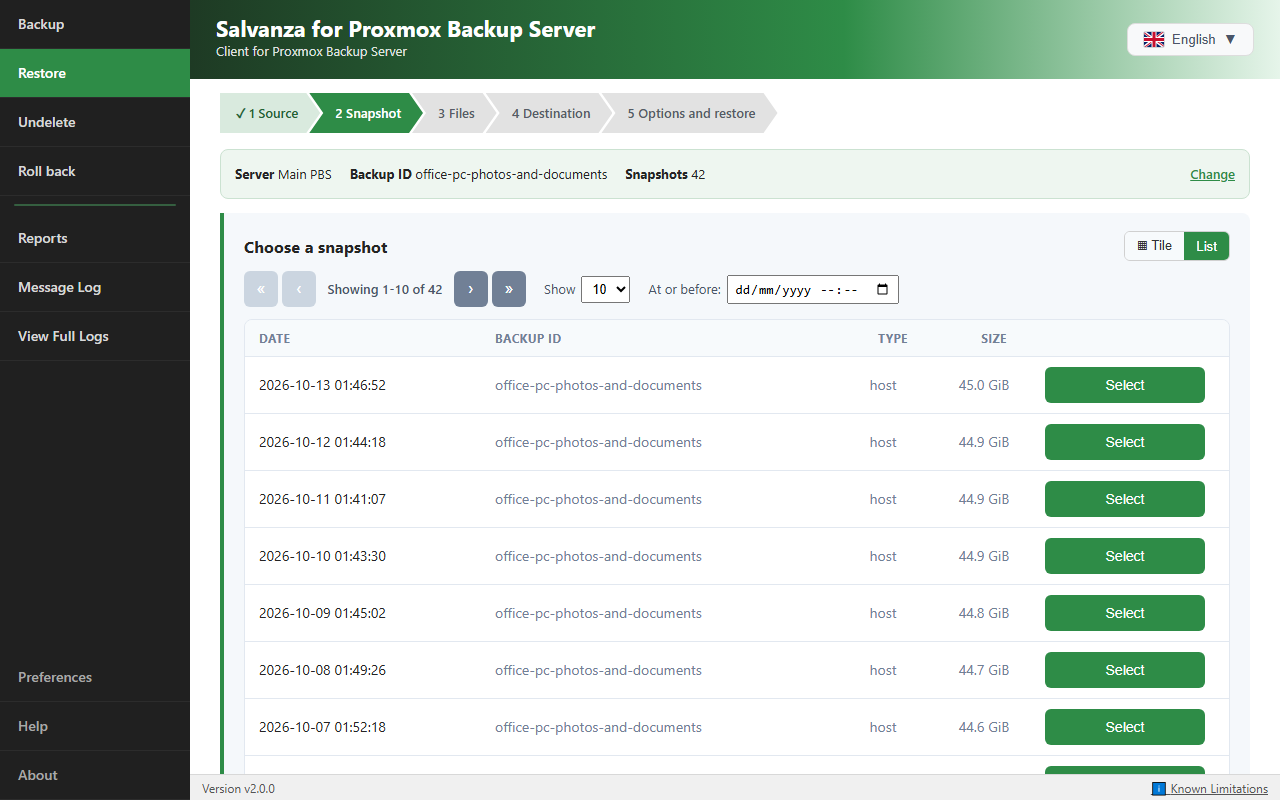
The rest of the package includes named Backup Sets with daily, weekly, monthly, yearly or manual schedules; an Undelete wizard for files that are still in backups but gone from disk; a Roll back feature that returns folders to a chosen backup with a preview and Undo; client-side AES-256-GCM encryption with key files in the official format and printable QR paper keys; multiple PBS servers with fingerprint-pinned certificates; upload, download and disk-read speed limits; four zstd compression levels; and email reports.
Platforms, compatibility and caveats
On Windows it installs from an MSI of about 18 MB that bundles the GUI, background service and CLI, and supports 64-bit Windows 10, Windows 11 and Windows Server. Linux packages cover Debian, Ubuntu, Mint, Fedora and Arch, and portable CLI archives exist for both platforms. The project says it has been verified against proxmox-backup-client 3.4.9 and PBS 4.2 using pxar v2 archives, and it can be scripted through JSON configs, PBS_* environment variables and exit codes.
The fine print matters. The GitHub repository describes the software as alpha quality and disclaims liability for data loss. Windows binaries are not yet code signed, so the project recommends checking the published SHA256 hashes, and some antivirus tools flag them as false positives. Windows Defender can cut backup speed to about a quarter of what is attainable. Windows symlinks and junctions are skipped, NTFS permissions and ACLs are stored in a separate file the official client does not restore, and on Linux, POSIX ACLs, extended attributes and file capabilities do not carry over between Salvanza and the official client.
Salvanza stresses that it is an independent project with no affiliation with Proxmox Server Solutions GmbH, and the rename followed trademark guidance. The GUI started as Nimbus Backup GUI from RDEM Systems and was reworked by other contributors before being merged into the repository. There is no enterprise edition: all code stays GPLv3, including paid customisations, and independent support can be bought. The repository has more than 470 stars on GitHub.
Frequently asked questions
Is Salvanza an official Proxmox product?
No. It is an independent community project, not affiliated with Proxmox Server Solutions GmbH.
Which operating systems does it support?
64-bit Windows 10, Windows 11 and Windows Server, plus Linux packages for Debian, Ubuntu, Mint, Fedora and Arch.
Can it restore a physical server as a VM?
Yes. Machine backups can be restored as Proxmox VE virtual machines, or to physical hardware with the Salvanza-BMR ISO.
Is it ready for production?
The repository itself calls it alpha quality, so test restores before relying on it.
Sources: