
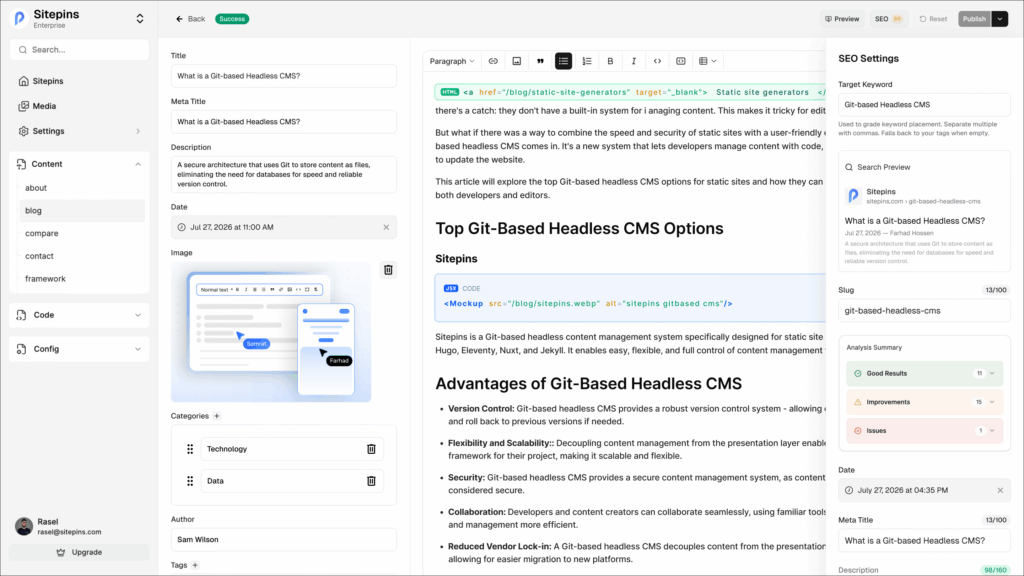
Static websites have become increasingly popular thanks to their speed, security, and low hosting costs. Frameworks such as Astro, Next.js, and Hugo have made building these sites easier than ever, but one challenge remains: allowing non-technical users to edit content without touching code.
That’s exactly the problem Sitepins aims to solve. The new open-source headless CMS takes a different approach from platforms like Decap CMS, TinaCMS, or Sanity. Instead of requiring developers to define schemas, collections, or configuration files, Sitepins automatically analyzes an existing Git repository and generates a visual editing interface. Most importantly, the Git repository remains the single source of truth.
Sitepins in 20 Seconds
- Turns any Git repository into a visual CMS with virtually no configuration.
- Supports Astro, Next.js, Hugo, Nuxt, Eleventy, Jekyll, and other static site generators.
- Every content edit becomes a real Git commit.
- Available as both a cloud service and a fully self-hosted open-source platform.
For years, traditional content management systems stored everything inside databases. As Git-first workflows became more common, content moved into Markdown and MDX files stored directly within project repositories.
While this approach is ideal for developers, it creates friction for marketing teams, content editors, and clients who simply want to update text or replace an image.
Sitepins bridges that gap without changing the developer workflow.
Git Remains the Single Source of Truth
One of Sitepins’ biggest differentiators is that it doesn’t create a separate content database.
Instead, the repository itself continues to store all content.
When someone edits a page through the visual interface, Sitepins automatically creates a standard Git commit in GitHub or GitLab. Existing CI/CD pipelines continue working exactly as before, rebuilding and deploying the website without any changes to the development process.
This provides several important benefits:
- Complete version history.
- Easy rollback to previous revisions.
- Native integration with existing Git workflows.
- No vendor lock-in.
If an organization decides to stop using Sitepins, all content remains exactly where it has always been.
Automatic Content Detection
One of the most tedious parts of traditional Git-based CMS platforms is defining schemas before anyone can edit content.
Most competing solutions require developers to manually describe every collection and field using YAML or JSON configuration files.
Sitepins largely eliminates that step.
Once connected to a repository, it automatically analyzes:
- Markdown files
- MDX content
- Frontmatter metadata
- Collections
- Folder structure
Using that information, it builds a ready-to-use editing interface with little or no manual configuration.
Developers can still customize field types, labels, validation rules, dropdown lists, and default values later if they need finer control.
Built for Teams Beyond Developers
Sitepins is designed to remove developers from routine content updates.
A common scenario for agencies looks like this:
A client wants to:
- change a photo;
- fix a typo;
- update a headline;
- modify pricing.
Although these changes only take seconds technically, they often require opening the repository, editing Markdown files, committing changes, and triggering a deployment.
With Sitepins, editors simply receive an email invitation and access a visual editor.
They don’t need GitHub accounts.
They never interact with Git.
Everything happens behind the scenes.
AI-Friendly by Design
Another interesting aspect of the project is its focus on AI-generated websites.
Sitepins explicitly supports projects created with tools such as:
- Claude
- Replit
- Bolt
- Lovable
provided the generated content is stored as Markdown or MDX inside a Git repository.
The workflow is straightforward:
AI generates the initial website.
Sitepins then becomes the day-to-day content management interface, eliminating the need to consume additional AI tokens every time someone wants to change a sentence.
More Than a Markdown Editor
Although Sitepins is fundamentally a Git-based CMS, it includes features often found only in commercial platforms.
These include:
- Live preview without rebuilding the site.
- Integrated media library.
- Editing support for Markdown, HTML, JSON, YAML, TOML, JavaScript, and TypeScript.
- Git branches, pull requests, and merge workflows.
- Real-time collaborative editing.
- Role-based permissions.
- Global search.
- AI writing assistant compatible with OpenAI, Anthropic, Google, and xAI using the user’s own API key.
- Built-in SEO tools with SERP previews and content recommendations.
The platform also integrates directly with Vercel for one-click deployments.
Wide Framework Support
Sitepins currently supports many of today’s most popular static site generators, including:
- Astro
- Next.js
- Hugo
- Nuxt
- Svelte
- TanStack Start
- Eleventy
- Jekyll
In every case, it works directly on the existing repository without requiring changes to the project’s structure.
Fully Self-Hostable
In addition to the managed cloud service, Sitepins offers a fully featured self-hosted edition.
The platform requires:
- Node.js 22+
- pnpm
- MongoDB
The frontend is built with Next.js, while the backend runs on Express and MongoDB.
Sitepins is released under the GNU AGPLv3 license, allowing organizations to self-host and modify the software freely, provided network-accessible modifications remain open under the same license.
A Strong Alternative in the Git-First CMS Ecosystem
The Git-based CMS ecosystem has grown significantly over the past few years. Solutions such as Decap CMS, TinaCMS, and commercial platforms like Sanity and Contentful each address different aspects of content management.
Sitepins distinguishes itself by removing almost all upfront configuration while preserving Git as the authoritative content source. This allows developers, marketers, technical writers, and clients to collaborate on the same repository without introducing proprietary databases or disrupting existing DevOps pipelines.
Its combination of automatic schema detection, visual editing, AI integration, and self-hosting makes Sitepins a compelling option for agencies, software teams, and organizations already embracing Git-first development.
Frequently Asked Questions
What is Sitepins?
Sitepins is an open-source Git-based headless CMS that provides a visual editing interface for content stored directly inside Git repositories.
Does Sitepins require a database for content?
No. All content remains inside the Git repository, and every modification is stored as a standard Git commit.
Which frameworks are supported?
Sitepins currently supports Astro, Next.js, Hugo, Nuxt, Svelte, Eleventy, TanStack Start, Jekyll, and several other static site generators.
Can Sitepins be self-hosted?
Yes. In addition to its cloud offering, Sitepins provides a fully self-hosted version built with Next.js, Express, and MongoDB under the GNU AGPLv3 license.