
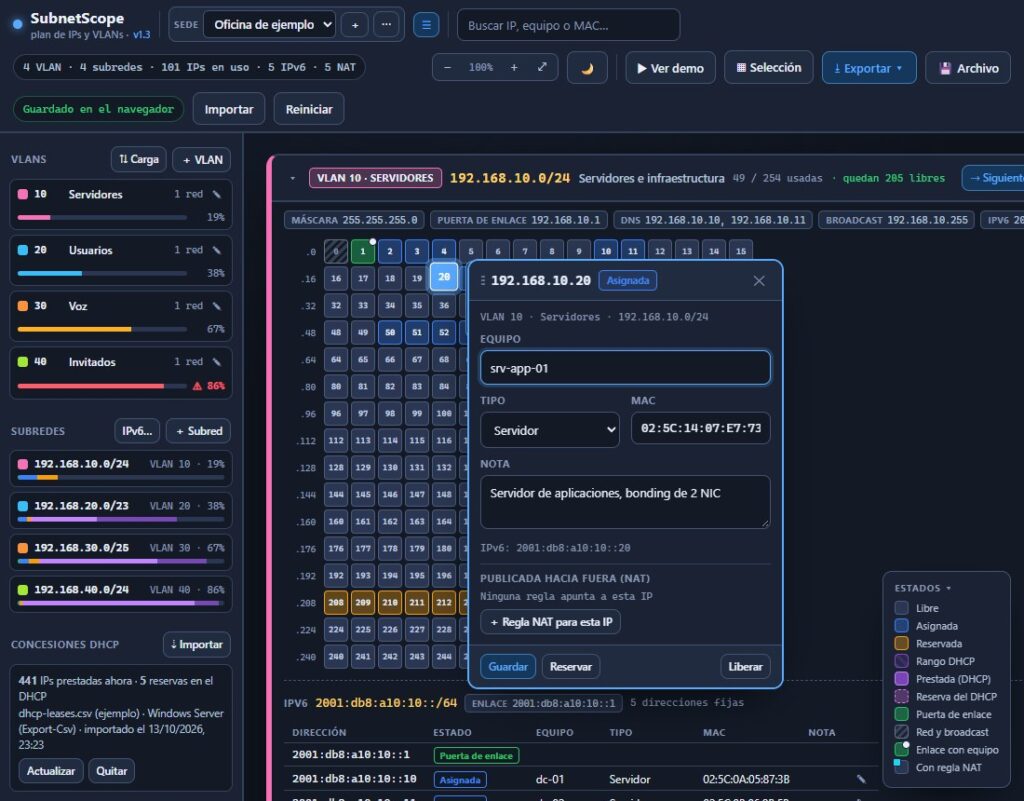
SubnetScope, the IP and VLAN planner that runs as a single HTML file with no server, can now import leases from a DHCP server to show which addresses are really handed out and which VLAN is busiest. Its author, the developer who publishes as marcosblg on GitHub, shipped six releases in a week based on user requests, reaching v1.6 on 16 October 2026.
SubnetScope and DHCP integration in 20 seconds
- SubnetScope imports DHCP leases from Windows Server, pfSense, MikroTik, Kea or a CSV.
- It flags conflicts with static IPs and leases older than a day.
- It calculates the load of each VLAN and warns from 80%.
- It adds dual-stack IPv6 and NAT rules, and has been AGPL-3.0 since v1.5.
The tool started as a companion to RackScope, another utility by the same author for documenting rack cabling, and targets anyone still managing addresses in spreadsheets. It can be tried directly at marcosblg.github.io/subnetscope or by downloading index.html and double-clicking it.
What SubnetScope does
The core, introduced in v1.0 on 9 October, is a grid with one cell per IP in each subnet, colored by state: free, assigned, reserved, DHCP range, gateway, network or broadcast. CIDR subnets range from /16 to /30, are linked to VLANs with ID, name and color, and the tool warns when two overlap. Each IP has a card with device, type, MAC, notes and history, and there is search by IP, name or MAC, a next-free-IP button, multi-select and subnet splitting.
Everything is stored in the browser or, if linked, in a JSON file of the user’s choice, with no accounts or network requests. It exports to CSV, PDF, PNG and JSON. The README warns that browser storage depends on the file path, so linking a JSON file is advisable to avoid data loss, and that Chromium-based browsers are the tested targets.
DHCP leases, the most requested feature
Version 1.2, released on 13 October, answers the question asked most often after launch: seeing what the DHCP server is handing out. SubnetScope imports leases exported from Windows Server with Export-Csv, pfSense or Linux with dhcpd.leases, MikroTik, Kea or a generic CSV, without connecting to the server: export the file, drag it into the tool, and leased IPs appear on the grid with device, MAC and expiry. They also show up in search and CSV exports, and the next-free-IP button skips them.
The tool warns when DHCP has leased an address documented as static for another device, a classic conflict, and when the leases are more than a day old. The same release adds VLAN load: the percentage of used IPs in each VLAN, sorted from most to least loaded, with a warning from 80%.
Version 1.3, on 14 October, went further. DHCP server reservations now appear with their owner and MAC even when not in use, and importing also reads the server’s ranges (MikroTik /ip pool, Windows scopes, the range in dhcpd.conf or Kea pools) and proposes them as each subnet’s DHCP range. On MikroTik, the router’s /export brings pool, leases and reservations in one go.
IPv6, NAT and the license change
Version 1.1, on 11 October, added dual-stack IPv6: each subnet can carry its IPv6 prefix and gateway, with a list of static addresses. Its planner proposes a /64 per subnet from the ISP’s /48 or /56, using the VLAN ID where possible, and doubles as a prefix calculator. That release also added documented NAT rules, from public IP and port to internal IP, with warnings when two rules share a public port or one points to an undocumented IP.
Later releases polished the experience: v1.4 brought undo and redo with Ctrl+Z and Ctrl+Y, v1.6 added an English interface, and v1.5 changed the license. The author’s announcement mentions MIT, but according to the CHANGELOG, SubnetScope has been distributed under AGPL-3.0 since v1.5, while earlier versions remain MIT. For internal use nothing changes, but it matters for anyone planning to embed it in a service offered to third parties.
For background on the concepts, SystemAdministration.net has covered VLAN design in VLAN segmentation and secure multi-tenant deployment.
Frequently asked questions
What is SubnetScope?
It is an IP and VLAN planner that runs as a single HTML file, with no server or installation, and keeps data on the user’s own computer.
Which DHCP servers does it support?
It imports leases exported from Windows Server, pfSense or Linux with dhcpd.leases, MikroTik and Kea, plus a generic CSV. It never connects to the server.
Is SubnetScope free and open source?
Yes. It is free and its code is on GitHub. Since v1.5 it uses the AGPL-3.0 license; earlier versions remain under MIT.
Does it support IPv6?
Yes. Since v1.1 it supports dual-stack IPv6 and a planner that assigns a /64 per subnet from the ISP’s /48 or /56.
Sources: