
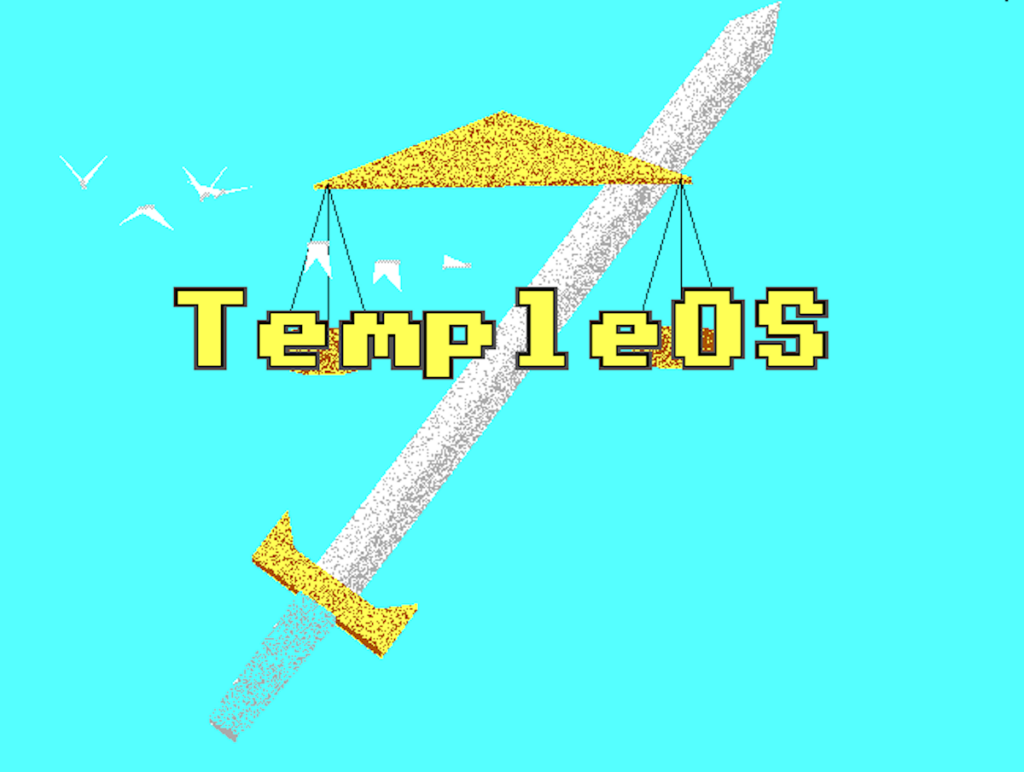
TempleOS is one of the strangest, saddest and most technically fascinating stories in modern computing. It was not a commercial operating system, nor an academic project, nor an alternative Linux distribution. It was the work of a single person, Terry A. Davis, an American programmer who spent more than a decade building a complete operating system from scratch, with its own kernel, compiler, programming language, editor, graphics system, games, documentation and development tools.
The story is often told from its most eccentric angle: an operating system “to talk to God”, an interface deliberately limited to 640 × 480 pixels and 16 colors, a language called HolyC, and a function that generated pseudo-random texts interpreted by its creator as divine answers. But reducing TempleOS to an internet oddity would be unfair. Behind it was a real engineering achievement, written by someone with uncommon technical talent and a mental illness that increasingly shaped his public life.
Terry A. Davis was born in 1969 and worked as a professional programmer, including at Ticketmaster. In the mid-1990s, he began experiencing mental health episodes that would eventually define much of his life. After several diagnoses and hospitalizations, Davis remained outside the conventional job market, but he did not stop programming. Quite the opposite: he began the work that would define his legacy.
A complete operating system, not a superficial experiment
TempleOS began around 2003 under other names, including J Operating System, LoseThos and SparrowOS, before adopting its final name in 2013. Its creator conceived it as the biblical “Third Temple”, an idea inseparable from his religious beliefs and delusions. Technically, however, it was much more than an eccentric project.
The system was written for the x86-64 architecture and worked as an environment for recreational programming. It had no networking, no internet support and no classic separation between user space and kernel space. It was not intended to compete with Windows, Linux or macOS. TempleOS was deliberately simple in some areas and surprisingly complex in others.
| Technical element | TempleOS feature |
|---|---|
| Architecture | x86-64 |
| Main language | HolyC |
| Model | Open source and public domain |
| Graphical interface | 640 × 480 pixels, 16 colors |
| Networking | No internet support |
| File systems | ISO 9660, FAT32 and RedSea |
| Multitasking | Cooperative |
| Original components | Kernel, compiler, editor, games and graphics system |
Davis wrote more than 100,000 lines of code. That figure alone would be remarkable for a personal project. But what stands out most is that he did not simply assemble existing pieces. He designed his own language, HolyC, a variant of C and C++ deeply integrated into the system. He also created RedSea, his own file system, and DolDoc, a document format capable of mixing text, links, images and 3D models inside files that still looked close to ASCII.
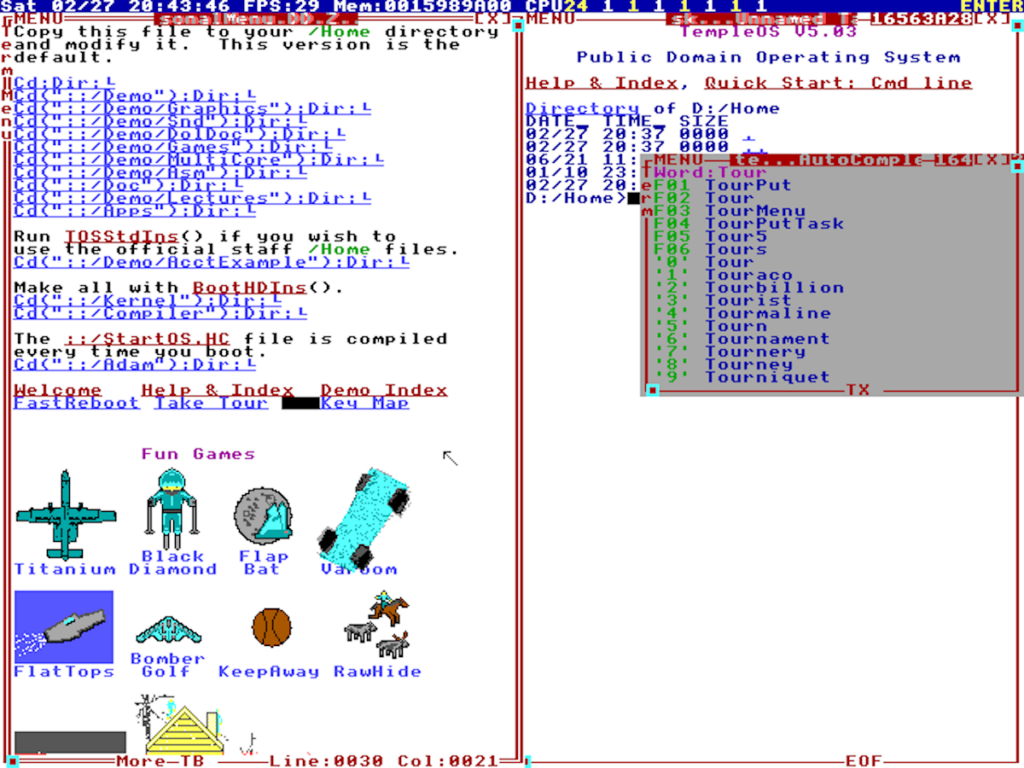
At a time when much of modern software depends on layers, frameworks, external dependencies and large teams, TempleOS feels almost like a historical anomaly: an operating system built with radical internal coherence by a single mind, under very strict personal rules.
HolyC, DolDoc and the idea of programming inside the system
One of TempleOS’s most interesting features is the integration between language, operating system and development environment. HolyC was not simply a language added to the system: it was the natural way to interact with it. Users could write and execute code directly from the shell, modify programs and work in an environment where the boundaries between console, editor and IDE were far more blurred than in conventional systems.
TempleOS had something of the classic home computer spirit, especially the Commodore 64, where users turned on the machine and immediately found themselves inside a programmable environment. Davis described his system as a “modern Commodore 64” for x86-64. The comparison was not accidental: TempleOS recovered a more direct form of computing, less abstract, less separated from the hardware and from the act of programming.
| Component | Function |
| HolyC | The system’s programming language |
| DolDoc | Document format with hyperlinks, graphics and images |
| RedSea | File system created by Davis |
| Integrated editor | Environment for programming and documentation |
| After Egypt | Oracle-like program based on pseudo-random text |
| Flight simulator | One of the included programs |
From today’s perspective, TempleOS is hard to classify. It was not practical as a desktop operating system. It was not designed for browsing, networking or running modern applications. But it was a brilliant demonstration of technical control. Anyone who looks at it only as a product misses the point: TempleOS was more a work of authorship than a market tool.
The religious dimension and the weight of illness
TempleOS cannot be explained without discussing Terry A. Davis’s mental health, but doing so requires care. Davis was not playing a character or creating a viral campaign. He sincerely believed he was building an operating system by divine command. He also believed that certain technical limitations of the system, such as its resolution and color palette, had been instructed by God.
One of its best-known programs, After Egypt, generated pseudo-random texts from words and biblical references. For any developer, it would be a random generator with a symbolic layer. For Davis, it meant something different: it worked as a way to receive messages. That distinction helps explain why TempleOS is so difficult to analyze. The same mind capable of designing a complete compiler and kernel was living inside a deeply altered reality.
For years, the internet treated Davis with a mixture of fascination, mockery and respect. In technical forums, many recognized the merit of his work. In other spaces, his figure became a meme. His public behavior, especially in videos and online communities, became increasingly troubling, with offensive comments and difficult episodes to watch. Attributing all of that to deliberate provocation oversimplifies a life deeply affected by illness.
Respecting his work does not require ignoring those parts. But neither should they become the center of the story. Terry A. Davis was an extraordinary programmer and a sick person who ended up isolated. Both things are true.
A technical legacy in a category of its own
TempleOS was publicly released in 2013 and received its final stable version in 2017. Davis died on August 11, 2018, at the age of 48, after being struck by a train in Oregon. The exact circumstances of his death were never definitively settled between accident and suicide, although some testimonies pointed to the latter possibility.
After his death, his family asked that those wishing to honor him donate to organizations dedicated to easing the suffering caused by mental illness. That request matters because it helps shift the focus from the internet myth to the human reality of his story.
The code and materials related to TempleOS remain available in public archives, repositories and communities that keep interest in the system alive. There are also forks, such as ZealOS, which attempt to preserve part of its technical spirit without the religious and personal burden of the original project.
| Legacy aspect | Current situation |
| Source code | Publicly available |
| Practical license | Public domain |
| Community | Small, active and scattered |
| Forks | ZealOS and other derivatives |
| Historical value | A unique work within OSDev |
| Technical value | Complete system written by one person |
The system has been described in technical communities as impressive for its level of integration. Not because it is useful in the conventional sense, but because it demonstrates something rarely seen: a complete architecture conceived, written and maintained by a single developer over many years.
TempleOS and modern computing
TempleOS also acts as an uncomfortable mirror for modern computing. Today, software is built on abstraction layers, cloud services, packages, dependencies and distributed teams. That has made enormous and complex systems possible, but it has also distanced many users from a direct understanding of the machine.
Davis did the opposite. He removed networking, limited graphics, simplified the environment, integrated programming with the operating system and created a closed universe where everything followed an internal logic. The result was not modern, but it was deeply coherent. TempleOS did not want to be compatible with the world. It wanted to be its own world.
That may be why it still attracts interest. TempleOS is not studied to find enterprise best practices or to deploy it in production. It is studied as a reminder that computing can also be personal exploration, creative obsession and handcrafted work.
The comparison with Linux often appears as a contrast. Linux began as the kernel of a student and grew thanks to thousands of contributions. TempleOS began and ended almost entirely as the work of a single programmer. One became global infrastructure. The other remained a marginal, strange and almost literary piece of software history. In their own ways, both show how far an idea can go when someone decides to write an operating system from scratch.
A story that deserves to be told without voyeurism
TempleOS needs no embellishment. Its story is powerful enough: a brilliant programmer, a devastating illness, a complete operating system, a community caught between respect and cruelty, and code that remains alive years after its creator’s death.
For a technology publication, the challenge is to tell that story without falling into two mistakes. The first would be to romanticize mental illness as a source of genius. The second would be to mock a vulnerable person because his work was born from an extreme religious vision. The fairest view lies somewhere in between: recognizing the technical achievement while also understanding the pain that ran through it.
TempleOS did not change the industry, did not gain market share and did not compete with the major operating systems. But it left behind an uncomfortable question: how many people would be capable of building an entire system alone, from the language to the kernel, without a team, without funding and without expecting anything in return?
Terry A. Davis did it. And that part of the story, beyond the myth, deserves respect.
Frequently asked questions
What is TempleOS?
TempleOS is a 64-bit operating system created by Terry A. Davis. It includes a kernel, compiler, its own language, graphics system, editor, games and programming tools.
Who was Terry A. Davis?
Terry A. Davis was an American programmer born in 1969. He worked as a professional developer and later spent more than a decade creating TempleOS alone. He died in 2018.
What is HolyC?
HolyC is the programming language developed by Davis for TempleOS. It is a variant of C and C++ integrated into the operating system and used both for programming and interacting with the environment.
Why is TempleOS known as the operating system for talking to God?
Because Davis claimed he had built it by divine command and that some system functions, such as After Egypt, allowed him to receive messages from God through pseudo-random text.