
Canonical has released Ubuntu 26.10 “Stonking Stingray”, an interim release that ships Linux 7.3, GNOME 51, a completed move to Rust-based coreutils and APT signature verification through Sequoia PGP instead of GnuPG. The release landed on 15 October 2026 and will be supported for nine months, until July 2027. It also brings changes worth checking before upgrading servers, including a split OpenSSH package and the move to OpenSSL 4.
Ubuntu 26.10 Stonking Stingray in 20 seconds
- Ubuntu 26.10 shipped on 15 October with Linux 7.3, GNOME 51 and systemd 261.
- Default coreutils are now Rust-based uutils, and APT uses Sequoia PGP.
- OpenSSH 10.5 is split in two packages and OpenSSL 4 arrives.
- Myna adds optional local speech-to-text; support ends in July 2027.
As an interim release, Ubuntu 26.10 does not replace Ubuntu 26.04 LTS, which remains the reference for production with five years of standard support. Its main value is as a preview of what will reach the next LTS. Jon Seager, VP of Ubuntu Engineering at Canonical, described Stonking Stingray as a sign of Ubuntu’s journey “to not just build up, but also build out”, with more architectures and use cases.
What changes for system administrators
The most visible change at the command line is that core utilities, including cp, mv and rm, now run entirely on the Rust uutils implementation. Canonical has been making this transition over several releases, and scripts that rely on less common GNU coreutils options are worth testing. As this site reported earlier, Ubuntu 26.10 replaces dbus-daemon with dbus-broker for both system and session buses, and the final release confirms it.
On security, APT now verifies repository signatures with Sequoia PGP, a Rust implementation of OpenPGP that Canonical presents as post-quantum ready; gpg and gpgv remain available. OpenSSL moves to version 4, adding Encrypted Client Hello and wider QUIC support, but configurations that use the ENGINE API or the pkcs11 engine must be migrated to the provider model.
OpenSSH 10.5 is split into openssh, without GSSAPI, and openssh-gssapi. Fresh installs default to the non-GSSAPI variant, which matters for Kerberos environments. The release notes also flag a known issue: purging the removed counterpart package while it sits in rc state can break remote access until a fix lands. Legacy System V init script support, through systemd-sysv-generator, has been removed.
Server packages move to Apache 2.4.68, PHP 8.5.9, MySQL 9.7 LTS, Postfix 3.11.7, Dovecot 2.4.4, HAProxy 3.4.2 (with random as the new default balancing algorithm), Samba 4.24.7, QEMU 11.0, libvirt 12.6 and cloud-init 26.2. Developers get GCC 15.2, LLVM 22.1, Rust 1.97.1, Go 1.27, Python 3.14.7, OpenJDK 25 and .NET 10, while ROCm moves to 10.0 with support for vLLM and SGLang.
Desktop: GNOME 51, Myna and window tiling
GNOME 51 brings performance work, better display handling and refinements in Settings, Files, Calendar and Remote Desktop, which now supports smartcard and Kerberos authentication. Ubuntu adds a popup with tiling layouts when dragging a window, and the App Center now offers a unified view for snaps and debs, plus a new Drivers page. WEP Wi-Fi support has been dropped.
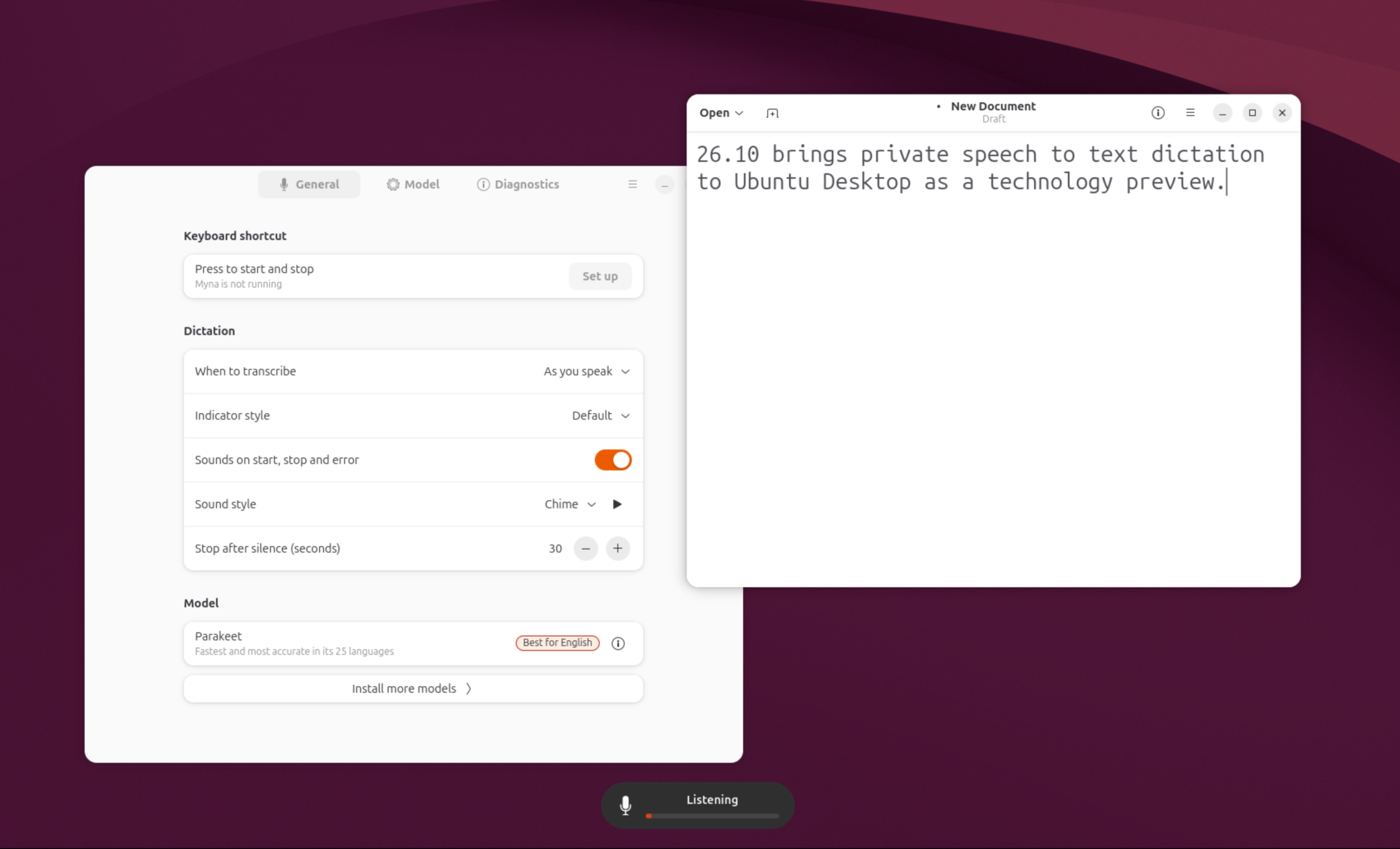
The headline desktop feature is Myna, a speech-to-text agent that runs on local models, so audio does not leave the machine. It is opt-in, not installed by default, and treated as a technology preview. Canonical plans to include it by default as Ubuntu 28.04 LTS approaches, as the first milestone of its AI roadmap for the desktop.
Hardware, enterprise and upgrade caveats
Linux 7.3 enables hardware such as Intel Nova Lake, AMD Zen 6 and NVIDIA 615 platforms, and adds out-of-the-box support for the Lustre parallel file system. There is a dedicated installer for amd64v3 hardware, support for Snapdragon X Elite and X2 Elite laptops, and desktop images for RISC-V, including the SpacemiT K3, the first RVA23 board. This site previously looked at why Linux 7.3 could be one of the most performance-focused kernel releases in years. In the enterprise, authd adds Microsoft Entra ID sign-in with password and MFA, and ADSys can enroll certificates directly against AD CS.
TPM-backed full-disk encryption now works on machines without a hardware root of trust if a PIN or passphrase is set, but systems already using it cannot upgrade from 26.04 LTS at launch; Canonical expects to enable that path during the 26.10 lifecycle. Other known issues include display freezes on some AMD dual-GPU laptops, Wi-Fi instability on certain Intel AX211 systems and a keyboard that may not work on Snapdragon X2 Elite laptops. For production, 26.04 LTS remains the safer choice, with 26.10 best tested in staging first.
Frequently asked questions
When was Ubuntu 26.10 released?
On 15 October 2026. It is an interim release supported until July 2027.
Which kernel and GNOME version does Ubuntu 26.10 use?
Linux 7.3 and GNOME 51, with systemd 261.
Can I upgrade from Ubuntu 26.04 LTS to 26.10?
Yes, except on systems using TPM-backed full-disk encryption, which cannot upgrade at launch. For production, staying on 26.04 LTS is recommended.
What is Myna in Ubuntu 26.10?
An optional speech-to-text agent that runs on local models. It is not installed by default and is a technology preview.
Sources: