

In the world of internal automation, more and more companies are juggling several disconnected pieces: a workflow engine on one side, a low-code tool on another, a separate background jobs system, and a growing pile of scripts solving specific tasks without much structure. That is the space where Windmill wants to position itself, with a platform that promises to turn scripts into webhooks, workflows, internal APIs, and lightweight user interfaces from a single starting point.
Published on GitHub by Windmill Labs, the project presents itself as a self-hostable alternative to tools such as Retool, Pipedream, Superblocks, or even to more complex orchestration approaches like Temporal. Its pitch combines script execution, workflow building, background jobs, and internal UI creation, all with a developer-first and infrastructure-oriented mindset. The idea is easy to explain: write a small piece of code, define its parameters, and let the platform generate a shareable UI, make it a step in a workflow, or expose it as an internal endpoint.
What Windmill actually offers
One of the project’s strongest points is its practical approach. Windmill supports several languages, including Python, TypeScript, Go, Bash, SQL, GraphQL, PowerShell, Rust, C#, Java, and PHP, among other runtimes. Instead of forcing users to learn a proprietary language or a closed syntax, it relies on fairly standard code and then connects it to a visual and automation layer.
The platform is built on an architecture that will look familiar to many modern teams: PostgreSQL as the central database, a backend written in Rust, a frontend in Svelte 5, and an execution model based on stateless API servers and workers pulling jobs from a queue stored in Postgres. For job isolation, Windmill mentions the use of nsjail and PID namespace isolation, which is an important detail for any tool that is expected to run code automatically inside an organization.
That design helps explain why Windmill is trying to occupy several categories at once. It does not want to be only a visual replacement for Retool, nor just a substitute for a classic orchestrator. It is aiming to become a kind of internal developer platform for automation, where the same script can serve as a manual task, a scheduled job, a webhook, an HTTP endpoint, or a step within a larger workflow.
It can also be deployed in multiple ways. The project offers a basic installation with Docker Compose, deployment with Helm on Kubernetes, and stated compatibility with providers such as AWS, Google Cloud, Azure, Fly.io, Render, Hetzner, and DigitalOcean. In its documentation, Windmill suggests a general sizing rule of 1 worker per 1 vCPU and 1 to 2 GB of RAM, which is a useful starting point for anyone evaluating a deployment.
Open source, but with licensing nuances
This is one of the areas that deserves a more careful explanation. Windmill presents itself as an open-source project, and a significant part of its codebase is indeed released under AGPLv3 and Apache 2.0, according to the repository. However, the documentation also introduces an important nuance: the so-called Community Edition distributed through its official Docker images and binary releases includes proprietary and non-public components as well.
That means that while the repository contains an open core that can be compiled without certain enterprise features, the community edition distributed by the company does not fit a strict definition of fully open-source software in every component. For internal use, Windmill allows organizations to use that Community Edition free of charge, but it restricts cases such as resale, managed service offerings, or certain commercial integrations without an additional agreement. This model is becoming increasingly common in infrastructure software: an open core, a commercial product on top, and clear limits once third-party business use enters the picture.
That distinction matters because Windmill is competing not only on technology, but also on narrative. In a market where many companies want to avoid overdependence on closed SaaS platforms, the open-source promise carries a lot of weight. But in this case, it is important to understand what is genuinely open, what depends on the official binary distribution, and what that means if an organization wants to embed it into its own product or use it beyond internal operations.
The main selling point: performance and local development
Windmill is also trying to win attention on performance. The company claims to offer the fastest self-hostable workflow engine and says it outperformed Airflow, Prefect, Temporal, Kestra, and Hatchet in its own benchmarks. In some public materials, it even speaks of being up to 13 times faster than Airflow in certain scenarios. That said, this should be read as a vendor claim based on benchmarks published by the company itself, not as an independently verified market-wide conclusion.
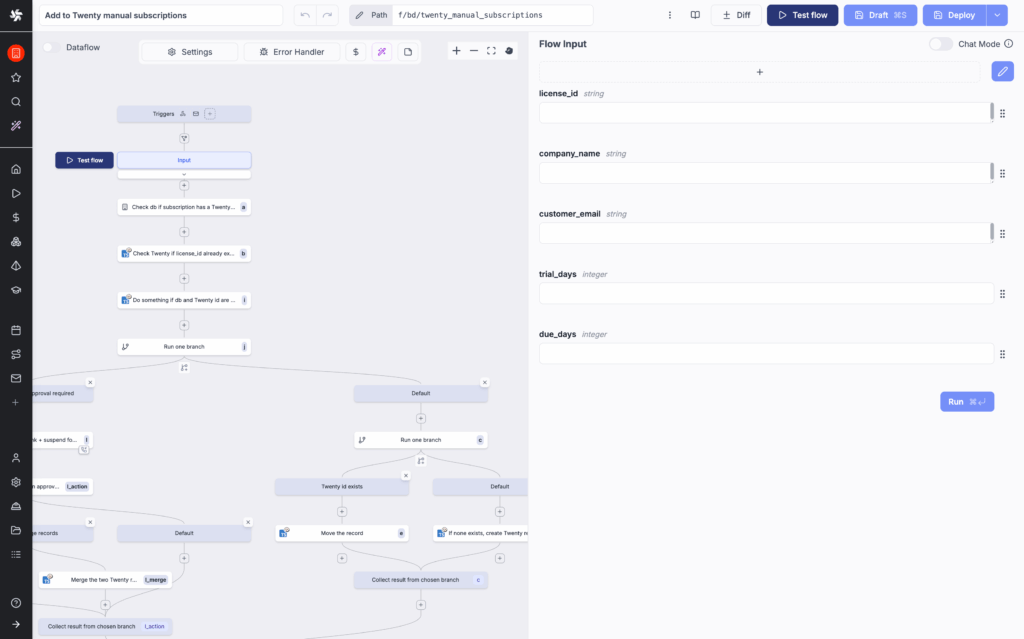
Even so, beyond the marketing headline, Windmill’s real appeal lies elsewhere: reducing friction for technical teams. The platform includes a CLI, a VS Code extension, two-way Git synchronization, and support for Claude Code as an AI-assisted development environment. That combination is especially notable because it fits a broader market shift in which internal tools are increasingly being designed not only for people, but also for agents and automations supported by AI models.
The project is also built around an idea that may have strong traction: many teams no longer want to choose between low-code and traditional code. They want both. They want to write a script in TypeScript or Python, connect it to secrets and variables, turn it into an internal UI with minimal extra effort, and, if needed, plug it into a larger workflow triggered by schedules, email, Kafka, HTTP, or WebSockets.
That is where Windmill becomes more interesting. Not because it claims to be an alternative to half a dozen products at once, but because it is trying to bring together several needs that are still fragmented across many organizations today.
Whether it can sustain that ambition will depend on several factors: product maturity, licensing clarity, deployment experience, and its ability to convince companies that already live across Retool, Airflow, internal scripts, and managed cloud services. But as a broader signal, it does reflect something very real: internal infrastructure is becoming more programmable, more visual, and more aligned with modern development workflows.
Frequently Asked Questions
What is Windmill and what is it used for?
Windmill is a platform for turning scripts into workflows, background jobs, webhooks, internal APIs, and lightweight user interfaces, with self-hosting as an option.
Is Windmill fully open source?
The repository contains code under AGPLv3 and Apache 2.0, but according to its own documentation, the Community Edition distributed by the company also includes proprietary components.
Can Windmill be installed on private servers or in the cloud?
Yes. The project supports deployment with Docker Compose, Kubernetes via Helm, and compatibility with several cloud providers and self-managed environments.
Is it really faster than Airflow or Temporal?
Windmill says it is, based on its public benchmarks, but those comparisons come from tests published by the company itself and should not be read as universal independent validation.