
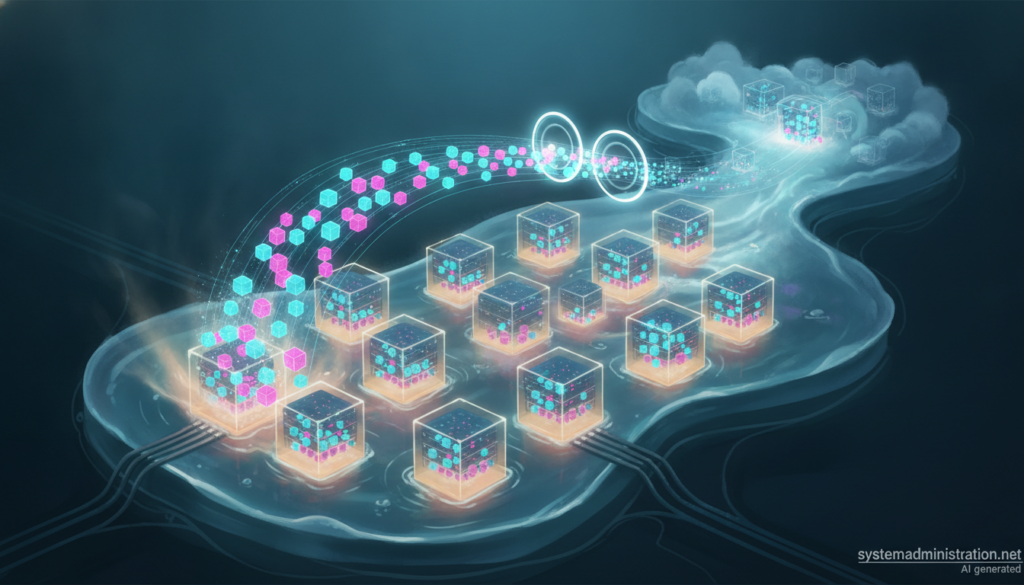
Agent Substrate is an open-source runtime for Kubernetes that separates an AI agent’s workspace (its memory, files and identity) from the machine that runs it, so idle agents are suspended and use no CPU or memory until they have work to do again. Google made it available for GKE in September, shipped version 1.0 on 5 November 2026 and has donated it to the Cloud Native Computing Foundation (CNCF) in Sandbox status alongside gVisor, the isolation technology it relies on. A technical write-up by Elia Secchi on Google Cloud’s DEV blog explains how it works and how to size it.
Agent Substrate key points in 30 seconds
- What it is: an open runtime (Apache 2.0) that maps many agents, called actors, onto a few pre-started workers.
- Isolation: each agent runs in a gVisor sandbox or a Cloud Hypervisor microVM, with outbound traffic blocked by default.
- Suspend: memory and files go into a snapshot and come back in under a second; 1.0 highlights resumes below 500 ms.
- Where: any Kubernetes cluster, with tooling optimised for GKE Standard.
The problem it tackles will be familiar to anyone who has tried to deploy interactive agents. An assistant or coding agent spends most of its time waiting for the user to type. If every session gets its own pod or VM, you pay the same for a machine that waits as for one that works. And according to the GKE documentation, Kubernetes cannot hibernate pods, and keeping millions of idle agents in a cluster would exhaust pod limits and control-plane memory.
Actors, workers and gateways
The architecture has three parts. Actors hold each agent’s memory, files and identity; they are a workspace with no machine attached. Workers are pods started in advance in a warm pool, and each one hosts many awake actors at once, each in its own sandbox. Gateways complete the picture: an ingress router sends requests to the right actor and an egress gateway injects credentials into outbound calls, so keys never sit inside the sandbox where AI-generated code runs.
Isolation is taken seriously. Each actor sees only its own files, processes and memory, on a private network with no path to other actors or to the control plane, and outbound connections are blocked until an egress policy allows specific destinations. That is what you need to run model-generated code without putting the rest of your infrastructure at risk.
Configuration rests on two objects: ActorTemplate, which defines the container image, environment variables and resources, and WorkerPool, which defines the worker pool. The application creates one actor per user session. Because it works with standard OCI images, it can host agents built with Google’s Agent Development Kit (ADK), LangChain, Claude Code, Codex or any framework that packages as a container.
Suspend, snapshot and wake
When an agent finishes its turn, the control plane’s SuspendActor API saves a snapshot of its memory and files to local disk and to Cloud Storage and frees its worker slot. If it wakes within 30 minutes, it goes back to the same node and restores from the local cache; after that, it can wake on any worker with room and restore from Cloud Storage in under a second. For comparison, the article says a GKE pod snapshot takes three to five seconds to restore.
There is fine print worth knowing. Sub-second memory restores require the worker to match the original hardware, sandbox runtime and image. Wake time grows with snapshot size, so large workspaces should use a Filestore volume. And open connections, such as database or Model Context Protocol (MCP) sessions, must reconnect after every wake, which the application has to handle.
The repository includes a counter demo to see it locally: after the actor is suspended, all three counters (memory, file and root filesystem) pick up where they left off.
# terminal 1
go install ./cmd/kubectl-ate
kubectl ate create actor my-counter-1 -a ate-demo-counter --template counter
kubectl ate proxy actor my-counter-1 -a ate-demo-counter

# terminal 2
curl -X POST http://localhost:8000
kubectl ate suspend actor my-counter-1 -a ate-demo-counter
curl -X POST http://localhost:8000Code language: PHP (php)
How to size the worker pool
The most useful part for operators is that the pool is sized not by total users but by the agents awake at peak. The infrastructure guide suggests multiplying total actors by the average active fraction and a burst factor to get peak running actors, then dividing by 80% of what one worker can hold. In the article’s example, 1,000 actors with 8% active and a 2x burst give 160 at peak; at 50 per worker with 20% headroom, 4 workers are enough.
By default a worker accepts up to 1,000 actors if it has CPU and memory left, and Google claims 10x the density of standard container runtimes. The README shows about 250 stateful actors on eight pods. On GKE it requires GKE Standard 1.37 or later with x86 nodes, and Google’s installer is available to eligible customers. The repository itself states that it is not an officially supported Google product, which is worth weighing before production use. The installer creates billable resources, and the documentation advises against running it from Cloud Shell.
Frequently asked questions
What is Agent Substrate?
An open-source Kubernetes runtime that suspends idle AI agents and spreads them across a shared pool of sandboxed workers.
Does it only run on Google Cloud?
No. It runs on any Kubernetes cluster, although Google provides deployment tooling optimised for GKE Standard.
How long does an agent take to wake?
Under a second from Cloud Storage, and version 1.0 highlights resumes below 500 ms. Large workspaces take longer.
How is each agent’s code isolated?
With a gVisor sandbox or Cloud Hypervisor microVM per actor, a private network and outbound traffic blocked except for allowed destinations.
Sources: