
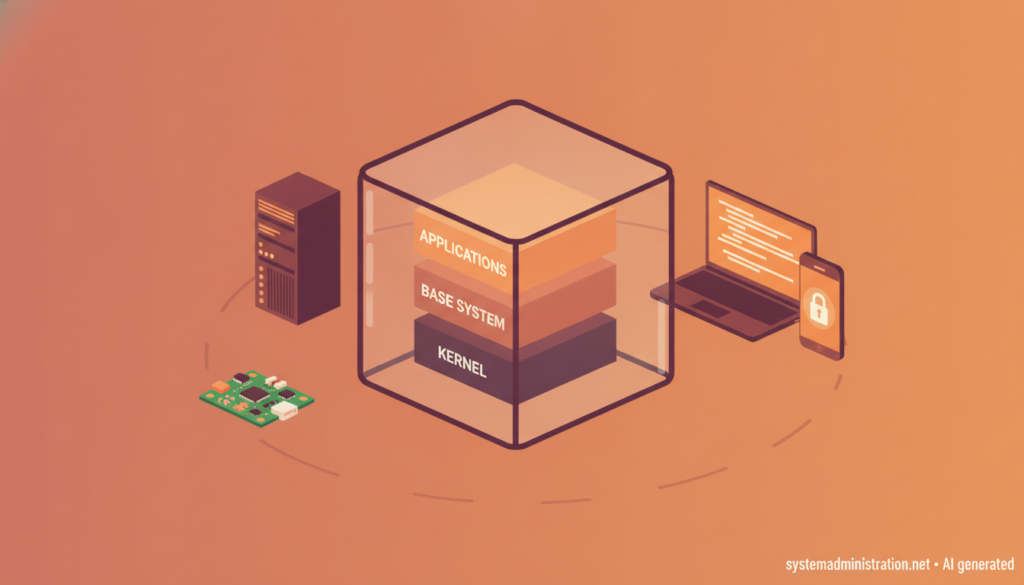
Immutable distributions built on Ubuntu can be counted on one hand. Next to the Fedora ecosystem, with Silverblue, Bluefin or Bazzite, the Ubuntu world today has one clear reference, Ubuntu Core 26, released in May 2026, plus a handful of alternatives for specific uses: the desktop edition of Ubuntu Core that Canonical has just revived, Kairos for Kubernetes nodes at the edge, Ubuntu Touch for phones and experimental Ubuntu images built with bootc. Vanilla OS, which started on Ubuntu, left that base in 2024.
Immutable Ubuntu-based distributions in 20 seconds
- Ubuntu Core 26 is the mature option, with up to 15 years of maintenance.
- Ubuntu Core Desktop is back in development, with no public image yet.
- Kairos turns Ubuntu into an image-based system with A/B upgrades.
- bootc on Ubuntu is still experimental.
An immutable, or atomic, distribution keeps the base system read-only and updates it as a unit: the update applies completely or not at all, and if something goes wrong the system goes back to the previous version. Canonical’s own Jon Seager, VP of Ubuntu Engineering, adds the key caveat in an essay on the subject: «In reality, no general-purpose operating system is fully immutable.» There is always a writable area for configuration, data and applications; what differs between distributions is how that area is separated and how updates are delivered.
Seager describes four approaches: ostree-based distributions, bootc-based distributions, NixOS and Ubuntu Core. The first three have little traction on Ubuntu, which explains why there are so few options. Canonical bet on its own snap-based model, and community projects that wanted something else ended up choosing another base.
Ubuntu Core 26, the reference option
Ubuntu Core 26 was released on May 14, 2026 and is built on Ubuntu 26.04 LTS. Canonical describes it as a minimal, immutable OS with up to 15 years of security maintenance, aimed at embedded, IoT and edge devices. A new Ubuntu Core version ships every two years on top of an Ubuntu LTS and is itself an LTS release; the previous one, Ubuntu Core 24, came out in June 2024.
Its immutability comes from packaging everything as snaps: a gadget snap with board-specific boot assets, a kernel snap with the kernel, modules and initramfs, a base snap with the Ubuntu LTS environment applications run in, and confined system and application snaps. snapd handles transactional updates, rollbacks and snapshots of user data. According to Canonical, the improved delta format in this release cuts update sizes by between 50% and 90% for most snaps.
UC26’s new features target industry: a Chisel-based build system for the base snap with explicit, traceable dependencies, integration with the Canonical Observability Stack for device fleets, Livepatch rebootless kernel patching now also on ARM64, OP-TEE integration to protect keys with ARM TrustZone and a stated goal of helping meet the EU Cyber Resilience Act (CRA). One change to know before migrating: from this release, the Python environment in the core base snap is no longer available at runtime.
Day-to-day administration happens through the snap tool. These commands show what has changed, force an update and roll back a component to its previous revision:
snap list
snap changes
sudo snap refresh
sudo snap revert snap-nameCode language: PHP (php)
Custom images are built from a signed model assertion that defines which snaps a device carries. Canonical provides test images for generic x86 and Raspberry Pi 4 and 5. Ubuntu Core is not a general-purpose desktop and does not install .deb packages: everything that runs has to come as a snap.
Ubuntu Core Desktop, the desktop comes back
Canonical outlined an immutable desktop based on Ubuntu Core in 2023, showed developer builds and then delayed it ahead of Ubuntu 24.04. Little was heard after 2024. On October 28, 2026, the company announced it is resuming the project with a dedicated team and rebuilding the pipelines that produce the images. According to Phoronix, daily images are expected during the Ubuntu 27.04 cycle, with work focused on three use cases: browser-centric machines, developer workstations and gaming machines.
The design takes the Ubuntu Core model to its end: bootloader, kernel, desktop environment, services and applications all ship as strictly confined snaps. The new effort drops the 2023 prototype, which bundled the login manager, GNOME and Firefox into a single snap, and separates them so the system is not tied to one desktop. Canonical aims for it to become the default Ubuntu experience over time, although Seager made clear that the current Ubuntu Desktop is not going away. There is no end-user ISO today.
Kairos, Ubuntu Touch and bootc: options for specific uses
Kairos is not a distribution but a meta-distribution: it takes an existing distribution and turns it into an image-based system, with the OS image shipped as an OCI container through a registry. Upgrades are atomic with an A/B scheme, automatic fallback and a recovery system. It is built for Kubernetes nodes at the edge, in the cloud or on bare metal. Ubuntu is one of its supported flavors, alongside Alpine, Debian, Fedora, openSUSE and Rocky Linux; since December 2025 the project also has its own base, Hadron, used by default for official images while the other flavors remain supported. Its documentation includes guides for enabling FIPS mode on Ubuntu 20.04, 22.04 and 24.04.
Ubuntu Touch, the mobile OS maintained by the UBports foundation since Canonical dropped it in 2017, uses a read-only system partition updated through images, including incremental updates, with separate storage for apps, data and configuration. It has been based on Ubuntu 24.04 LTS since version 24.04-1.0, and 24.04-2.0 came out in July 2026. It is neither a desktop nor a server option, but it is one of the oldest uses of the immutable model on Ubuntu.
bootc on Ubuntu is the newest and least mature route. bootc, a CNCF project driven by Red Hat, lets you define a system as an OCI container image and deploy and update it atomically. At Ubuntu Summit 26.04, Red Hat engineer Joseph Marrero Corchado showed how to use it with Ubuntu, and there is an experimental Ubuntu 26.04 LTS bootc image, plus the images collected by the Bootcrew project. There are no official Canonical base images, so for now this is lab territory.
That leaves Vanilla OS, which often shows up on these lists. Its first release, Kinetic, was based on Ubuntu with an A/B partition system. In 2023 the team announced a move to Debian Sid, partly because of Ubuntu’s commitment to snap, and Vanilla OS 2 «Orchid» shipped in July 2024 on Debian. It is no longer an Ubuntu-based immutable distribution.
Which one to choose
- IoT devices, kiosks or industrial equipment: Ubuntu Core 26. It is the only option with long commercial support and an update model proven in production.
- Kubernetes nodes at the edge or on bare metal: Kairos with the Ubuntu flavor, if you want to keep Ubuntu packages and tooling inside an image-based lifecycle.
- Immutable desktop: there is no stable Ubuntu-based option today. Wait for Ubuntu Core Desktop daily images or look beyond Ubuntu.
- Experimenting with container images as the OS: bootc with community Ubuntu images, in a lab.
- Free mobile OS: Ubuntu Touch, on the devices listed by UBports.
The scarcity has a simple explanation. Ubuntu already has a mature immutable model of its own, but it was designed for devices rather than desktops. If Canonical delivers on Core Desktop, the picture may change during the cycle leading to Ubuntu 28.04 LTS. Until then, anyone who wants an atomic desktop on an Ubuntu base has very little to choose from.
Frequently asked questions
Is there an official immutable Ubuntu for the desktop?
Not publicly yet. Canonical resumed Ubuntu Core Desktop in October 2026 and expects daily images during the Ubuntu 27.04 cycle.
How long is Ubuntu Core 26 supported?
Canonical offers up to 15 years of security maintenance. Ubuntu Core 26 was released on May 14, 2026 on top of Ubuntu 26.04 LTS.
Is Vanilla OS still based on Ubuntu?
No. Vanilla OS 2 «Orchid», released in July 2024, is based on Debian Sid. Only the first release used Ubuntu.
Can I install .deb packages on Ubuntu Core?
No. On Ubuntu Core all software, including the kernel and base system, is delivered as confined snaps.
Sources:
- Ubuntu Core 26 documentation
- Ubuntu Core release notes
- Canonical: Ubuntu Core 26 launch
- Ubuntu Discourse: The Immutable Linux Paradox
- Phoronix: Canonical reviving Ubuntu Core Desktop
- Kairos: meta-distribution architecture
- Kairos: introducing Hadron
- UBports: Ubuntu Touch 24.04
- Ubuntu Summit: bootc for Ubuntu hosts
- LWN: Vanilla OS 2 Orchid