
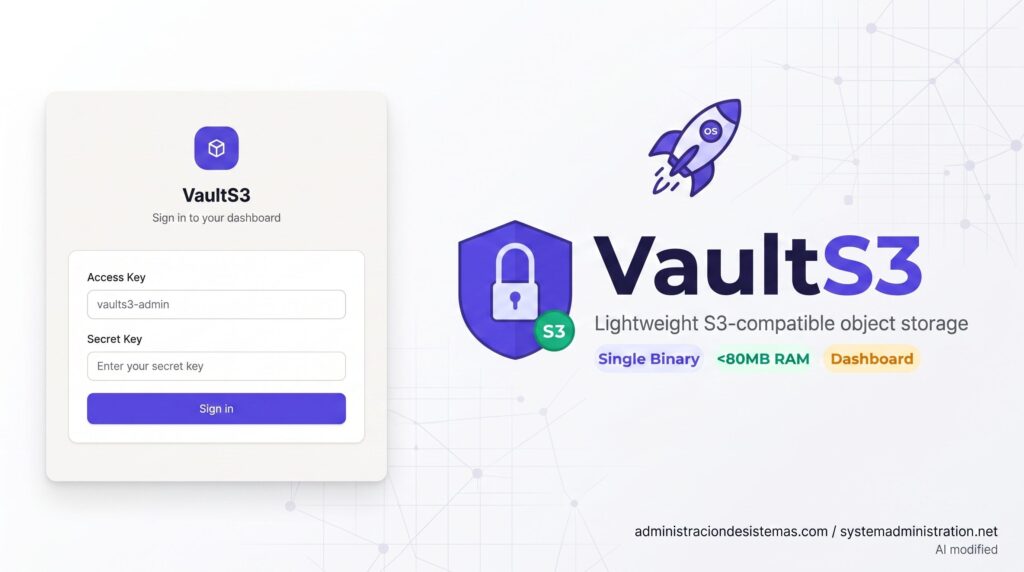
VaultS3 is a new open-source project offering an especially lightweight way to deploy Amazon S3 API-compatible object storage on your own infrastructure. Its developer says the server uses around 17 MiB of RAM while idle, ships as a single binary, and includes features such as IAM, encryption, versioning, object locking, Prometheus metrics, erasure coding, and a built-in web dashboard. Its technical proposition is certainly interesting, although the project itself highlights an equally important consideration: it is primarily maintained by a single developer, and some of its distributed features are still considered beta.
VaultS3 in 30 seconds
- VaultS3 implements more than 80 S3 API operations and runs as a single binary without mandatory external services.
- Its developer measures approximately 17 MiB of RAM while idle, although memory consumption rises considerably under load.
- It includes IAM, OIDC, encryption, versioning, object locking, erasure coding, replication, a dashboard, and Prometheus metrics.
- Single-node deployments are considered stable, while Raft clustering and active-active replication remain in beta.
- It is released under the AGPL-3.0 license and can run on Docker, Kubernetes, Linux, macOS, and Windows.
The project arrives at a time when S3 no longer refers exclusively to Amazon Web Services’ storage service. Its API has become a de facto standard for applications, backups, data lakes, and tools that need to interact with object storage.
That means projects such as VaultS3 can work with clients originally designed for Amazon S3 without requiring developers to completely redesign their applications.
The project itself was born out of its developer’s personal requirements. According to the explanation on GitHub, he had been running MinIO and decided to develop his own alternative after some of the functionality he relied on moved behind commercial offerings.
17 MiB at idle, but not 17 MiB under load
The figure that immediately stands out is its memory footprint.
VaultS3 reports using approximately 17 MiB of RAM while idle, based on an August 2026 comparison involving several object-storage projects running through Docker.
Under the same conditions, the developer measured approximately 23 MiB for Garage, 70 MiB for RustFS, 98 MiB for SeaweedFS, 101 MiB for Silo, and 184 MiB for MinIO.
Those figures need to be interpreted carefully.
The measurements were conducted by the VaultS3 project itself on a single host with all services idle. They are not an independent benchmark and do not demonstrate that VaultS3 will necessarily consume fewer resources under every workload.
In fact, the developer provides another figure that puts the 17 MiB claim into perspective: when writing 64 MiB objects at concurrency 16, VaultS3 can reach approximately 185 MiB of RAM usage.
That behaviour is hardly surprising. An object-storage server needs buffers, data structures, and additional resources when it begins processing multiple simultaneous operations.
The interesting part, therefore, is not that VaultS3 can permanently serve storage workloads using only 17 MiB, but rather that its baseline process has a very small footprint when largely inactive.
For labs, homelabs, edge environments, and smaller servers, that characteristic could make it particularly attractive.
A single binary with an S3 API and built-in dashboard
VaultS3 aims to keep deployment simple.
The server is distributed as a single binary and does not require an external database or control plane to get started. Docker images, .deb, .rpm, and .apk packages are also available, along with static binaries for Linux, macOS, and Windows.
For Kubernetes, the project provides both a Helm chart and a single manifest.
The S3 API and web dashboard can share the same port. The dashboard provides file management, user administration, statistics, auditing, search, and backup functionality.
S3 compatibility covers more than 80 operations, including Signature Version 4 authentication, multipart uploads, range requests, checksums, and presigned URLs.
The project goes considerably further than providing a basic object-storage server.
It includes IAM users, groups, and policies, as well as OIDC/JWT integration, LDAP, STS, IP allowlists, and audit trails.
For encryption, VaultS3 supports AES-256-GCM and several S3-style mechanisms, including SSE-S3, SSE-KMS, and SSE-C.
It also provides per-bucket keys, key rotation, and crypto-shredding, which makes selected data inaccessible by destroying the encryption keys required to decrypt it.
Versioning, object locking, erasure coding, and replication
Data protection is one of the project’s most extensive areas of functionality.
VaultS3 supports object versioning, version comparison, and rollback. It also provides object locking, lifecycle policies, compression, storage tiering, and scheduled backups.
For protection against disk failures, it can use Reed-Solomon erasure coding and includes a background healing process capable of detecting and reconstructing missing or damaged fragments.
The developer considers this functionality stable when used across multiple disks within a single node.
The situation changes once multiple servers are involved.
VaultS3 includes clustering based on Raft-replicated metadata and uses consistent hashing to distribute objects across nodes. However, the project currently classifies this mode as beta.
Its documentation even describes known issues.
For example, under certain circumstances an object overwrite immediately followed by a read from another node can temporarily return the previous data while exposing the metadata associated with the new object. According to the project, the system converges in approximately two seconds, and enabling versioning avoids this particular scenario.
That disclosure matters because it illustrates the difference between having a feature and considering it mature enough to hold the only copy of critical information.
The project’s own recommendation is fairly clear: use single-node deployments, optionally with erasure coding, for production data that matters; clustering and active-active replication should only be adopted after validating them against the intended workload.
Active-active is available, but still beta
VaultS3 can configure both one-way asynchronous replication and bidirectional active-active replication, using vector clocks for conflict resolution.
In theory, this makes it possible to maintain data across different locations.
However, this functionality is also classified as beta. The developer states that the conflict-resolution logic has automated tests, but the cross-site synchronization worker has seen less real-world use.
For companies looking at distributed object storage across multiple data centers, that distinction should matter more than the length of the feature list.
An object-storage platform can pass functional tests and operate correctly for months, but resilience, recovery from network partitions, and consistency during simultaneous failures require considerable real-world validation.
VaultS3 does not claim to replace Amazon S3
The project itself makes a useful distinction between implementing the S3 API and delivering the same service characteristics as Amazon.
Amazon S3 is designed for 99.999999999% durability, commonly described as eleven nines, and stores data redundantly across multiple Availability Zones for its standard configurations.
VaultS3 provides tools for building redundancy, but the resulting durability ultimately depends on the disks, servers, network, backups, and architecture configured by whoever operates the platform.
That is a fundamental difference.
Self-hosting can make sense when cloud egress and request charges dominate the bill, when data needs to remain on hardware directly controlled by an organization, or when clients and storage servers operate within the same local network.
Amazon S3, in return, removes much of the operational burden. Customers do not have to replace disks, maintain physical hardware, engineer infrastructure-level redundancy, or plan the physical growth of the storage platform.
VaultS3 estimates approximately 10 million objects per node and suggests that reaching one billion objects could require around 30 nodes. Amazon S3, by contrast, operates at a scale customers do not need to physically provision themselves.
The AGPL license also deserves attention
VaultS3 is distributed under the GNU Affero General Public License 3.0 (AGPL-3.0).
It can be used, modified, and redistributed commercially, but the AGPL introduces important obligations when modified software is subsequently made available as a network service.
Organizations planning to integrate proprietary modifications should therefore review those licensing conditions before adoption.
The developer publicly commits to keeping the functionality currently included in the core free and maintaining the server under AGPL-3.0. Separate commercial products are available for multi-cluster management, Kubernetes operations, multi-tenancy, and compliance.
There is another consideration the project openly acknowledges: VaultS3 currently depends heavily on a single maintainer.
Its GitHub repository has already attracted around 1,300 stars, suggesting rapidly growing interest, but a growing community is not the same as having the support organization, deployment history, and resources accumulated by projects that have been operating for many years.
For homelabs, labs, edge deployments, development environments, or selected internal deployments with independent backups, VaultS3 offers an unusual combination of low resource consumption and advanced functionality.
For storing the only copy of critical data in a distributed cluster, the project’s own documentation recommends considerably more caution.
Frequently asked questions
How much RAM does VaultS3 use?
The developer has measured approximately 17 MiB while idle. Memory consumption increases under load: a test writing 64 MiB objects at concurrency 16 reached around 185 MiB.
Is VaultS3 compatible with Amazon S3?
VaultS3 implements more than 80 S3 API operations, including SigV4, multipart uploads, presigned URLs, range requests, and checksums. This does not mean that it supports every feature available in Amazon S3.
Is VaultS3 production-ready?
The project considers its single-node mode stable, including erasure coding across multiple disks. Raft clustering, metadata sharding, and active-active replication have lower maturity levels and should be validated before being used for critical data.
Is VaultS3 free?
The core is open source under the AGPL-3.0 license. Separate paid enterprise tools are available, but the developer has committed to keeping the functionality currently included in the core open.