
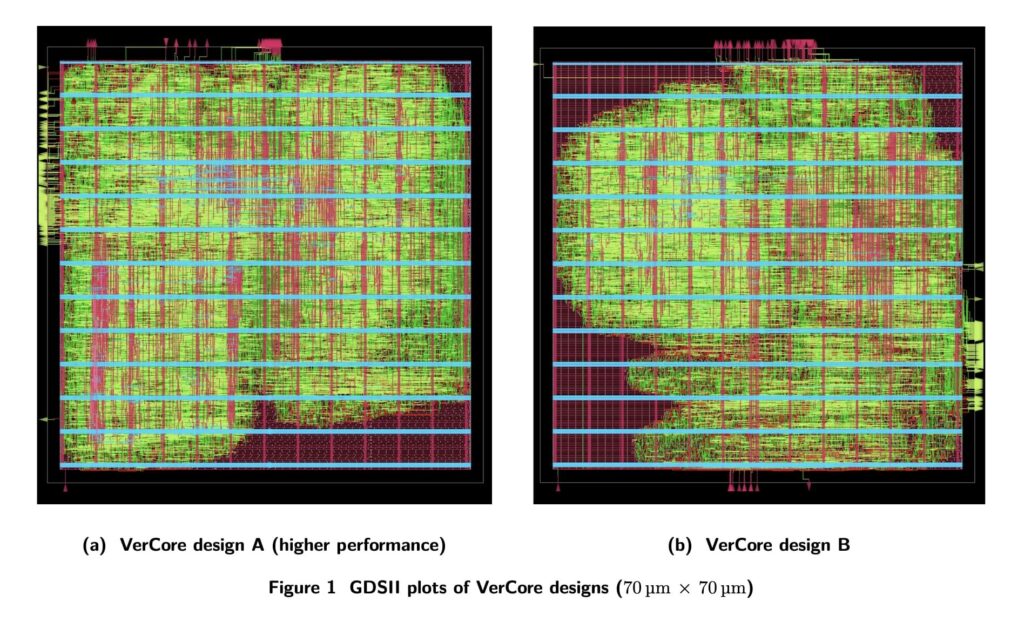
The idea that an Artificial Intelligence agent could design a complete CPU in just 12 hours sounds like science fiction, but the VerCore case deserves a more careful reading. Startup Verkor.io says its Design Conductor system autonomously created a functional RISC-V CPU core, from an initial 219-word specification to a GDSII file, the format used in the final stages of a chip’s physical design.
The development does not mean that an AI has already manufactured a commercial processor, nor that VerCore can compete with modern CPUs from Intel, AMD, Apple or Arm. In fact, its performance is closer to that of basic processors from more than a decade ago. The real novelty lies elsewhere: the system appears to have completed a workflow that normally requires specialist teams in architecture, RTL, verification, synthesis, place and route, and timing closure.
A simple processor, but designed end to end
VerCore is a 32-bit RISC-V core compatible with RV32I and ZMMUL. According to the technical paper published by Verkor.io, it uses a five-stage pipeline, in-order execution and single-issue architecture. The design reached a clock speed of 1.48 GHz on ASAP7, an academic predictive PDK for a 7 nm-class process, and scored 3,261 points in CoreMark.
CoreMark is a benchmark commonly used to measure the performance of microcontrollers and embedded CPUs. It should not be read as a direct equivalent to PC, gaming or workstation benchmarks, but it does help place the design in context. Verkor.io itself compares VerCore with an Intel Celeron SU2300, a low-power processor associated with basic laptops and netbook-era devices.
That comparison is useful because it keeps the announcement in perspective. VerCore is not a high-performance CPU. It does not compete with a modern Core i5, a Ryzen or Apple Silicon. Its value lies in having been generated, tested and taken all the way to physical layout by an autonomous agent in a very short period of time.
| Processor or core | Reference year | Architecture / type | Reported clock speed | Performance reference | Contextual reading |
|---|---|---|---|---|---|
| VerCore | 2026 | RISC-V RV32I + ZMMUL, 5 stages, in-order, single-issue | 1.48 GHz | 3,261 CoreMark points | Technical demonstrator designed by AI; validated in simulation, not fabricated |
| Intel Celeron SU2300 | 2011 as published CoreMark reference | x86, Penryn family, low power, 2 cores / 2 threads | 1.20 GHz | Approximate level cited by Verkor.io | Helps place VerCore in a basic CPU class from more than a decade ago |
| Intel Atom D525 | 2011 as published CoreMark reference | x86 Atom, designed for nettops and low-power systems | 1.80 GHz | Listed in CoreMark results from that period | Context for low-cost and energy-efficient processors from the early 2010s |
| Freescale i.MX515 | 2011 as published CoreMark reference | ARM Cortex-A8, embedded SoC | 800 MHz | Listed in CoreMark results from that period | Context for embedded platforms and compact devices |
| Microchip PIC32MX795F512L | 2011 as published CoreMark reference | 32-bit MIPS microcontroller | 80 MHz | Listed in CoreMark results from that period | Microcontroller-class reference, very different from a general-purpose CPU |
The table should not be read as an exact performance ranking across all those chips. Each processor was designed for different purposes, with different compilers, memory systems, platforms and test environments. Its purpose is to offer a sense of scale: VerCore sits closer to older basic, embedded or low-power processors than to modern desktop or server CPUs.
The key caveat: VerCore has not been fabricated yet
The main limitation of the announcement is that VerCore does not yet exist as a physical chip. It has been validated in simulation, with its behaviour compared against Spike, the reference simulator for the RISC-V architecture, and it has been taken to GDSII using electronic design automation tools. That step matters, but it is not the same as having a commercial processor manufactured in silicon.
In semiconductors, the leap from a simulated design to a fabricated and reliable chip is enormous. Tape-out, manufacturing, electrical testing, physical validation, power behaviour, robustness against process variation and industrial qualification are all complex stages. A bug discovered too late can cost millions.
That is why the announcement should not be exaggerated. Design Conductor has not proved that Artificial Intelligence can replace an entire chip engineering team in complex commercial products. What it does suggest is that autonomous agents may begin to automate very costly parts of the design cycle, especially in exploration, variant generation, debugging and preliminary closure.
How the Artificial Intelligence agent worked
Design Conductor is not a standalone language model, but a system that orchestrates advanced models and chip design tools. Starting from the initial document, the agent produced a microarchitecture proposal, implemented modules in Verilog, created testbenches, ran simulations and corrected errors until the processor’s behaviour matched expectations.
The technical report describes, for example, how the system analysed VCD traces, converted them into CSV files, reviewed register writes and detected problems in the pipeline flush logic after jump instructions. It also explored design variants with different branch penalties and eventually incorporated techniques such as early forwarding and a four-stage Booth-Wallace multiplier.
In other words, the process was not simply a matter of asking an AI to write Verilog code. The relevant part was the iteration: design, test, find discrepancies, identify the root cause, fix the issue and measure again. That cycle resembles the daily work of a hardware engineering team, although in this case it was carried out by an autonomous system inside a controlled environment.
Why RISC-V is the ideal ground for this kind of experiment
The choice of RISC-V is not accidental. The architecture has become an open and modular standard for processor design. That openness makes academic research, custom designs and automation experiments easier, without the same licensing barriers found in proprietary architectures.
The RISC-V ecosystem also has accessible simulators, toolchains and documentation, making it a particularly suitable environment for testing new forms of AI-assisted hardware design. In this case, the combination of RISC-V, Spike, OpenROAD and ASAP7 enabled a relatively open and reproducible workflow.
The industrial interest is clear. If these systems mature, they could accelerate the exploration of specialised chips for sectors where custom silicon is currently too expensive to justify. Instead of spending months studying a single architecture, a team could evaluate many variants with different trade-offs between power, area and performance.
Even so, Verkor.io’s own report acknowledges technical limitations. Models can make inefficient architectural decisions, reason incorrectly about Verilog or confuse the behaviour of a circuit with that of sequential software. The most reasonable conclusion is not that engineers will disappear, but that their role may shift towards defining objectives, carrying out critical review, strengthening verification and making architecture-level decisions.
The real news, then, is not that VerCore is a powerful CPU. It is not. The real news is that an Artificial Intelligence tool has begun to autonomously travel part of the road between a written specification and the physical design of a chip. In an industry where time, cost and scarcity of specialised talent matter more every year, that shift may prove more important than the specific benchmark score of this first processor.
Frequently asked questions
Is VerCore as powerful as a modern Intel processor?
No. VerCore does not compete with modern processors from Intel, AMD, Apple or Arm. According to the comparison provided by Verkor.io, its performance is closer to that of an Intel Celeron SU2300, a basic low-power processor associated with devices from more than a decade ago.
What does VerCore’s 3,261 CoreMark score mean?
It means the design has been assessed using a benchmark commonly used for embedded CPUs and microcontrollers. The figure helps place its relative performance, but it should not be directly compared with PC benchmarks such as Cinebench, Geekbench or PassMark.
Can VerCore already be manufactured as a real chip?
There is no evidence so far that VerCore has been physically fabricated. The design has reached GDSII and has been validated in simulation, but silicon manufacturing requires additional verification, physical testing and industrial validation stages.
Why does it matter that the CPU is RISC-V?
RISC-V is an open and modular architecture, which makes research, custom processor design and experimentation with new tools easier. That openness makes it a particularly attractive platform for testing Artificial Intelligence-assisted chip design systems.