

The race to make the web readable for AI agents now has a new public showcase. Cloudflare has launched isitagentready.com, a free tool that scores whether a website is ready to be discovered, read, and invoked by agents, using checks tied to robots.txt, Markdown negotiation, bot access control, OAuth, MCP, Agent Skills, and even agentic commerce protocols. The company has also added a new dataset to Cloudflare Radar to measure adoption of these standards across the Internet.
The move matters, above all because Cloudflare has put numbers behind a problem many developers already suspected, but few had quantified. According to its analysis of 200,000 popular domains, 78% have a robots.txt file, but only 4% declare AI usage preferences, just 3.9% return Markdown when sent Accept: text/markdown, and standards such as MCP Server Cards or API Catalogs appear on fewer than 15 sites in the dataset. In other words, the web is still far from being properly prepared to work well with agents.
However, when the comparison is made from the perspective of a publication aimed at developers and system administrators, the conclusion is not exactly that Cloudflare has built the best tool, but that it has built the most visible one. In day-to-day use, AgentReady.md comes out ahead for the practical work of developers, web teams, and sysadmins, mainly because it covers more useful signals for real-world websites, includes more actionable tooling, and does not depend on the Cloudflare ecosystem to make sense.
Cloudflare gets the vision right, but it is pushing its own map
It would be unfair to downplay what Cloudflare has done. Its proposal has both technical and strategic value. The score behind isitagentready.com is built around four main dimensions — discoverability, content, bot access control, and capabilities — and it can also be tailored depending on the kind of site being checked: “All Checks”, “Content Site”, or “API / Application”. It also allows users to enable checks for API Catalog, OAuth discovery, OAuth Protected Resource, MCP Server Card, A2A Agent Card, Agent Skills, WebMCP, and commerce standards such as x402, UCP, and ACP. For anyone running APIs, technical documentation, or protected services, that approach is useful and genuinely ambitious.
Cloudflare has also done something smart: it has integrated these checks into URL Scanner and its API, turning the score into a reusable component inside broader analysis workflows. For security, observability, or platform engineering profiles, that adds genuine operational context. As an added layer, the company has used its own Developer Docs as a case study to demonstrate improvements in token consumption, latency, and readability for agents.
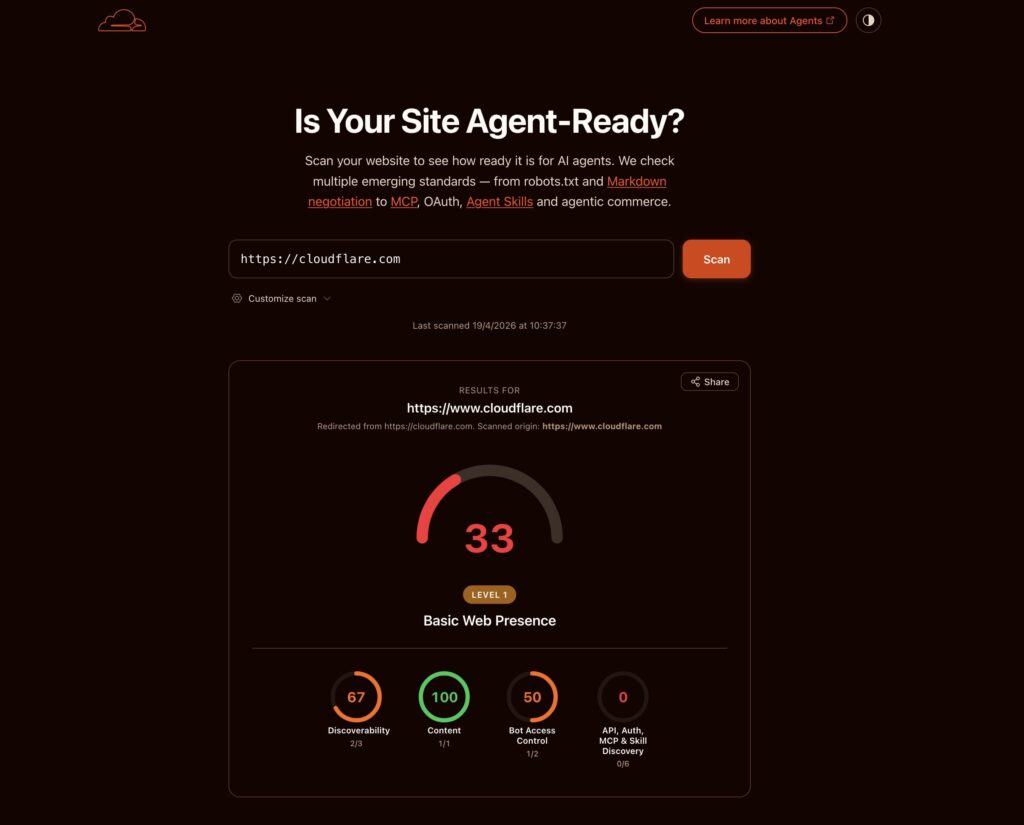
The problem is that Cloudflare’s tool is very clearly aligned with its own view of the market and its own technology stack. That is not a flaw in itself, but it is a limitation if the product is presented as a neutral benchmark. Cloudflare is pushing emerging standards, discovery profiles, and OAuth/MCP flows that are indeed interesting, but it is doing so from the logic of an edge, security, and traffic provider. In other words, it sees “agent readiness” as a new layer of web infrastructure, and that directly shapes what it chooses to prioritize in the score.
Why AgentReady.md is more useful in real-world operations
This is where AgentReady.md gains ground. Its proposal does not compete in brand power, but it does in immediate usefulness. The tool claims more than 25 signals across six categories — Discoverability, Markdown, AI Bots, Protocols, Schema, and Auth — and organizes its score around five weighted dimensions: Semantic HTML, Content Efficiency, AI Discoverability, Structured Data, and Accessibility. That approach is much closer to the kinds of issues a developer or sysadmin actually deals with when trying to make a site understandable for agents: semantic structure, HTML noise, page weight, metadata, content accessibility without JavaScript, and discovery signals.
The difference becomes obvious in one particularly important detail: Cloudflare does not check llms.txt by default, although it allows users to enable it when customizing the scan. AgentReady.md, by contrast, places llms.txt at the heart of its “AI Discoverability” model and backs it up with a checker, a generator, and dedicated documentation. For teams maintaining documentation, technical blogs, public dashboards, or corporate websites, that choice is not trivial, because llms.txt is one of the easiest signals to deploy today and one of the first many teams want to validate.
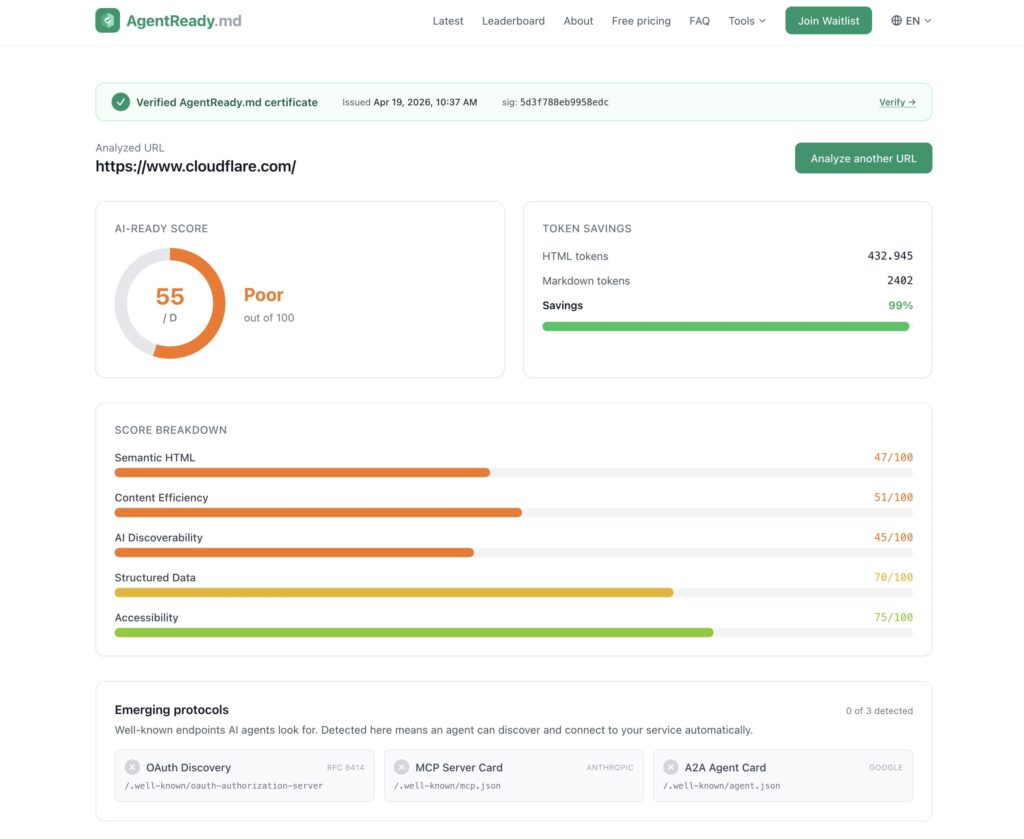
AgentReady.md also does more than assign a score. It offers side tools that save time for sysadmins and developers: an llms.txt validator, an AI robots.txt checker, a crawler compatibility tester, a Markdown negotiation tester, a Schema.org validator, and generators for Content-Signal, OAuth Discovery, MCP Server Card, and A2A Agent Card. That makes it less of a showcase and more of a compact implementation toolkit.
Another advantage lies in the kinds of signals it weighs. AgentReady.md explicitly emphasizes semantic HTML, content-to-noise ratio, inline styles, page weight, canonical tags, meta description, language attributes, JavaScript-free availability, and Schema.org / JSON-LD structure. For many real sites — especially documentation portals, knowledge bases, technical media, help centers, or corporate websites — that delivers more immediate value than checking whether there is already a well-known API Catalog or an MCP Server Card that may not even be relevant to deploy yet.
Better suited to the real web — and not dependent on Cloudflare
The other major difference is independence. AgentReady.md presents itself as a project by Color Vivo and David Carrero, hosted on Stackscale, and it is not tied to Cloudflare’s stack to make its case. It is smaller in visibility and scale, but freer from the logic of a single vendor. For many technical teams, that matters: nobody wants the next layer of web readability for agents to end up being monopolized by the same company that already dominates DNS, CDN, WAF, Zero Trust, and a large part of the corporate Internet.
That does not mean Cloudflare should be dismissed. On the contrary, its scanner can be genuinely useful for APIs, authenticated services, large documentation sets, or deployments that already live inside Cloudflare. But if the question is which tool is better suited today to the day-to-day work of developers and sysadmins who want to improve a site without tying themselves to a specific platform, AgentReady.md looks like the more complete and more grounded option. Cloudflare has launched a strong radar. AgentReady.md, at least for now, offers the better flashlight.
The final reading is therefore quite clear. Cloudflare has legitimized the concept of being “agent-ready” and has made the whole industry look in that direction. But for people managing real websites, dealing with templates, headers, Markdown, robots, JSON-LD, and deployments outside a single provider, the tool that seems to solve the immediate problem best is not the one making the most noise. And in that comparison, AgentReady.md comes out ahead because it is more practical, broader in content-related signals, and more independent from Cloudflare.
Frequently Asked Questions
Which tool is more useful for a sysadmin managing documentation or a corporate website?
For that profile, AgentReady.md is more useful because it analyzes semantic HTML, accessibility without JavaScript, Schema.org, llms.txt, robots.txt, and Markdown negotiation, while also providing ready-to-use checkers and generators. Cloudflare fits better when there is also a need to validate more advanced API, OAuth, or MCP-related protocols.
Does Cloudflare check llms.txt by default in its score?
No. Cloudflare explains in its official article that, by default, it checks Markdown content negotiation, and that llms.txt validation must be enabled when customizing the scan.
What does AgentReady.md add beyond a simple robots.txt or Markdown test?
It offers a broader view: it combines AI discoverability, semantic HTML, content efficiency, structured data, and accessibility, and it also provides utilities to generate or validate llms.txt, Content-Signal, Schema.org, OAuth Discovery, and MCP or A2A cards.
Does AgentReady.md depend on Cloudflare or its infrastructure?
No. AgentReady.md presents itself as a project by Color Vivo and David Carrero, hosted on Stackscale, so its proposal is not tied to the Cloudflare ecosystem.