
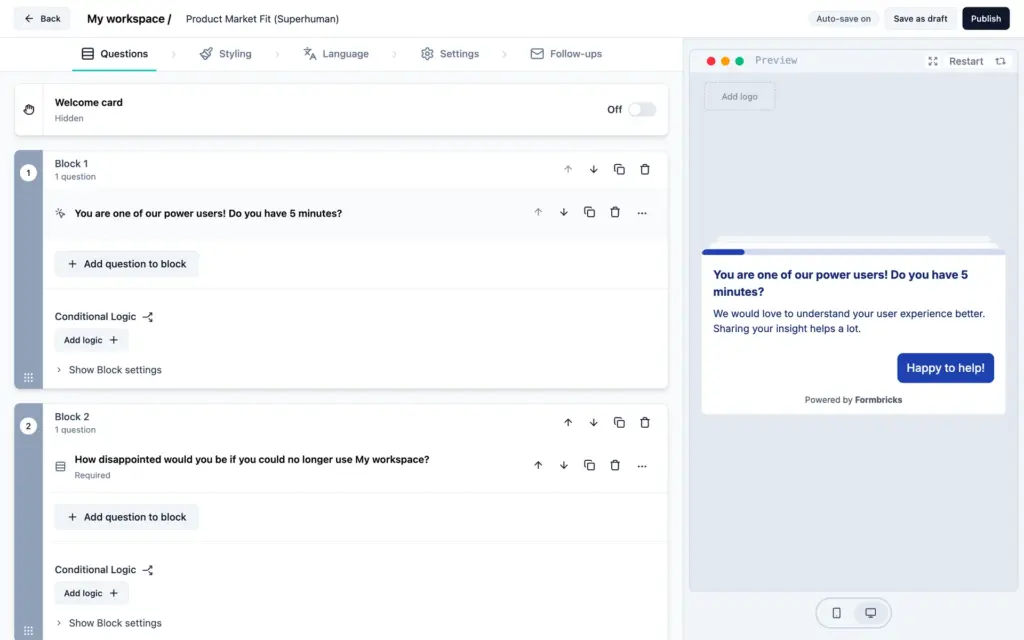
Formbricks is an open-source survey platform that runs questionnaires inside an app, on a website, through a link or by email, and can be installed on your own server with a script that sets up Docker, the database, a reverse proxy and the SSL certificate. Its core is licensed under AGPLv3 and the project presents itself as an open-source alternative to Qualtrics.
Formbricks key facts in 30 seconds
- Open-source survey platform for apps, websites, links and email, with a no-code editor.
- AGPLv3 core plus Enterprise features that require a licence key.
- The one-click installer works on Debian 12 and 13 and on Ubuntu.
- It needs your own domain and ports 80 and 443 open.
- It integrates with Slack, Notion, Zapier and n8n.
With more than 13,000 GitHub stars, Formbricks targets product and customer teams that want to collect feedback at different points of the user journey without sending that data to a third-party service. There is a cloud version with a free plan, but self-hosting is what matters to anyone with privacy or data-residency requirements.
What it can do
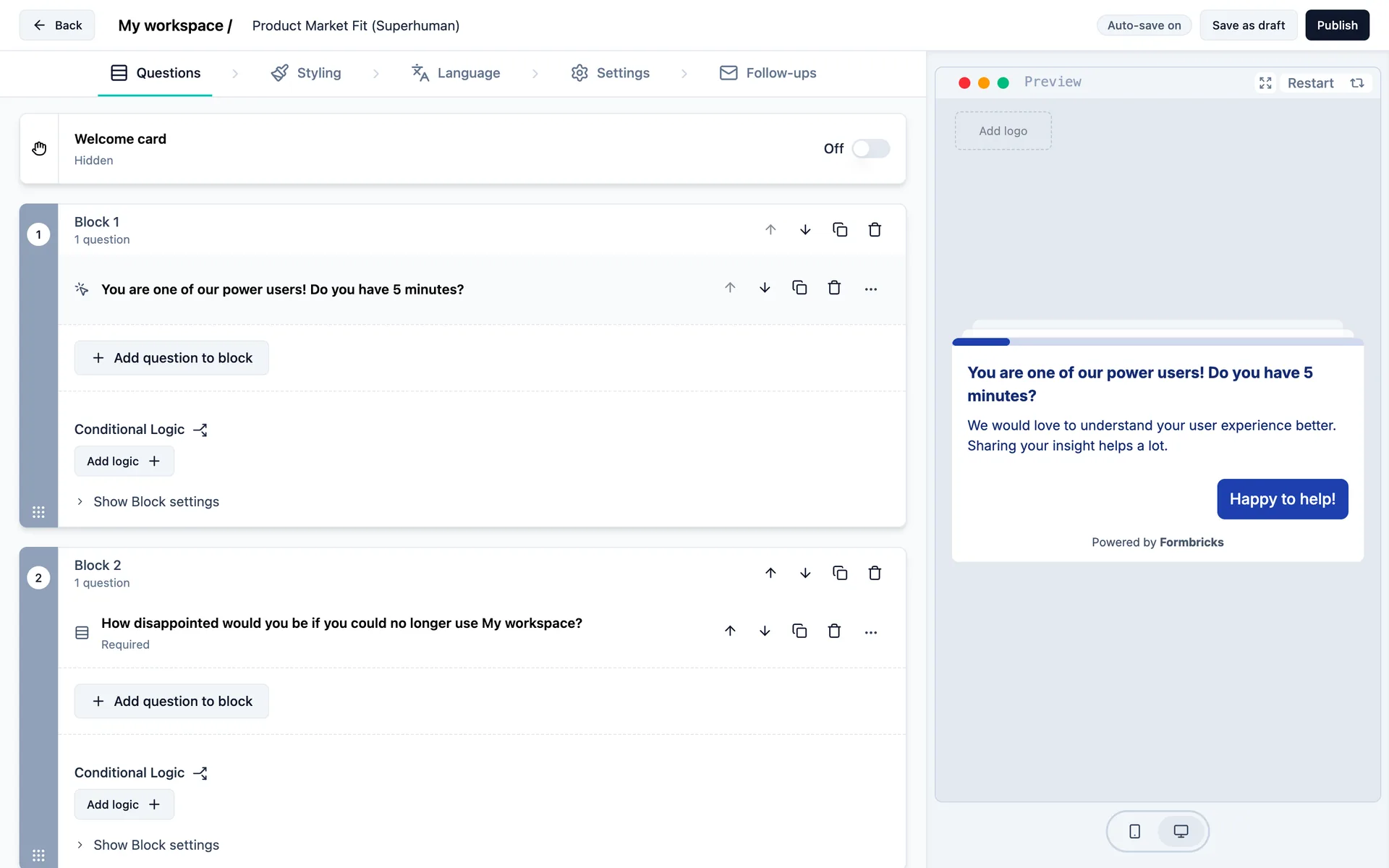
The no-code editor offers several question types, conditional logic between blocks, styling, languages and a live preview, plus best-practice templates. Surveys can target specific user groups without touching the app’s code, be shared as a link or embedded in a website. Organisation members collaborate on questionnaires, and results can be analysed in the platform itself or pushed to Slack, Notion, Zapier or n8n.
Under the hood it is built with TypeScript, Next.js, React, Tailwind CSS, Prisma and Auth.js. According to the documentation, the version 6 production stack includes PostgreSQL, SpiceDB for permissions, the Hub service and its worker, and Cube for analytics, plus object storage.
One-click install on Debian or Ubuntu
Before running the installer you need three things: a Debian 12 or 13 or Ubuntu server with SSH access, curl and a sudo user; a domain with A or AAAA records pointing to that server, and only to it, because a stray AAAA record pointing elsewhere breaks certificate validation; and ports 80 and 443 open in the firewall, for IPv6 too if the domain has an AAAA record. With that in place, the official script installs Docker if needed and configures PostgreSQL, SpiceDB, Traefik as the reverse proxy and, optionally, a Let’s Encrypt certificate:
curl -fsSL https://raw.githubusercontent.com/formbricks/formbricks/stable/docker/formbricks.sh -o formbricks.sh
chmod +x formbricks.sh
./formbricks.sh installCode language: JavaScript (javascript)
Downloading the script and running it afterwards, rather than piping it straight into a shell, leaves room to review it. Generated credentials for PostgreSQL, Hub, Cube and AuthZed are stored in ./formbricks/.env with 0600 permissions: that file belongs in your backups and must never be committed to a repository. For other systems, or a more customised install, the docs describe a manual Docker deployment.
The installer can bundle RustFS as object storage on the same server. The documentation warns that this option is meant for small, simple deployments rather than high availability, and recommends local SSD or NVMe disks, avoiding NFS and other network filesystems and, for more demanding setups, using external object storage.
AGPL, Enterprise and contributions
The AGPL core is fully functional for building and running link, website and in-app surveys, and can be used for free, commercially too, as long as modifications are published under the same licence. Alongside it, the repository contains Enterprise-licensed code in apps/web/modules/ee: it already ships in the Docker images but only unlocks with a licence key. Formbricks explains that this edition funds development and that, for now, it does not sell white-label versions. One more detail: the project welcomes bug reports and feature requests, but only accepts code contributions as an exception.
Frequently asked questions
Is Formbricks free?
The core is open source under AGPLv3 and can be self-hosted without a subscription. Enterprise features require a paid licence key.
Which systems does the one-click installer support?
Debian 12 and 13 and Ubuntu. Other distributions should use the manual Docker install.
What do I need before installing it?
A domain with A or AAAA records pointing only to that server, ports 80 and 443 open and a user with sudo rights.
Where are the generated passwords stored?
In ./formbricks/.env, with 0600 permissions. Include it in backups and keep it private.
Sources: